


Pediatric BMI changes during COVID-19 pandemic: An electronic health record-based retrospective cohort study
- PMID: 34337366
- PMCID: PMC8318998
- DOI: 10.1016/j.eclinm.2021.101026
Pediatric BMI changes during COVID-19 pandemic: An electronic health record-based retrospective cohort study
Abstract
Background: Beginning March 2020, the COVID-19 pandemic has disrupted different aspects of life. The impact on children's rate of weight gain has not been analysed.
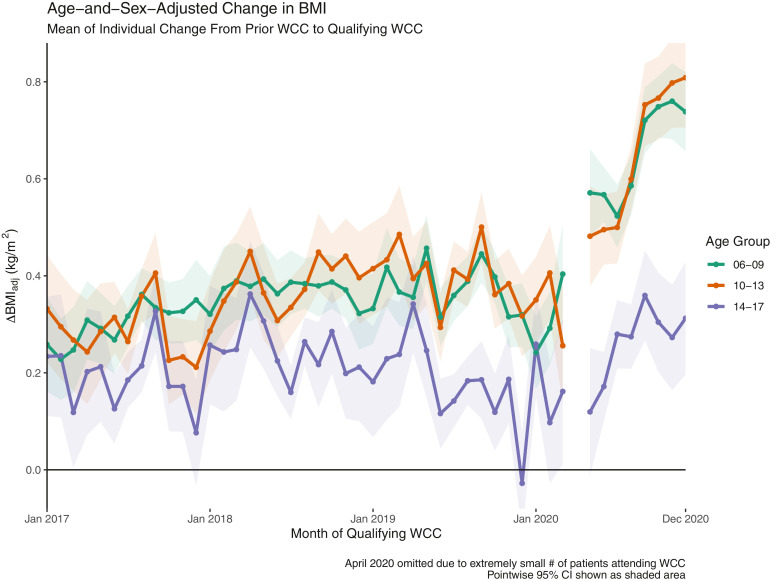
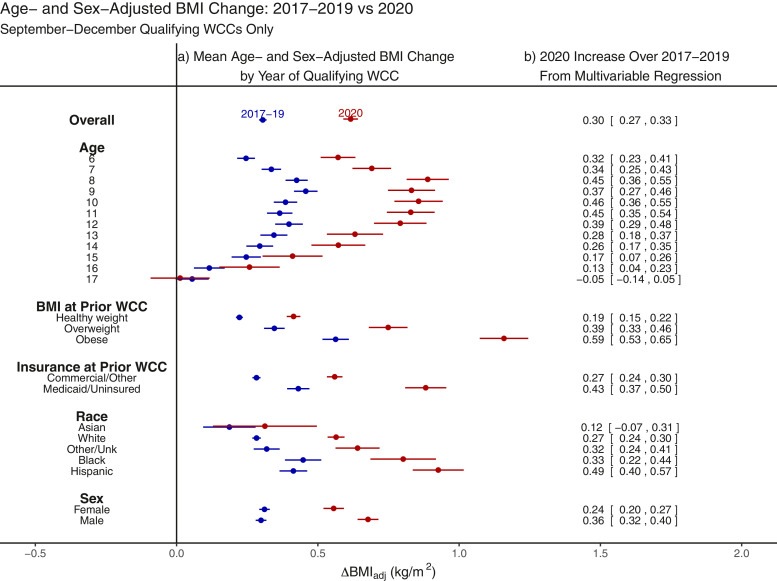
Methods: In this retrospective cohort study, we used United States (US) Electronic Health Record (EHR) data from Optum® to calculate the age- and sex- adjusted change in BMI (∆BMIadj) in individual 6-to-17-year-old children between two well child checks (WCCs). The mean of individual ∆BMIadj during 2017-2020 was calculated by month. For September-December WCCs, the mean of individual ∆BMIadj (overall and by subgroup) was reported for 2020 and 2017-2019, and the impact of 2020 vs 2017-2019 was tested by multivariable linear regression.
Findings: The mean [95% Confidence Interval - CI] ∆BMIadj in September-December of 2020 was 0·62 [0·59,0·64] kg/m2, compared to 0·31 [0·29, 0·32] kg/m2 in previous years. The increase was most prominent in children with pre-existing obesity (1·16 [1·07,1·24] kg/m2 in 2020 versus 0·56 [0·52,0·61] kg/m2 in previous years), Hispanic children (0·93 [0·84,1·02] kg/m2 in 2020 versus 0·41 [0·36,0·46] kg/m2 in previous years), and children who lack commercial insurance (0·88 [0·81,0·95] kg/m2 in 2020 compared to 0·43 [0·39,0·47] kg/m2 in previous years). ∆BMIadj accelerated most in ages 8-12 and least in ages 15-17.
Interpretation: Children's rate of unhealthy weight gain increased notably during the COVID-19 pandemic across demographic groups, and most prominently in children already vulnerable to unhealthy weight gain. This data can inform policy decisions critical to child development and health as the pandemic continues to unfold.
Funding: Amgen, Inc.
Keywords: COVID-19; Obesity; Overweight; Pediatrics; Public health; Vulnerable populations.
© 2021 The Author(s).
Conflict of interest statement
AC is an employee of Amgen, Inc; AL, JM, CAB, JHP, KAR, FH and CGB are employees at Amgen, Inc and declare stock option in Amgen, Inc; AL declares stock in Johnson and Johnson as well; JMS is a consultant of Amgen, Inc, reports consulting fees at Amgen, Inc and is a formal employee of Amgen, Inc; JRS is a contract employee at Amgen, Inc through SimulStat and declares stock option at Amgen, Inc.
Figures
References
LinkOut - more resources
Full Text Sources
