


Pigtail Suture Stents Significantly Reduce Stent-related Symptoms Compared to Conventional Double J Stents: A Prospective Randomized Trial
- PMID: 34337527
- PMCID: PMC8317849
- DOI: 10.1016/j.euros.2021.03.011
Pigtail Suture Stents Significantly Reduce Stent-related Symptoms Compared to Conventional Double J Stents: A Prospective Randomized Trial
Abstract
Background: Double J (DJ) ureteral stents are commonly inserted after ureteroscopy (URS) procedures for stone treatment. However, stent-related symptoms are still a major issue.
Objective: To determine whether a commercially available pigtail suture stent (PSS) can reduce stent-related symptoms compared to a conventional DJ stent after uncomplicated URS.
Design setting and participants: We designed a randomized, single-blind, parallel-group trial from January to November 2020. The inclusion criteria were stone-free URS without intraprocedural complications. Patients with distal ureteral stones were excluded.
Intervention: Insertion of a PSS or DJ stent after URS.
Outcome measurements and statistical analysis: The primary endpoint was the Urinary Symptom Index score on the Ureteral Stent Symptoms Questionnaire (USSQ) 2 wk after URS. Secondary endpoints were USSQ domain scores and responses to individual USSQ questions at 2 d and 2 wk after surgery.
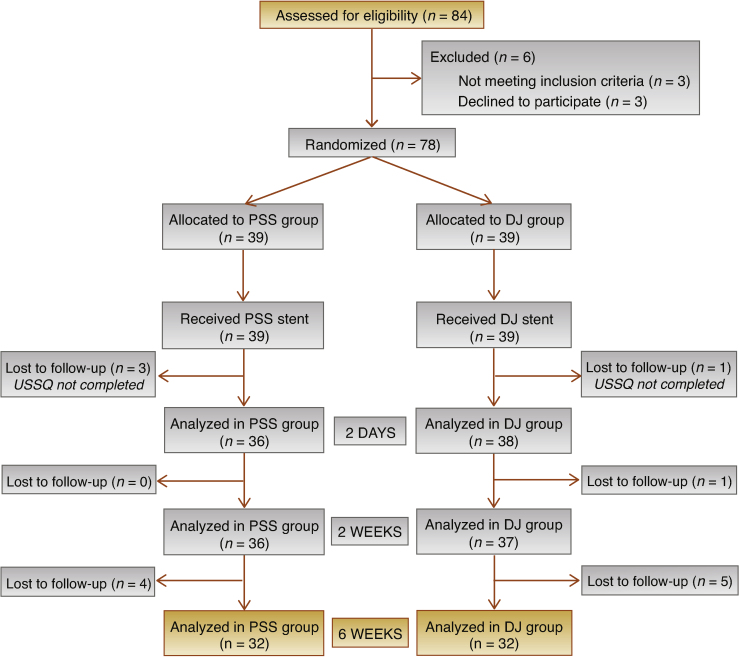
Results and limitations: A total of 78 patients were randomized and treated according to protocol. The Urinary Symptom Index score (p = 0.004), overall Visual Analogue Scale (VAS) score (p = 0.022), and the percentage of patients complaining of pain (63.9% vs 86.1%, p = 0.029) were significantly in favor of PSS at both 2 d and 2 wk after URS. At 2 d, the VAS score among patients with pain (p = 0.025) and the General Health Index score (p = 0.036) were significantly better in the PSS group. No severe complications occurred in either group. Study limitations are the exclusion of patients with distal ureteral stones and the limited sample size.
Conclusions: PSS significantly reduced stent-related symptoms after URS, in particular urinary symptoms and pain, compared to conventional DJ stents, and showed a good safety profile.
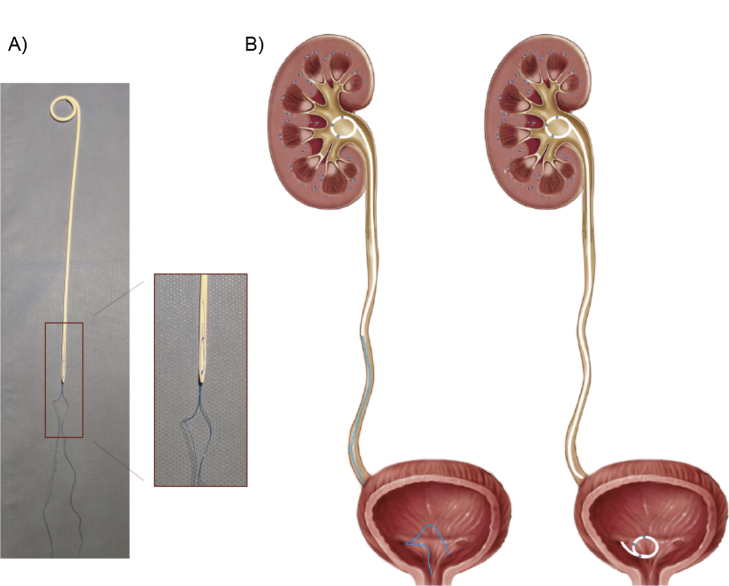
Patient summary: Stents are hollow tubes placed in the passage between the kidney and the bladder (ureter). The standard stent has two coiled ends (double J stent) to keep it in place in both the kidney and the bladder. We tested a commercial stent with two strings at the bladder end (pigtail suture stent) after procedures to remove stones from the upper urinary tract and found that it caused less stent-related symptoms compared to a double J stent. This trial is registered at Clinicaltrials.gov as NCT03344120.
Keywords: Double J stent; Lower urinary tract symptoms; Nephrolithiasis; Pain; Pigtail suture stents; RIRS; Stent-related symptoms; Stents; URS; Ureteroscopy; Urinary calculi.
© 2021 The Authors.
Figures
References
-
- Pereira J.F., Bower P., Jung E. Ureteral stenting practices following routine ureteroscopy: an international survey. World J Urol. 2019;37:2501–2508. - PubMed
-
- Bosio A., Alessandria E., Dalmasso E. How bothersome double-J ureteral stents are after semirigid and flexible ureteroscopy: a prospective single-institution observational study. World J Urol. 2019;37:201–207. - PubMed
-
- Auge B.K., Sarvis J.A., L’Esperance J.O., Preminger G.M. Practice patterns of ureteral stenting after routine ureteroscopic stone surgery: a survey of practicing urologists. J Endourol. 2007;21:1287–1291. - PubMed
-
- Sali G.M., Joshi H.B. Ureteric stents: overview of current clinical applications and economic implications. Int J Urol. 2020;27:7–15. - PubMed
