


Excessive supraventricular ectopic activity and risk of incident atrial fibrillation in a consecutive population referred to ambulatory cardiac monitoring
- PMID: 34337573
- PMCID: PMC8322818
- DOI: 10.1016/j.hroo.2021.04.002
Excessive supraventricular ectopic activity and risk of incident atrial fibrillation in a consecutive population referred to ambulatory cardiac monitoring
Abstract
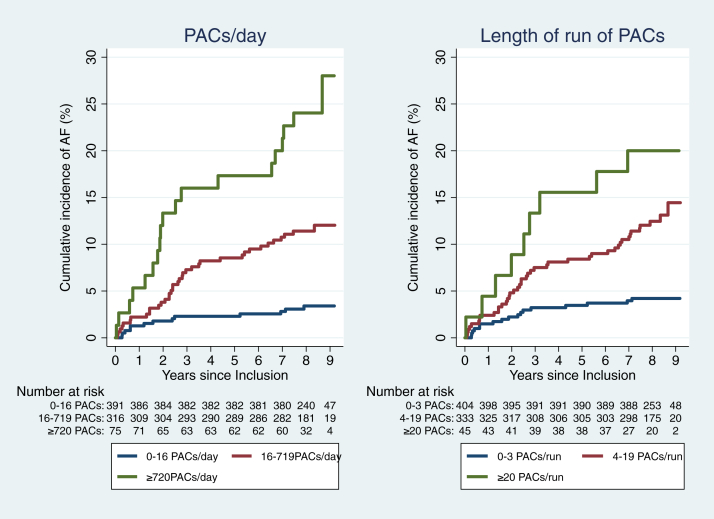
Background: Excessive supraventricular ectopic activity (ESVEA), defined as ≥720 premature atrial contractions (PAC) per day or any runs of ≥20 PACs, has been proposed as a surrogate marker for paroxysmal atrial fibrillation (PAF).
Objective: We aimed to estimate the prognostic impact of ESVEA on the future development of PAF in consecutive patients referred to ambulatory cardiac monitoring.
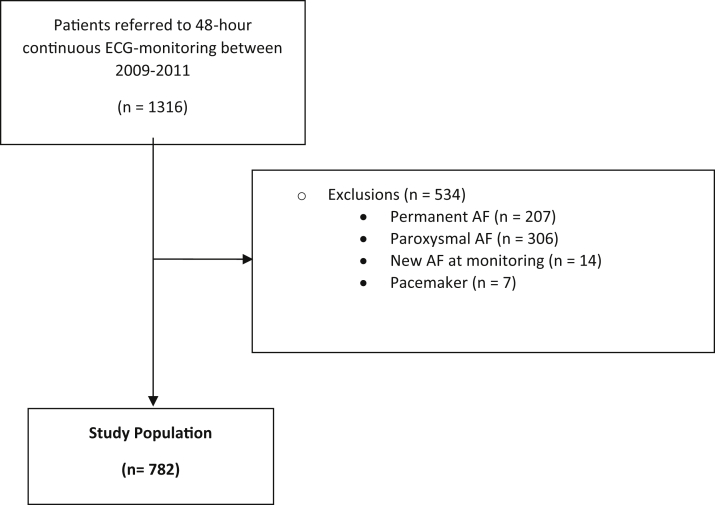
Methods: The cohort consists of a population with comorbidities referred to 48-hour ambulatory electrocardiogram aged 30-98 (n = 1316) between 2009 and 2011. After exclusion of known or current atrial fibrillation (AF) (n = 527) and patients with pacemakers (n = 7), 782 patients were included, with a median follow-up of 8.1 years. Events of incident AF and death were retrieved from patient records.
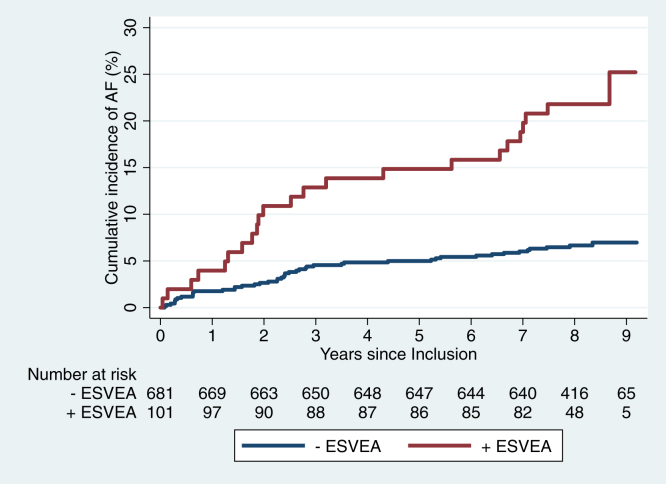
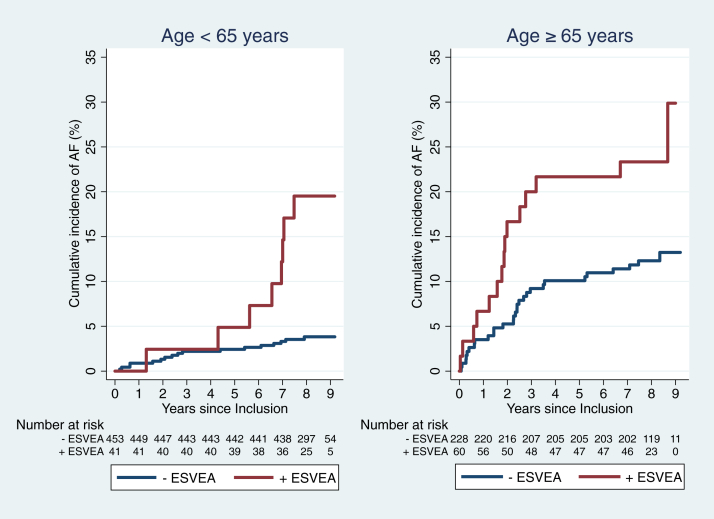
Results: Mean age was 58.6 ± 15.5 years and 56.5% were women. A total of 101 patients had ESVEA at baseline (12.9%). During follow-up, 69 (8.9%) developed incidental AF. Twenty-three patients with ESVEA developed AF (23%). Incidence rate of AF in patients with and without ESVEA was 37.1/1000 person-years and 9.1 per 1000 person-years, respectively (P < .001). ESVEA was associated with incident AF after adjustment for potential confounders in Cox regression analysis (hazard ratio [HR]: 2.39; 95% confidence interval [CI]: 1.40-4.09) and in competing risk analysis with death as competing risk (subdistribution HR: 2.35; 95% CI: 1.30-4.17).
Conclusion: ESVEA increases the risk of incident AF substantially in a population referred to ambulatory cardiac monitoring.
Keywords: Atrial fibrillation; Epidemiology; Premature atrial contractions; Risk stratification; Survival analysis.
© 2021 Heart Rhythm Society. Published by Elsevier Inc.
Figures
References
-
- Colilla S., Crow A., Petkun W. Estimates of current and future incidence and prevalence of atrial fibrillation in the U.S. adult population. Am J Cardiol. 2013;112:1142–1147. - PubMed
-
- McGrath E.R., Kapral M.K., Fang J. Association of atrial fibrillation with mortality and disability after ischemic stroke. Neurology. 2013;81:825–832. - PubMed
-
- Binici Z., Intzilakis T., Nielsen O.W. Excessive supraventricular ectopic activity and increased risk of atrial fibrillation and stroke. Circulation. 2010;121:1904–1911. - PubMed
-
- Chong B.-H., Pong V., Lam K.-F. Frequent premature atrial complexes predict new occurrence of atrial fibrillation and adverse cardiovascular events. Europace. 2012;14:942–947. - PubMed
LinkOut - more resources
Full Text Sources
