Self-reported and actigraphic short sleep duration in older adults
- PMID: 34338629
- PMCID: PMC8804982
- DOI: 10.5664/jcsm.9584
Self-reported and actigraphic short sleep duration in older adults
Abstract
Study objectives: Persons > 65 years with short sleep duration (≤ 6 hours) are at risk for adverse outcomes, but the accuracy of self-reported sleep duration may be affected by reduced symptom awareness. We evaluated the performance characteristics of self-reported vs objectively measured sleep duration in this age group.
Methods: In 2,980 men from the Osteoporotic Fractures in Men Sleep Study and 2,855 women from the Study of Osteoporotic Fractures we examined the agreement and accuracy of self-reported vs actigraphy-measured short and normal (> 6 but < 9 hours) sleep duration. We evaluated associations of select factors (demographics; medical, physical, and neuropsychiatric conditions; medication and substance use; and sleep-related measures) with risk of false-negative (normal sleep duration by self-report but short sleep duration by actigraphy) and false-positive (short sleep duration by self-report and normal sleep duration by actigraphy) designations, respectively, using logistic regression.
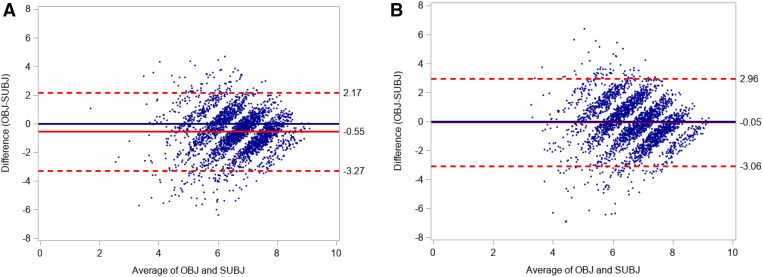
Results: Average ages were 76.3 ± 5.5 and 83.5 ± 3.7 years in men and women, respectively. There was poor agreement between self-reported and actigraphic sleep duration (kappa ≤ 0.24). False negatives occurred in nearly half and false positives in over a quarter of older persons. In multivariable models in men and women, false negatives were independently associated with obesity, daytime sleepiness, and napping, while false positives were significantly lower with obesity.
Conclusions: Under- and overreporting of short sleep is common among older persons. Reliance on self-report may lead to missed opportunities to prevent adverse outcomes or unnecessary interventions. Self-reported sleep duration should be objectively confirmed when evaluating the effect of sleep duration on health outcomes.
Citation: Miner B, Stone KL, Zeitzer JM, et al. Self-reported and actigraphic short sleep duration in older adults. J Clin Sleep Med. 2022;18(2):403-413.
Keywords: actigraphy; aging; sleep disorders; sleep duration.
© 2022 American Academy of Sleep Medicine.
Conflict of interest statement
All authors have read and approved the manuscript. Dr. Miner is supported by the Claude D. Pepper Older Americans Independence Center at Yale School of Medicine (P30AG021342), the American Academy of Sleep Medicine Foundation, a foundation of the American Academy of Sleep Medicine, and the National Institute on Aging (R03AG073991). Dr. Gill was a recipient of an Academic Leadership Award (K07AG043587) from the National Institute on Aging. Dr. Yaggi is supported by a Midcareer Investigator Award in Patient Oriented Research by the National Heart, Lung, and Blood Institute (K24HL132093). The Study of Osteoporotic Fractures (SOF) is supported by National Institutes of Health funding. The National Institute on Aging (NIA) provides support under the following grant numbers: R01 AG005407, R01 AR35582, R01 AR35583, R01 AR35584, R01 AG005394, R01 AG027574, R01 AG027576, and R01 AG026720. The Osteoporotic Fractures in Men Study (MrOS) is supported by National Institutes of Health (NIH) funding. The following institutes provide support: the National Institute on Aging (NIA), the National Institute of Arthritis and Musculoskeletal and Skin Diseases (NIAMS), the National Center for Advancing Translational Sciences (NCATS), and NIH Roadmap for Medical Research under the following grant numbers: U01 AG027810, U01 AG042124, U01 AG042139, U01 AG042140, U01 AG042143, U01 AG042145, U01 AG042168, U01 AR066160, and UL1 TR000128. The National Heart, Lung, and Blood Institute (NHLBI) provides funding for the MrOS Sleep ancillary study “Outcomes of Sleep Disorders in Older Men” under the following grant numbers: R01 HL071194, R01 HL070848, R01 HL070847, R01 HL070842, R01 HL070841, R01 HL070837, R01 HL070838, and R01 HL070839. The authors report no conflicts of interest.
Figures
References
-
- World Health Organization . Global Action Plan on the Public Health Response to Dementia 2017-2025. Geneva, Switzerland: : World Health Organization; ; 2017. .
Publication types
MeSH terms
Grants and funding
- U01 AG042145/AG/NIA NIH HHS/United States
- R01 AR035583/AR/NIAMS NIH HHS/United States
- U01 AG042140/AG/NIA NIH HHS/United States
- UL1 TR001863/TR/NCATS NIH HHS/United States
- UL1 TR000128/TR/NCATS NIH HHS/United States
- K24 HL132093/HL/NHLBI NIH HHS/United States
- R01 HL070842/HL/NHLBI NIH HHS/United States
- U01 AG027810/AG/NIA NIH HHS/United States
- R01 HL070839/HL/NHLBI NIH HHS/United States
- R01 AG005394/AG/NIA NIH HHS/United States
- R01 AG027574/AG/NIA NIH HHS/United States
- R03 AG073991/AG/NIA NIH HHS/United States
- U01 AG042124/AG/NIA NIH HHS/United States
- R01 HL070847/HL/NHLBI NIH HHS/United States
- R01 AG027576/AG/NIA NIH HHS/United States
- T32 AG019134/AG/NIA NIH HHS/United States
- U01 AG042139/AG/NIA NIH HHS/United States
- R01 HL070841/HL/NHLBI NIH HHS/United States
- K07 AG043587/AG/NIA NIH HHS/United States
- U01 AG042143/AG/NIA NIH HHS/United States
- R01 AR035584/AR/NIAMS NIH HHS/United States
- P30 AG021342/AG/NIA NIH HHS/United States
- K76 AG074905/AG/NIA NIH HHS/United States
- R01 HL070838/HL/NHLBI NIH HHS/United States
- R01 AG026720/AG/NIA NIH HHS/United States
- R01 AR035582/AR/NIAMS NIH HHS/United States
- U01 AR066160/AR/NIAMS NIH HHS/United States
- R01 AG005407/AG/NIA NIH HHS/United States
- R01 HL071194/HL/NHLBI NIH HHS/United States
- R01 HL070837/HL/NHLBI NIH HHS/United States
- R01 HL070848/HL/NHLBI NIH HHS/United States
- U01 AG042168/AG/NIA NIH HHS/United States
LinkOut - more resources
Full Text Sources
Medical