. 2021 Nov;238(11):3119-3130.
doi: 10.1007/s00213-021-05929-1. Epub 2021 Aug 2.

Individual differences in social play behaviour predict alcohol intake and control over alcohol seeking in rats

Affiliations

Individual differences in social play behaviour predict alcohol intake and control over alcohol seeking in rats

Heidi M B Lesscher et al. Psychopharmacology (Berl). 2021 Nov.

Abstract

Rationale: Social play behaviour is a rewarding social activity displayed by young mammals, thought to be important for the development of brain and behaviour. Indeed, disruptions of social play behaviour in rodents have been associated with cognitive deficits and augmented sensitivity to self-administration of substances of abuse, including alcohol, later in life. However, the relation between social development and loss of control over substance use, a key characteristic of substance use disorders including alcohol use disorder (AUD), has not been investigated. Moreover, it remains unknown how inherent differences in playfulness relate to differences in the sensitivity to substance use and AUD.

Objective: The objective of this study is to determine how individual differences in juvenile social play behaviour predict alcohol intake and loss of control over alcohol seeking.

Methods: Juvenile male Lister hooded rats were characterized for their tendency to engage in social play behaviour. Subsequently, alcohol consumption and conditioned suppression of alcohol seeking were assessed in the tertiles of rats that showed the most and least social play.

Results: The rats that engaged most in social play behaviour consumed more alcohol than their less playful counterparts. However, whereas the most playful rats showed intact conditioned suppression of alcohol seeking, the least playful rats showed no such suppression.

Conclusion: Individual levels of playfulness predict the sensitivity to alcohol-directed behaviour. Highly playful rats are more prone to alcohol intake, yet show greater control over alcohol seeking. These findings increase our understanding of the relationship between social development and vulnerability to AUD.

Keywords: AUD; Addiction; Alcohol; Individual differences; Loss of control; Rats; Social play.


Conflict of interest statement

The authors declare no competing interests.

Figures
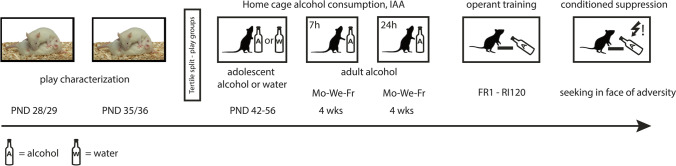
Fig. 1
Fig. 1
Experimental timeline
Fig. 2
Fig. 2
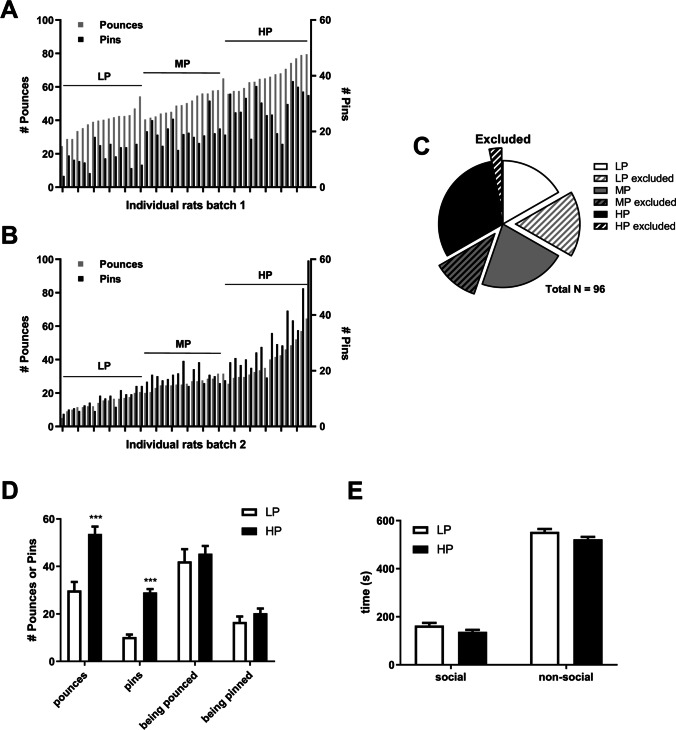
Social play behaviour for all individual rats. A and B The number of pounces (grey) and pins (in black) for all individual animals in batch 1 and 2, respectively (N = 48 per batch); LP, low players; MP, medium players; HP, high players. C The distribution of the rats that were excluded because they could not with certainty be classified as LP, MP or HP. D The average number of pounces and pins performed and the number of occasions the animals were being pounced or pinned are shown for the groups of selected LP (N = 16) and HP (N = 29). E The average time spent on social or non-social exploration for the selected groups of LP (N = 16) and HP (N = 29). Data are shown as average + SEM by play subgroup. ***Significant from low playing rats (p < 0.001)
Fig. 3
Fig. 3
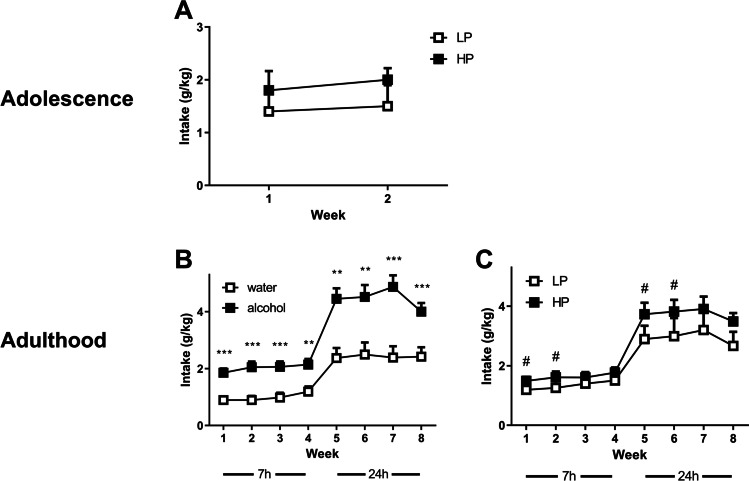
Alcohol intake for the selected groups of low and high playing rats that were allowed to drink either alcohol or water during adolescence. A The alcohol intake during adolescence is shown (LP N = 9, HP N = 14). B The levels of alcohol intake (g/kg) in adulthood, in 7-h (weeks 1–4) and 24-h (weeks 5–8) sessions, by water (N = 22) or alcohol (N = 23) pre-exposure. C The levels of alcohol intake (g/kg) for the same rats, grouped by low (LP, N = 16) or high (HP, N = 29) tendency to engage in social play behaviour. Shown are the average + SEM levels of weekly alcohol intake per group. Post hoc pairwise comparisons: ** or *** significant difference between adolescent water and adolescent alcohol (p < 0.01 or p < 0.001, respectively); # significant difference between low and high playing rats (p < 0.05)
Fig. 4
Fig. 4
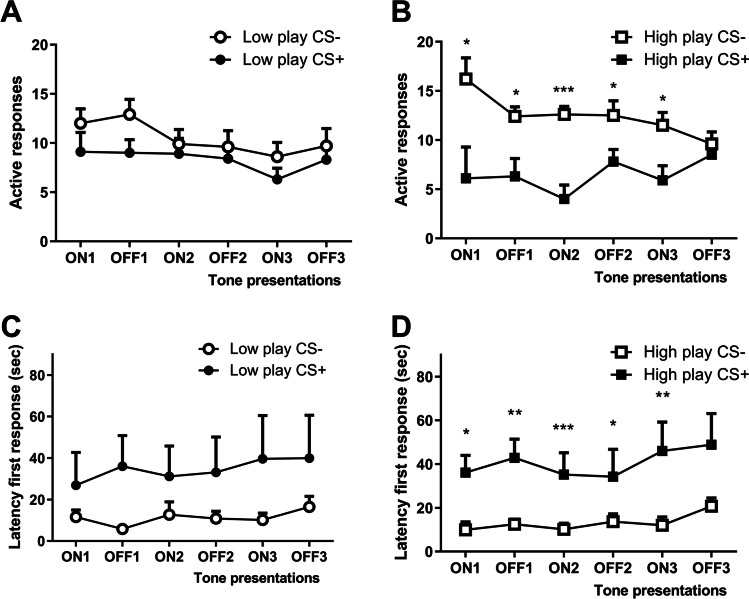
Conditioned suppression of alcohol seeking in low and high playing rats after 8 weeks of intermittent alcohol consumption. The number of active responses during consecutive CS-ON and CS-OFF intervals is shown for low players (A LP, CS − N = 9; CS + N = 7) and high players (B LP, CS − N = 13; CS + N = 16) that were control conditioned (CS −) or conditioned to associate a tone with footshocks (CS +). The latencies to the first active response during the CS-ON and CS-OFF intervals in low players (C LP, CS − N = 9; CS + N = 7) and high players (D LP, CS − N = 13; CS + N = 16), conditioned (CS +) and non-conditioned (CS −). Data are presented as mean + SEM active responses or latencies, binned in 2-min intervals. Significant differences between CS − and CS + subgroups are indicated by *, ** and *** (post hoc pairwise comparisons, p < 0.05, p < 0.01 and p < 0.001, respectively)
Fig. 5
Fig. 5
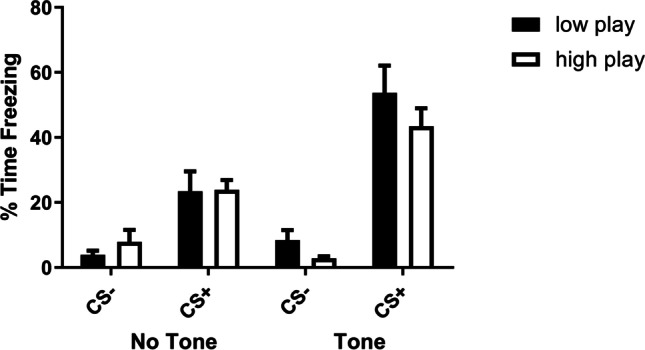
Freezing in low and high playing rats during the 2 min before (no tone) and during 2-min presentation of the footshock-associated CS + (tone) period in the conditioning chamber. The conditioned low and high playing rats (CS +) showed significant context- and CS-induced freezing, when compared to their respective CS − control groups. Group sizes for low playing rats: LP CS − N = 9, LP CS + N = 7, for high playing rats: HP CS − N = 13, HP CS + N = 16. The fear conditioning test was performed 1 week after completion of the conditioned suppression test. Data are presented as mean + SEM. ***Significant difference between CS + and CS − groups (post hoc pairwise comparisons, p < 0.001)

References

    1. Achterberg EJ, van Kerkhof LW, Servadio M, van Swieten MM, Houwing DJ, Aalderink M, Driel NV, Trezza V, Vanderschuren LJMJ. Contrasting roles of dopamine and noradrenaline in the motivational properties of social play behavior in rats. Neuropsychopharmacology. 2016;41:858–868. doi: 10.1038/npp.2015.212. - DOI - PMC - PubMed
    1. Achterberg EJM, van Swieten MMH, Driel NV, Trezza V, Vanderschuren LJMJ. Dissociating the role of endocannabinoids in the pleasurable and motivational properties of social play behaviour in rats. Pharmacol Res. 2016;110:151–158. doi: 10.1016/j.phrs.2016.04.031. - DOI - PMC - PubMed
    1. Achterberg EJM, Damsteegt R, Vanderschuren LJMJ. On the central noradrenergic mechanism underlying the social play-suppressant effect of methylphenidate in rats. Behav Brain Res. 2018;347:158–166. doi: 10.1016/j.bbr.2018.03.004. - DOI - PubMed
    1. Alaux-Cantin S, Warnault V, Legastelois R, Botia B, Pierrefiche O, Vilpoux C, Naassila M. Alcohol intoxications during adolescence increase motivation for alcohol in adult rats and induce neuroadaptations in the nucleus accumbens. Neuropharmacology. 2013;67:521–531. doi: 10.1016/j.neuropharm.2012.12.007. - DOI - PubMed
    1. American Psychiatric Association (2013) Diagnostic and statistical manual of mental disorders (5th ed.). vol Book, Whole. American Psychiatric Association, Washington, DC.