


Directed stimulation of the dentato-rubro-thalamic tract for deep brain stimulation in essential tremor: a blinded clinical trial
- PMID: 34340623
- PMCID: PMC9130622
- DOI: 10.1177/19714009211036689
Directed stimulation of the dentato-rubro-thalamic tract for deep brain stimulation in essential tremor: a blinded clinical trial
Abstract
Objective: Observational studies utilising diffusion tractography have suggested a common mechanism for tremor alleviation in deep brain stimulation for essential tremor: the decussating portion of the dentato-rubro-thalamic tract. We hypothesised that directional stimulation of the dentato-rubro-thalamic tract would result in greater tremor improvement compared to sham programming, as well as comparable improvement as more tedious standard-of-care programming.
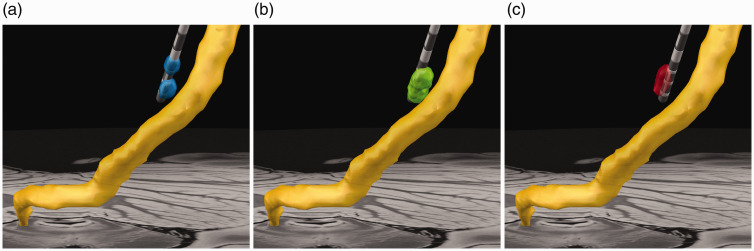
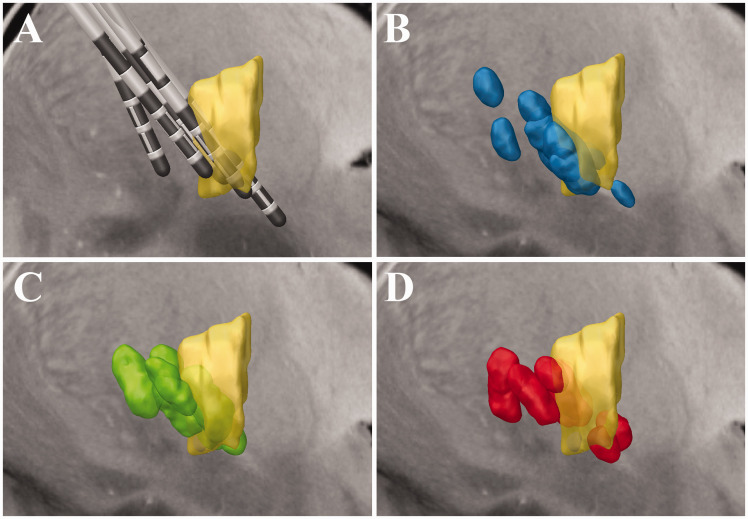
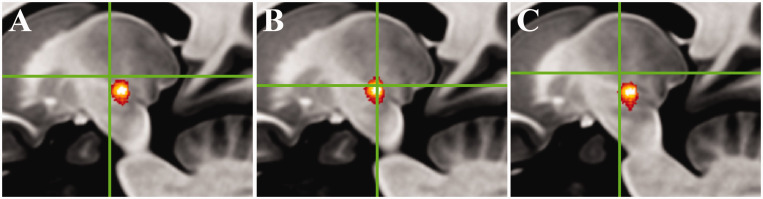
Methods: A prospective, blinded crossover trial was performed to assess the feasibility, safety and outcomes of programming based solely on dentato-rubro-thalamic tract anatomy. Using magnetic resonance imaging diffusion-tractography, the dentato-rubro-thalamic tract was identified and a connectivity-based treatment setting was derived by modelling a volume of tissue activated using directional current steering oriented towards the dentato-rubro-thalamic tract centre. A sham setting was created at approximately 180° opposite the connectivity-based treatment. Standard-of-care programming at 3 months was compared to connectivity-based treatment and sham settings that were blinded to the programmer. The primary outcome measure was percentage improvement in the Fahn-Tolosa-Marín tremor rating score compared to the preoperative baseline.
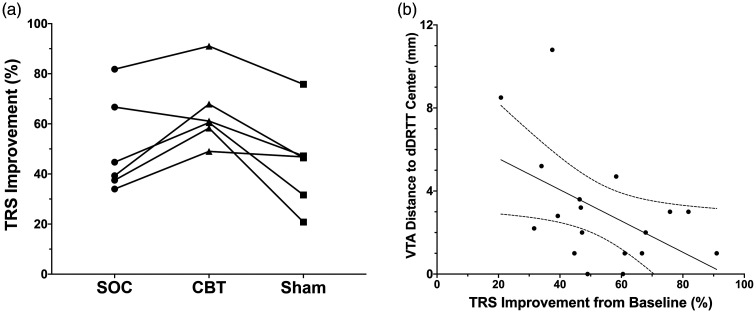
Results: Among the six patients, tremor rating scores differed significantly among the three experimental conditions (P=0.030). The mean tremor rating score improvement was greater with the connectivity-based treatment settings (64.6% ± 14.3%) than with sham (44.8% ± 18.6%; P=0.031) and standard-of-care programming (50.7% ± 19.2%; P=0.062). The distance between the centre of the dentato-rubro-thalamic tract and the volume of tissue activated inversely correlated with the percentage improvement in the tremor rating score (R2=0.24; P=0.04). No significant adverse events were encountered.
Conclusions: Using a blinded, crossover trial design, we have shown the technical feasibility, safety and potential efficacy of connectivity-based stimulation settings in deep brain stimulation for treatment of essential tremor.
Keywords: Essential tremor; deep brain stimulation; dentato-rubro-thalamic tract.
Figures
References
-
- Louis ED, Ferreira JJ. How common is the most common adult movement disorder? Update on the worldwide prevalence of essential tremor. Mov Disord 2010; 25: 534–541. doi:10.1002/mds.22838 - PubMed
-
- Thanvi B, Lo N, Robinson T. Essential tremor-the most common movement disorder in older people. Age Ageing 2006; 35: 344–349. doi:10.1093/ageing/afj072 - PubMed
-
- Okun MS, Tagliati M, Pourfar M, et al. Management of referred deep brain stimulation failures: a retrospective analysis from 2 movement disorders centers. Arch Neurol 2005; 62: 1250–1255. doi:10.1001/archneur.62.8.noc40425 - PubMed
-
- Coenen VA, Allert N, Madler B. A role of diffusion tensor imaging fiber tracking in deep brain stimulation surgery: DBS of the dentato-rubro-thalamic tract (DRT) for the treatment of therapy-refractory tremor. Acta Neurochir (Wien) 2011; 153: 1579–1585. doi:10.1007/s00701-011-1036-z - PubMed
Publication types
MeSH terms
Grants and funding
LinkOut - more resources
Full Text Sources
