Review
. 2022 Jan;47(1):225-246.
doi: 10.1038/s41386-021-01101-7. Epub 2021 Aug 2.

Prefrontal cortex and depression

Affiliations
Review

Prefrontal cortex and depression

Diego A Pizzagalli et al. Neuropsychopharmacology. 2022 Jan.

Erratum in

  • Correction: Prefrontal cortex and depression.
    Pizzagalli DA, Roberts AC. Pizzagalli DA, et al. Neuropsychopharmacology. 2022 Jan;47(2):609. doi: 10.1038/s41386-021-01160-w. Neuropsychopharmacology. 2022. PMID: 34413479 Free PMC article. No abstract available.

Abstract

The prefrontal cortex (PFC) has emerged as one of the regions most consistently impaired in major depressive disorder (MDD). Although functional and structural PFC abnormalities have been reported in both individuals with current MDD as well as those at increased vulnerability to MDD, this information has not translated into better treatment and prevention strategies. Here, we argue that dissecting depressive phenotypes into biologically more tractable dimensions - negative processing biases, anhedonia, despair-like behavior (learned helplessness) - affords unique opportunities for integrating clinical findings with mechanistic evidence emerging from preclinical models relevant to depression, and thereby promises to improve our understanding of MDD. To this end, we review and integrate clinical and preclinical literature pertinent to these core phenotypes, while emphasizing a systems-level approach, treatment effects, and whether specific PFC abnormalities are causes or consequences of MDD. In addition, we discuss several key issues linked to cross-species translation, including functional brain homology across species, the importance of dissecting neural pathways underlying specific functional domains that can be fruitfully probed across species, and the experimental approaches that best ensure translatability. Future directions and clinical implications of this burgeoning literature are discussed.


Conflict of interest statement

The authors declare no competing interests.

Figures
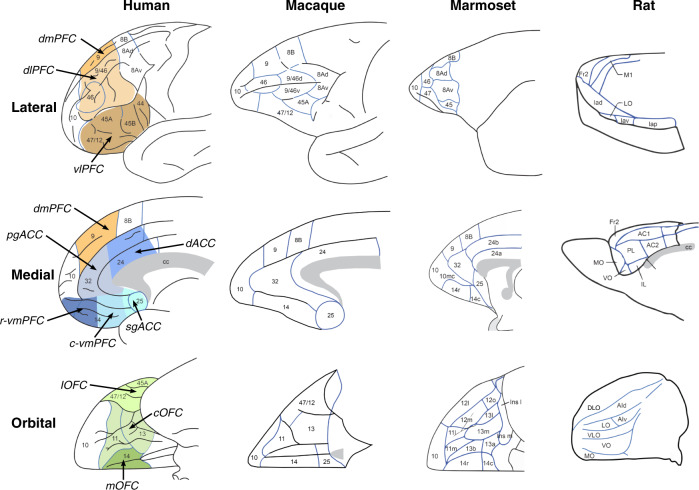
Fig. 1
Fig. 1. Schematics of the medial, lateral and orbital views of the prefrontal and anterior cingulate cortex in humans, the NHPs, macaques and marmosets, and rats.
Specific areas are labeled based on the parcellation maps of Petrides and Pandya for humans and macaques [273], Paxinos et al. for marmoset [274] and Palomero-Gallagher and Zilles for lateral and medial views [275] and Uylings et al. [276] for the orbital view in rats. Note that an alternative parcellation of the orbital and medial views of human and macaques is provided by Price et al. [11] in which area 13, 14 and 12/47 are further subdivided, area 10 extends further caudally on the medial surface, replacing medial area 14 and area 25 in humans is smaller, with the addition of an adjacent subregion of area 32 (32/PL) and area 25 in macaques does not extend onto the orbital surface. See also Box 1. Caudal ventromedial (c-vm)PFC; central (c)OFC; dorsal (d)ACC; dorsomedial (dm)PFC; dorsolateral (dl)PFC; lateral (l)OFC; medial (m)OFC; perigenual (pg)ACC; rostral ventromedial (r-vm)PFC; subgenual (sg)ACC; ventrolateral (vl)PFC.
Fig. 2
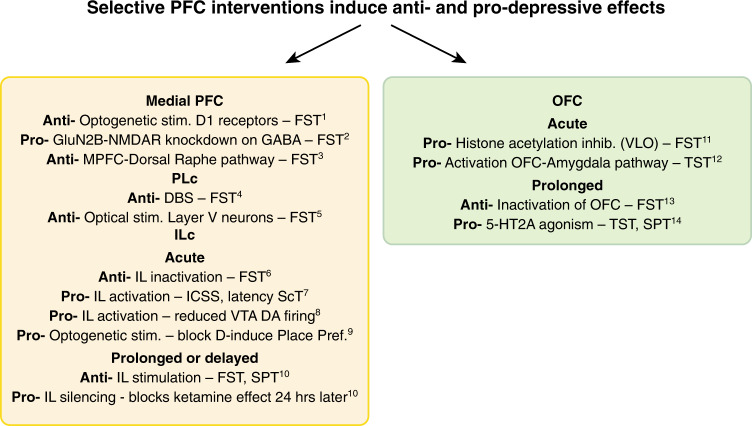
Fig. 2. Summary of putative pro-depressant (pro) or antidepressant (anti) effects of interventions within the medial prefrontal cortex (medial PFC) and orbitofrontal cortex (OFC) of otherwise, normal, healthy rodents.
FST forced swim test, ICSS intracranial self-stimulation, Place Pref place preference test, ScT sucrose consumption test, SPT sucrose preference test, TST tail suspension test, VLO ventrolateral orbital cortex, VTA DA ventral tegmental area dopamine neurons. 1. Hare, B.D. et al. Nat. Commun. 10, 1–12 (2019). 2. Gerhard, D.M. et al. J. Clin. Invest. 130, 1336–1349 (2020). 3. Warden, M.R. et al. Nature 492, 428–432 (2012). 4. Hamani, C. et al. Biol. Psychiatry 71, 30–35 (2012). 5. Kumar, S. et al. J. Neurosci. 33, 1116–1129 (2013). 6. Slattery, D.A., Neumann, I. & Cryan, J.F. J. Psychopharmacol. 25, 1295-1303 (2011). 7. John, C.S. et al. Neuropsychopharmacology 37, 2467–2475 (2012). 8. Moreines, J.L., Owrutsky, Z.L. & Grace, A.A. Neuropsychopharmacology 42, 904–913 (2017). 9. Ferenczi, E.A. et al. Science 351, aac9698 (2016). 10. Fuchikami, M. et al. Proc. Natl. Acad. Sci. 112, 8106–8111 (2015). 11. Zhao, Y. et al. PLoS One 8, e52698 (2013). 12. Kuniishi, H., Yamada, D., Wada, K., Yamada, M. & Sekiguchi, M. Transl. Psychiatry 10, 1–11 (2020). 13. Kuniishi, H. et al. Front. Behav. Neurosci. 10, 250 (2017). 14. Xu, C. et al. Neuropharmacology 109, 7–17 (2016).
Fig. 3
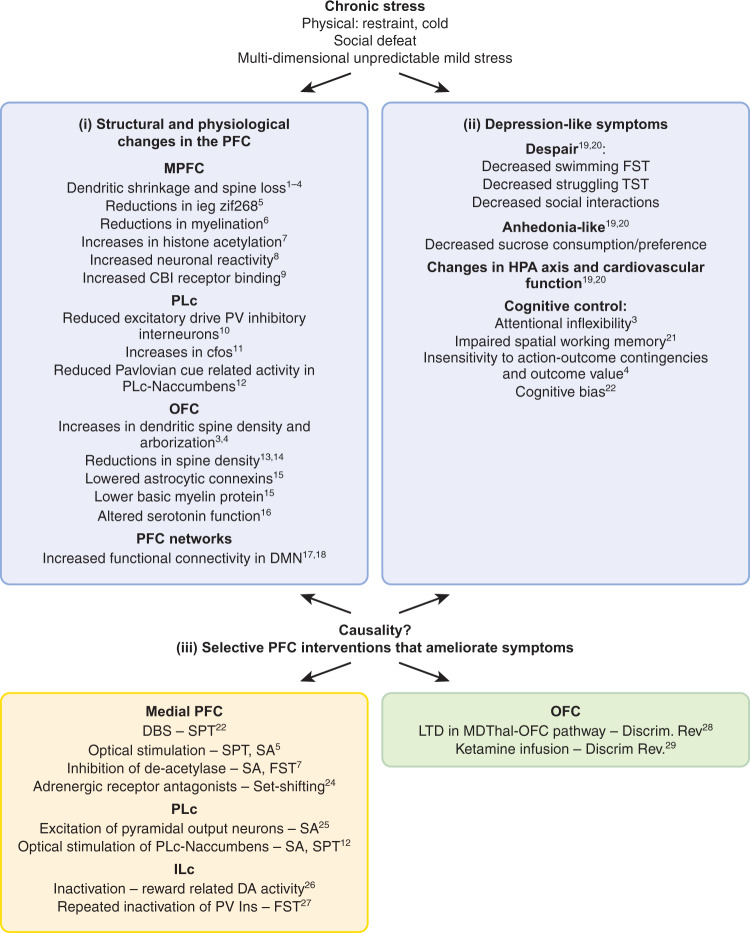
Fig. 3. Summary of findings in rodents subject to chronic stress as adults revealing (i) structural and physiological changes in the medial prefrontal cortex (medial PFC) and orbitofrontal cortex (OFC), (ii) associated behavioral changes and (iii) interventions within the medial PFC and OFC that ameliorate the behavioral changes.
Both (i) and (iii) implicate dysregulation within medial PFC and OFC in relation to the behavioral changes associated with chronic stress. ieg immediate early gene, CB1 endocannabinoid presynaptic receptor, DA dopamine, DBS deep brain stimulation, Discrim Rev discrimination reversal task, DMN default mode network, FST forced swim test, LTD long-term depression, MDThal mediodorsal thalamus, NAccumbens nucleus accumbens, PV parvalbumin neurons, SA social avoidance (interaction) test, SPT sucrose preference test. 1. Cook, S.C. & Wellman, C.L. J. Neurobiol. 60, 236–248 (2004). 2. Radley, J.J. et al. Exp. Neurol. 196, 199–203 (2005). 3. Liston, C. et al. J. Neurosci. 26, 7870–7874 (2006). 4. Dias-Ferreira, E. et al. Science (80-.). 325, 621–625 (2009). 5. Covington, H.E. et al. J. Neurosci. 30, 16082–16090 (2010). 6. Lehmann, M.L., Weigel, T.K., Elkahloun, A.G. & Herkenham M. Sci. Rep. 7, 46548. 7. Covington, H.E., Maze, I., Vialou, V. & Nestler, E.J. Neuroscience 298, 329–335 (2015). 8. Kumar, S. et al. Nat. Commun. 5, 1–9 (2014). 9. McLaughlin, R.J. et al. Behav. Brain Res. 237, 333–337 (2013). 10. Perova, Z., Delevich, K. & Li, B. J. Neurosci. 35, 3201–3206 (2015). 11. Vialou, V. et al. J. Neurosci. 34, 3878–3887 (2014). 12. Spring, M.G. et al. J. Neurosci. JN-RM-1869-20 (2021). 13. Xu, C. et al. Neuropharmacology 109, 7–17 (2016). 14. Gourley, S.L., Swanson, A.M. & Koleske, A.J. J. Neurosci. 33, 3107–3112 (2013). 15. Miguel-Hidalgo, J.J., Moulana, M., Deloach, P.H. & Rajkowska, G. Chronic Stress (Thousand Oaks, Calif.) 2, 247054701881418 (2018). 16. Lapiz-Bluhm, M.D.S., Soto-Piña, A.E., Hensler, J.G. & Morilak, D.A. Psychopharmacology (Berl). 202, 329–341 (2009). 17. Henckens, M.J.A.G. et al. Neuroimage 105, 312–322 (2015). 18. Grandjean, J. et al. Neuroimage 142, 544–552 (2016). 19. Gururajan, A., Reif, A., Cryan, J.F. & Slattery, D.A. Nat. Rev. Neurosci. 20, 686–701 (2019). 20. Willner, P. Neurobiol. Stress 6, 78–93 (2017). 21. Mizoguchi, K. et al. J. Neurosci. 20, 1568–1574 (2000). 22. Papciak, J., Popik, P., Fuchs, E. & Rygula, R. Behav. Brain Res. 256, 305–310 (2013). 23. Hamani, C. et al. Biol. Psychiatry 71, 30–35 (2012). 24. Jett, J.D. & Morilak, D.A. Neuropsychopharmacology 38, 585–595 (2013). 25. Kumar, S. et al. J. Neurosci. 33, 1116–1129 (2013). 26. Moreines, J.L., Owrutsky, Z.L. & Grace, A.A. Neuropsychopharmacology 42, 904–913 (2017). 27. Nawreen, N. et al. eNeuro 7, (2020). 28. Adler, S.M., Girotti, M. & Morilak, D.A. Neurobiol. Stress 13, 100258 (2020). 29. Patton, M.S., Lodge, D.J., Morilak, D.A. & Girotti, M. Neuropsychopharmacology 42, 1220–1230 (2017).
Fig. 4
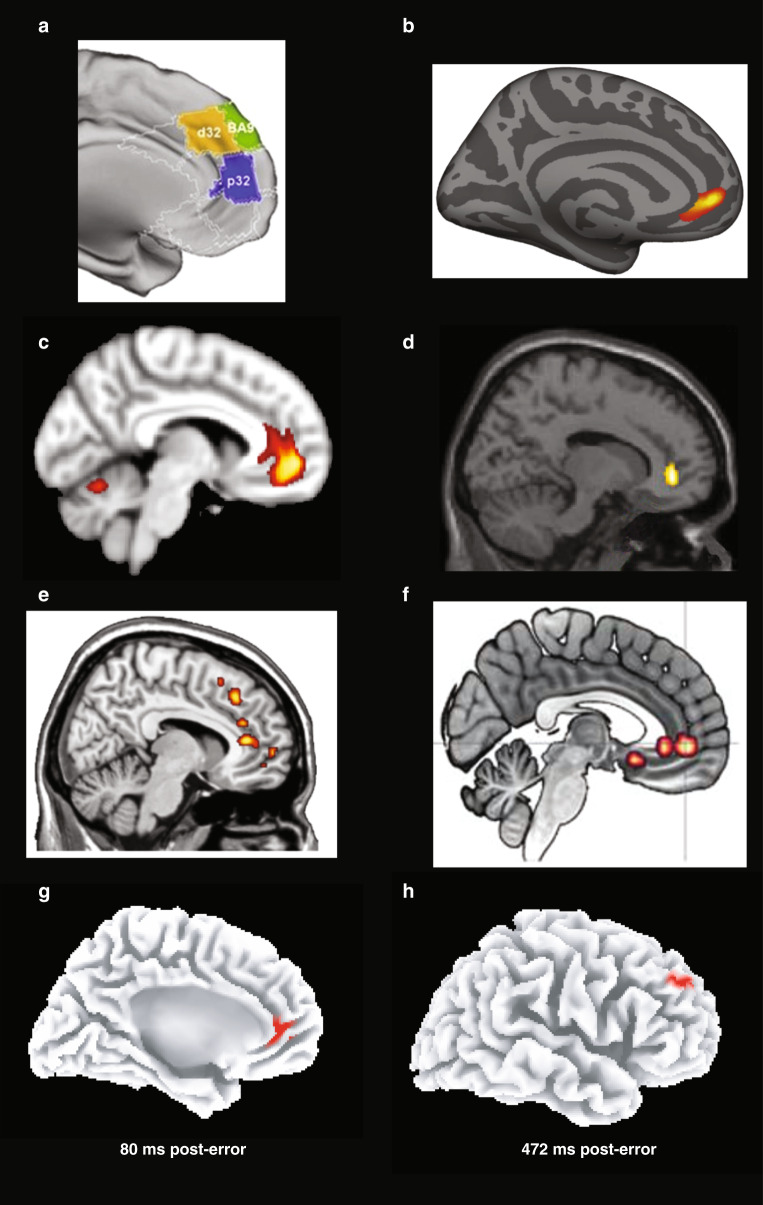
Fig. 4. Functional and structural findings implicating the perigenual anterior cingulate cortex (and other mPFC regions) in major depressive disorder (MDD).
a Individuals with current MDD and at-risk individuals (unaffected first-degree relatives) showed abnormal coupling involving the pgACC (see “p32”; decreased coupling with posterior cingulate), dmPFC (see “BA9”; decreased coupling with ventral intraparietal sulcus), and dACC (see “d32”; increased coupling with the occipital cortex) [73]. b pgACC region showing a positive correlation between cortical thickness change and improvement in depression symptoms with repetitive transcranial magnetic stimulation of the left dlPFC [90]. c pgACC region in which pre- to post-treatment changes in gray matter volume correlated with antidepressant response to transcranial magnetic stimulation of the left dlPFC [91]. d pgACC region showing higher activation to masked sad faces in MDD than healthy controls [169]. e Greater activation in the pgACC (and other mPFC regions) in response to a sad mood manipulation predicted relapse among fully remitted individuals 18 months later [155]. f Increased functional connectivity between the sgACC/pgACC and the amygdala during an implicit emotional processing task in individuals with increased MDD vulnerability [189]. g Increased pgACC activation 80 ms after committing a mistake in a speeded reaction time task in MDD vs. healthy controls [242]; and h Decreased left dlPFC activation 472 ms after committing a mistake in MDD vs. healthy controls [242]. Adapted with permission from publishers.
Fig. 5
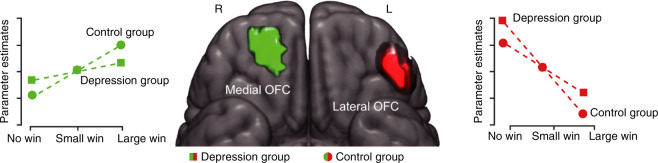
Fig. 5. Abnormal orbitofrontal activation in depression during reward anticipation.
Central orbitofrontal cortex (see green) and lateral orbitofrontal cortex (see red) region in which individuals with elevated depression severity (see squares) had reduced sensitivity to differing reward values and potentiated activation to non-rewards (no-win outcome) during reward anticipation compared to the control group (see circles) [114]. Adapted with permission from publishers.
Fig. 6
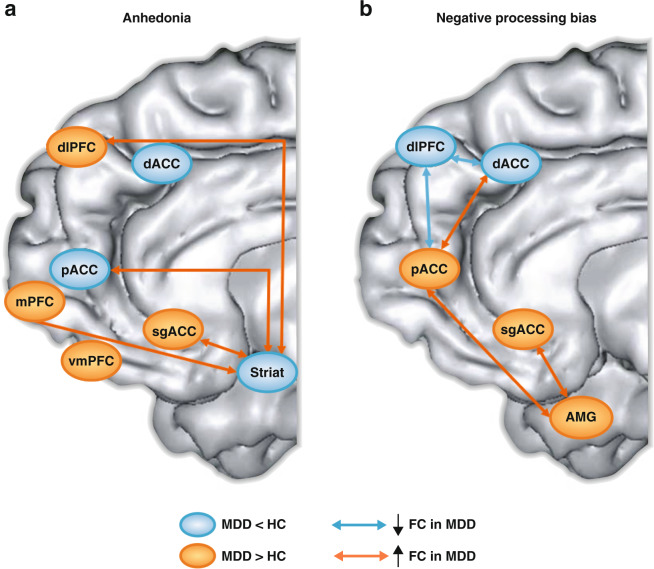
Fig. 6. Summary of functional abnormalities in tasks probing (a) reward-related processes and (b) negative processing biases in major depressive disorder (MDD).
Regions highlighted in orange and blue show higher activation and lower activation, respectively, in MDD samples than healthy controls (HC). Orange and blue arrows denote higher and lower functional connectivity, respectively, in MDD samples than healthy controls. AMG amygdala, dACC dorsal anterior cingulate cortex, dlPFC dorsolateral prefrontal cortex, mPFC medial prefrontal cortex, pgACC perigenual anterior cingulate cortex, sgACC subgenual anterior cingulate cortex, Striat Striatum vmPFC ventromedial prefrontal cortex.
Fig. 7
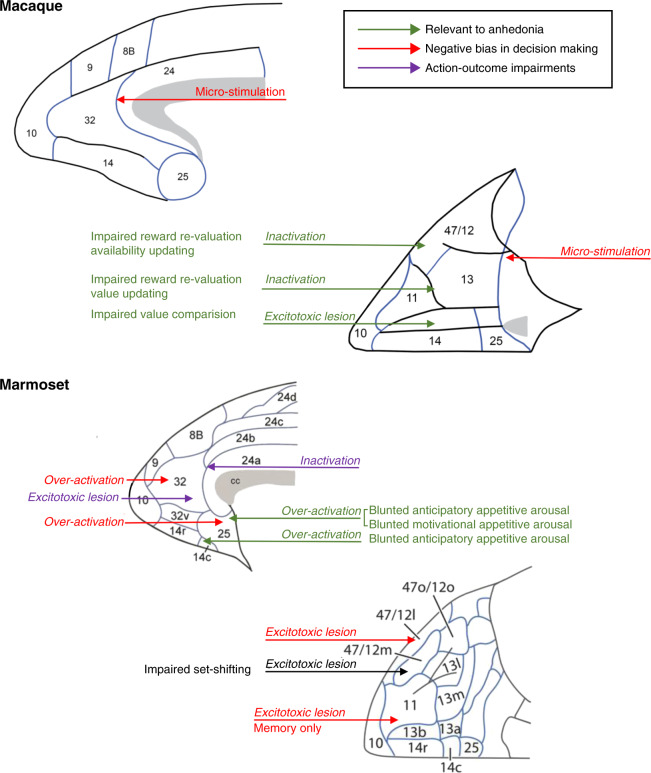
Fig. 7. Schematic of medial and orbital views of macaque and marmoset prefrontal and anterior cingulate cortex illustrating regions in which reductions or increases in activity induce behavioral deficits of relevance to symptoms of anhedonia, negative bias and despair/helplessness in MDD.
Relevant to anhedonia: Areas 47/12, 11/13, and 14 in macaques [115]; Areas 25 [61] and 14 [142] in marmosets; Negative bias in decision making: Area 32/24 border [39] and caudal OFC [202] in macaques; Areas 32 and 25 [41] and areas 47/12 and 11 [38] in marmosets; Action-outcome impairments: Areas 24 [206] and 32 [204] in marmosets; Attentional set-shifting: Area 47/12 in marmosets [207].

References

    1. Wittchen HU, Jacobi F, Rehm J, Gustavsson A, Svensson M, Jönsson B, et al. The size and burden of mental disorders and other disorders of the brain in Europe 2010. Eur Neuropsychopharmacol. 2011;21:655–79. - PubMed
    1. Moussavi S, Chatterji S, Verdes E, Tandon A, Patel V, Ustun B. Depression, chronic diseases, and decrements in health: results from the World Health Surveys. Lancet. 2007;370:851–8. - PubMed
    1. Pizzagalli DA. Depression, stress, and anhedonia: toward a synthesis and integrated model. Annu Rev Clin Psychol. 2014;10:393–423. - PMC - PubMed
    1. Hyman SE. Revolution stalled. Sci Transl Med. 2012;4:155cm11. doi: 10.1126/scitranslmed.3003142. - DOI - PubMed
    1. Hyman SE. Can neuroscience be integrated into the DSM-V? Nat Rev Neurosci. 2007;8:725–32. - PubMed

Publication types