Review
. 2022 Jan 26;39(1):20-32.
doi: 10.1039/d1np00039j.

Cheminformatic analysis of natural product-based drugs and chemical probes

Affiliations
Review

Cheminformatic analysis of natural product-based drugs and chemical probes

Samantha Stone et al. Nat Prod Rep. .

Abstract

Covering: 1981 to 2019Natural products continue to play a major role in drug discovery, with half of new chemical entities based structurally on a natural product. Herein, we report a cheminformatic analysis of the structural and physicochemical properties of natural product-based drugs in comparison to top-selling brand-name synthetic drugs, and a selection of chemical probes recently discovered from diversity-oriented synthesis libraries. In this analysis, natural product-based drugs covered a broad range of chemical space based on size, polarity, and three-dimensional structure. Natural product-based structures were also more prevalent in top-selling drugs of 2018 compared to 2006. Further, the drugs clustered well according to biosynthetic origins, but less so based on therapeutic classes. Macrocycles occupied distinctive and relatively underpopulated regions of chemical space, while chemical probes largely overlapped with synthetic drugs. This analysis highlights the continued opportunities to leverage natural products and their pharmacophores in modern drug discovery.


Conflict of interest statement

Conflicts of interest

S.L.C., as an employee of Lodo Therapeutics, facilitated partial financial support for this work. Lodo Therapeutics was subsequently acquired by Zymergen, Inc.

Figures
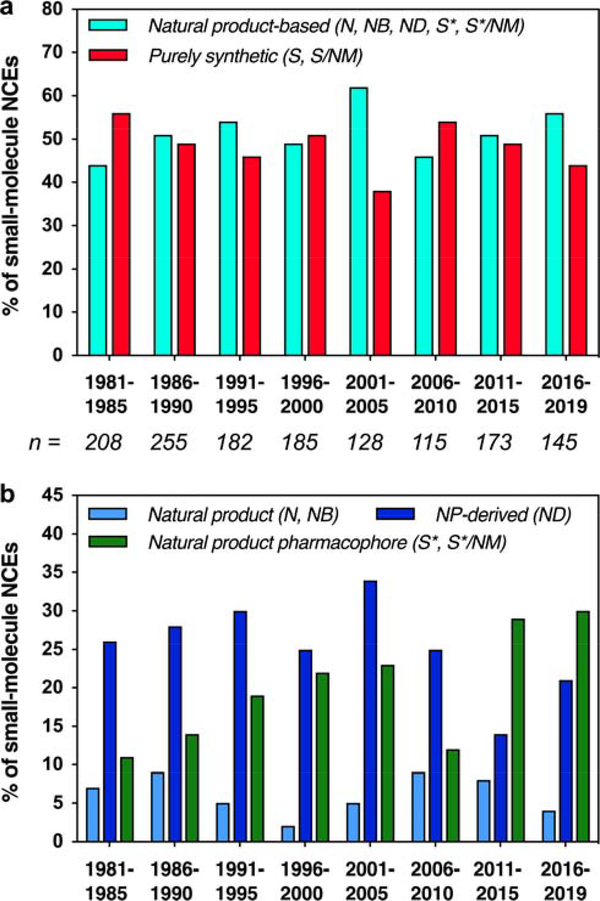
Fig. 1
Fig. 1
(a) Fractions of small-molecule new chemical entity (NCE) drug approvals based structurally on natural products vs. purely synthetic in origin. Total number (n) of small-molecule NCEs listed below each time period. (b) Fractions of NCEs that were unmodified natural products, defined natural product botanicals, natural product derivatives, or synthetic but based structurally on a natural product; purely synthetic drugs not shown. Data binned in 5-year periods, except final 4-year period. Categories as defined by Newman and Cragg: N = unaltered natural product; NB = botanical drug (defined mixture); ND = natural product derivative; S = synthetic drug; S* = synthetic drug (natural product pharmacophore); /NM = mimic of natural product.
Fig. 2
Fig. 2
Bar graphs of selected structural and physicochemical properties of natural product drugs (N), natural product-derived drugs (ND), top 40 brand-name drugs from 2006 and 2018 from natural product (-N) and purely synthetic (-S) origins, and recently discovered chemical probes from diversity-oriented synthesis libraries (DOS). See Supporting Information Figure S2 for complete data.
Fig. 3.
Fig. 3.
PCA and loading plots based on 20 structural and physicochemical parameters for natural product drugs (N), natural product-derived drugs (ND), top 40 brand name drugs in 2006 and 2018 derived from natural products (-N) or purely synthetic (-S), and recently discovered chemical probes from diversity-oriented synthesis libraries (DOS). See Supporting Information for complete data, including PC2 vs PC3 plots (Supporting Information Figure S3).
Fig. 4
Fig. 4
PCA plots of drugs coded by biosynthetic origin (colored markers) and macrocyclic structure (black outlines). All natural product-based drugs (N, ND, S*, S*/NM) are shown, in addition to purely synthetic drugs present in the Top 40 collections (S, S/NM; gray markers), as well as chemical probes identified from diversity-oriented synthesis libraries (DOS; bold green diamonds).
Fig. 5
Fig. 5
PCA plots of drugs coded by therapeutic class. All natural product-based drugs (N, ND, S*, S*/NM) are shown, in addition to purely synthetic drugs present in the Top 40 collections (S, S/NM), as well as chemical probes identified from diversity-oriented synthesis libraries (DOS; bold green diamonds).

References

    1. Newman DJ; Cragg GM “Natural products as sources of new drugs over the nearly four decades from 01/1981 to 09/2019.” J. Nat. Prod 2020, 83, 770–803. - PubMed
    1. Stratton CF; Newman DJ; Tan DS “Cheminformatic comparison of approved drugs from natural product versus synthetic origins.” Bioorg. Med. Chem. Lett 2015, 25, 4802–4807. - PMC - PubMed
    1. van Montfort RLM; Workman P “Structure-based drug design: Aiming for a perfect fit.” Essays Biochem 2017, 61, 431–437. - PMC - PubMed
    1. Song M; Hwang GT “DNA-encoded library screening as core platform technology in drug discovery: Its synthetic method development and applications in DEL synthesis.” J. Med. Chem 2020, 63, 6578–6599. - PubMed
    1. Jones LH; Bunnage ME “Applications of chemogenomic library screening in drug discovery.” Nat. Rev. Drug Discov 2017, 16, 285–296. - PubMed

Publication types

MeSH terms

Substances