


Duplex Ultrasound Screening for Deep and Superficial Vein Thrombosis in COVID-19 Patients
- PMID: 34342886
- PMCID: PMC8426740
- DOI: 10.1002/jum.15798
Duplex Ultrasound Screening for Deep and Superficial Vein Thrombosis in COVID-19 Patients
Abstract
Background: There is growing evidence regarding the venous thromboembolic (VTE) pathophysiology of coronavirus disease 2019 (COVID-19). Several studies have reported varying incidences of this disease.
Objectives: The main purpose of this study was to determine the real incidence of deep or superficial vein thrombosis in COVID-19. The study also aimed to identify risk and protective factors for VTE.
Methods: Patients were consecutively enrolled and assessed with a bilateral Duplex ultrasonography of lower limbs during hospitalization. The exam was repeated weekly until discharge, and then follow-up for 1 month.
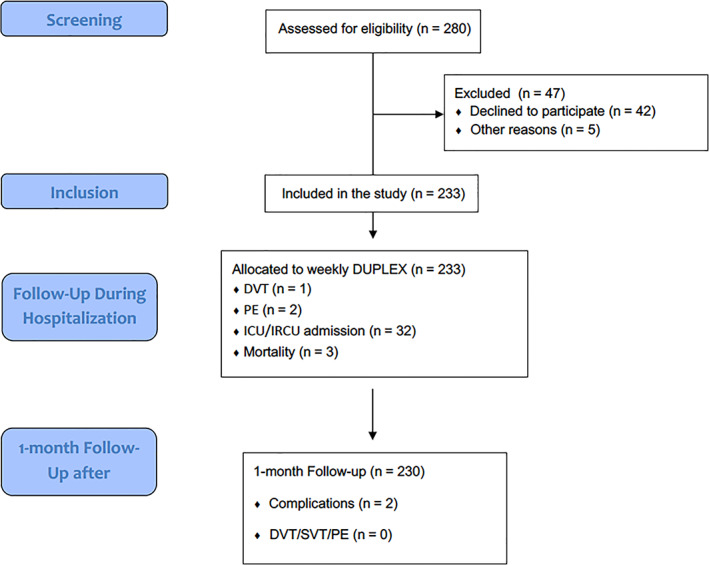
Results: Two-hundred and thirty-three patients were enrolled. Mean age was 54.4 years (SD 12.7) and 47.8% were female. About 127 patients (54.5%) had comorbidities. At enrollment, patients were normotensive and had normal saturation (95.6%-SD 1.6, with a respiratory rate of 19.1 rpm-SD 4.0), with 130 needing at least supplementary oxygen therapy (55.8%). About 147 patients (63.1%) had at least 1 Duplex ultrasonography study performed and 1.7% had 5 or more studies. One patient had a distal posterior tibial vein thrombosis, which showed signs of chronicity and was congruent with the patient history. Therefore, the incidence of thrombotic events was nearly zero.
Discussion: Our study results suggest that performing a Duplex Ultrasonography screening protocol in stable COVID-19 patient populations, who may need hospitalization but are without symptoms of vein thrombosis, is not founded. We presumably emphasize the advantage of using intermediate LMWH doses as well as early walking in COVID-19 patients.
Keywords: Coronavirus Disease 2019 (COVID-19); Severe Acute Respiratory Syndrome Coronavirus 2 (SARS-CoV-2); deep vein thrombosis; duplex ultrasonography; superficial vein thrombosis.
© 2021 American Institute of Ultrasound in Medicine.
References
-
- Kyriakoulis KG, Kokkinidis DG, Kyprianou IA, et al. Venous thromboembolism in the era of COVID‐19. Phlebology 2021; 36:91–99. - PubMed
MeSH terms
Substances
LinkOut - more resources
Full Text Sources
Medical
Miscellaneous
