Meta-Analysis
. 2022 Feb;26(2):361-372.
doi: 10.1177/13623613211019547. Epub 2021 Aug 4.

Potential role for immune-related genes in autism spectrum disorders: Evidence from genome-wide association meta-analysis of autistic traits

Affiliations
Meta-Analysis

Potential role for immune-related genes in autism spectrum disorders: Evidence from genome-wide association meta-analysis of autistic traits

Martina Arenella et al. Autism. 2022 Feb.

Abstract

Autism spectrum disorders are complex, with a strong genetic basis. Genetic research in autism spectrum disorders is limited by the fact that these disorders are largely heterogeneous so that patients are variable in their clinical presentations. To address this limitation, we investigated the genetics of individual dimensions of the autism spectrum disorder phenotypes, or autistic-like traits. These autistic-like traits are continuous variations in autistic behaviours that occur in the general population. Therefore, we meta-analysed data from four different population cohorts in which autistic-like traits were measured. We performed a set of genetic analyses to identify common variants for autistic-like traits, understand how these variants related to autism spectrum disorders, and how they contribute to neurobiological processes. Our results showed genetic associations with specific autistic-like traits and a link to the immune system. We offer an example of the potential to use a dimensional approach when dealing with heterogeneous, complex disorder like autism spectrum disorder. Decomposing the complex autism spectrum disorder phenotype in its core features can inform on the specific biology of these features which is likely to account to clinical variability in patients.

Keywords: autism spectrum disorders; genetics; immune system; molecular and cellular biology.


Conflict of interest statement

Declaration of conflicting interests: The author(s) declared the following potential conflicts of interest with respect to the research, authorship and/or publication of this article: In the past 3 years, J.K.B. has been a consultant to, member of advisory board of and speaker for Takeda/Shire, Roche, Medice, Novartis, Angelini and Servier. He is not an employee of any of these companies, and a stock shareholder of any of these companies. He has no other financial or material support, including expert testimony, patients and royalties. G.P. is the director of Drug Target ID, Ltd. The other authors declare no conflict of interest.

Figures

Figure 1.
Figure 1.
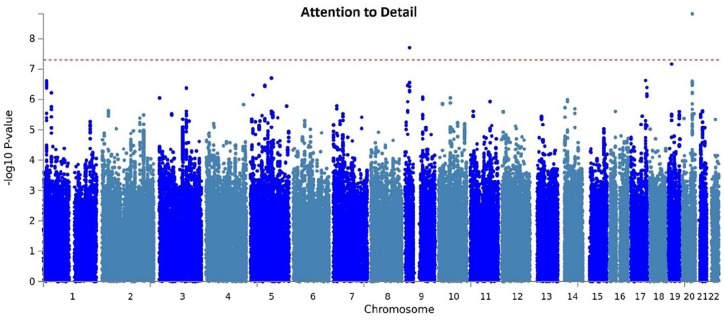
Manhattan plot of the GWAS meta-analysis for ‘attention to detail’. Each dot represents the result of the linear regression analysis for each single variant taking the attention to detail mean score as dependent variable and correcting for age, sex, gender and four MDS components. The x-axis shows the chromosomes and the y-axis shows the −log (two-sided) p-value of the association. The red dotted line indicates the threshold for genome-wide significance.
Figure 2.
Figure 2.
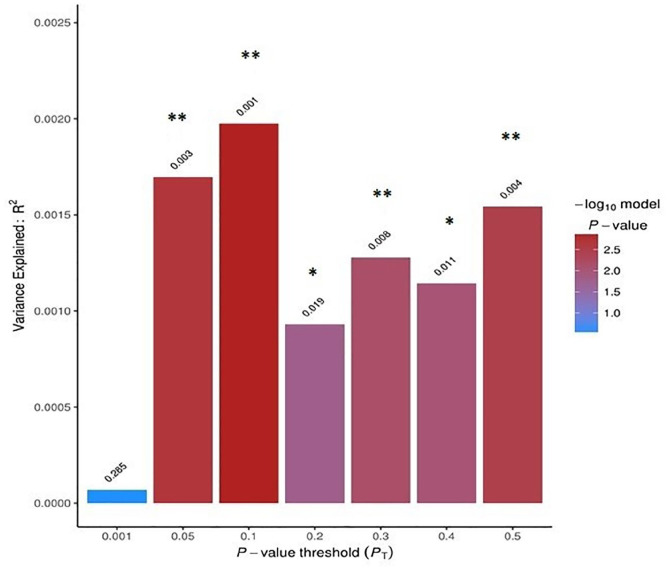
Polygenic risk-based results of ASDs and ‘rigidity’. Polygenic risk score-based results showing the degree of shared genetic aetiology between ASDs (‘base’ phenotype) and ‘rigidity’ (‘target’ phenotype) at seven broad p-value thresholds (PT). The bar plot was created with PRSice1. The x-axis displays the seven p-value thresholds tested and the y-axis displays the variance explained by the genetics of the ‘base’ phenotype in the ‘target’ phenotype. The colours of the bars indicated the −log10 p-value of the association. *p-values < 0.05 after FDR-correction; **p-values < 0.01 after FDR-correction.
Figure 3.
Figure 3.
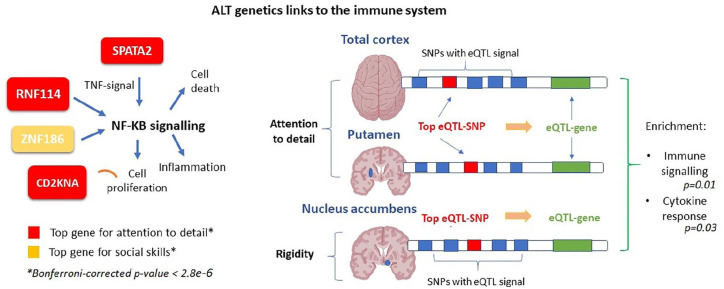
Summary figure of immune-related findings in ALT genetics. Summary figure to illustrate our findings pointing to a relationship between ALTs and the immune system. On the right, results of gene-wide analyses highlight significant ALTs associations with genes that are involved in immune functioning (NF-KB signalling). On the left, results of gene co-expression network analyses show that eQTL-genes, linked to ALTs, for total cortex, putamen and nucleus accumbens are enriched in immune processes (association p-values for the immune pathways are reported). *Genes exceeded the Bonferroni-corrected p-value threshold of 2.8e−6.

References

    1. Atladóttir H. Ó., Pedersen M. G., Thorsen P., Mortensen P. B., Deleuran B., Eaton W. W., Parner E. T. (2009). Association of family history of autoimmune diseases and autism spectrum disorders. Pediatrics, 124(2), 687–694. - PubMed
    1. The Autism Spectrum Disorders Working Group of The Psychiatric Genomics Consortium. (2017). Meta-analysis of GWAS of over 16,000 individuals with autism spectrum disorder highlights a novel locus at 10q24.32 and a significant overlap with schizophrenia. Molecular Autism, 8, 21. - PMC - PubMed
    1. Baron-Cohen S., Wheelwright S., Skinner R., Martin J., Clubley E. (2001). The autism-spectrum quotient (AQ): Evidence from Asperger syndrome/high-functioning autism, males and females, scientists and mathematicians. Journal of Autism and Developmental Disorders, 31(1), 5–17. - PubMed
    1. Bijlmakers M.-J. J., Kanneganti S. K., Barker J. N., Trembath R. C., Capon F. (2011). Functional analysis of the RNF114 psoriasis susceptibility gene implicates innate immune responses to double-stranded RNA in disease pathogenesis. Human Molecular Genetics, 20(16), 3129–3137. - PMC - PubMed
    1. Billstedt E., Gillberg I. C., Gillberg C. (2011). Aspects of quality of life in adults diagnosed with autism in childhood: A population-based study. Autism, 15(1), 7–20. - PubMed

Publication types