


Serum surfactant protein D in COVID-19 is elevated and correlated with disease severity
- PMID: 34344306
- PMCID: PMC8329621
- DOI: 10.1186/s12879-021-06447-3
Serum surfactant protein D in COVID-19 is elevated and correlated with disease severity
Abstract
Background: The serum surfactant protein D (SP-D) level is suggested to be a useful biomarker for acute lung injuries and acute respiratory distress syndrome. Whether the serum SP-D level could identify the severity of coronavirus disease 2019 (COVID-19) in the early stage has not been elucidated.
Methods: We performed an observational study on 39 laboratory-confirmed COVID-19 patients from The Fourth People's Hospital of Yiyang, Hunan, China. Receiver operating characteristic (ROC) curve analysis, correlation analysis, and multivariate logistic regression model analysis were performed.
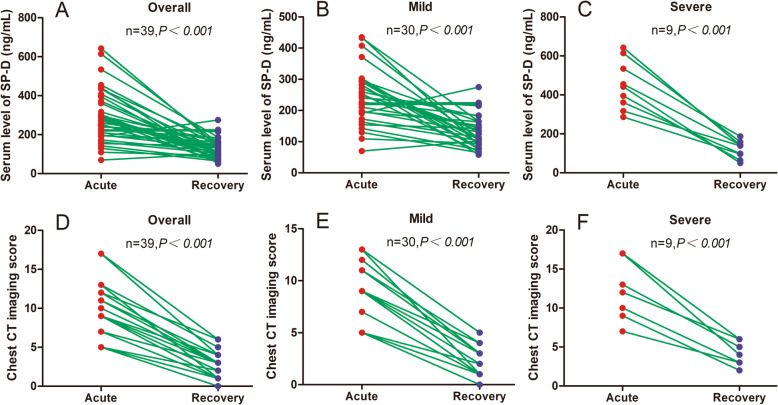
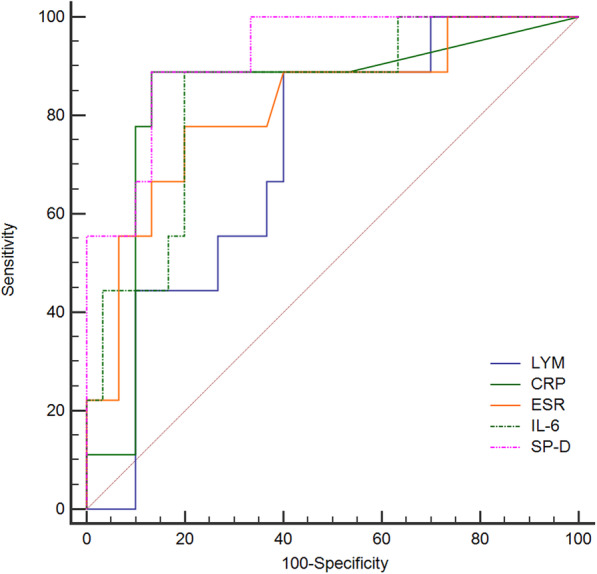
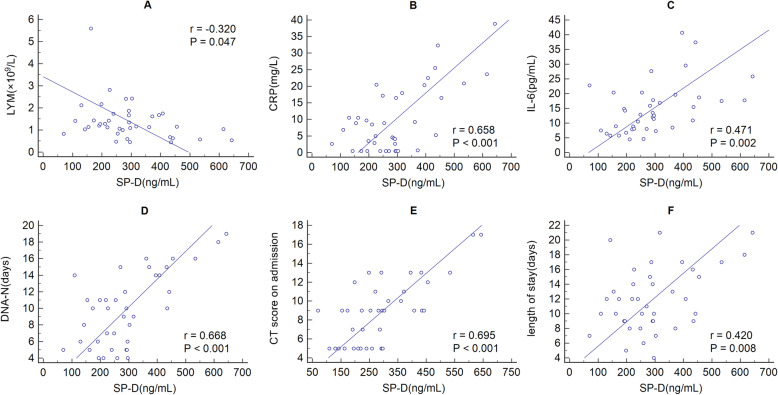
Results: In the acute phase, the serum levels of SP-D were elevated significantly in severe COVID-19 patients than in mild cases (mean value ± standard deviation (SD), 449.7 ± 125.8 vs 245.9 ± 90.0 ng/mL, P<0.001), while the serum levels of SP-D in the recovery period were decreased dramatically than that in the acute phase (mean value ± SD, 129.5 ± 51.7 vs 292.9 ± 130.7 ng/ml, P<0.001), and so were for the stratified patients. The chest CT imaging scores were considerably higher in the severe group compared with those in the mild group (median value, 10.0 vs 9.0, P = 0.011), while markedly lower in the recovery period than those in the acute phase (median value, 2.0 vs 9.0, P<0.001), and so were for the stratified patients. ROC curve analysis revealed that areas under the curve of lymphocyte counts (LYM), C-reaction protein (CRP), erythrocyte sedimentation rate (ESR), interleukin-6 (IL-6), and SP-D for severe COVID-19 were 0.719, 0.833, 0.817, 0.837, and 0.922, respectively. Correlation analysis showed that the SP-D levels were negatively correlated with LYM (r = - 0.320, P = 0.047), while positively correlated with CRP (r = 0.658, P<0.001), IL-6 (r = 0.471, P = 0.002), the duration of nucleic acid of throat swab turning negative (r = 0.668, P<0.001), chest CT imaging score on admission (r = 0.695, P<0.001) and length of stay (r = 0.420, P = 0.008). Multivariate logistic regression model analysis showed that age (P = 0.041, OR = 1.093) and SP-D (P = 0.008, OR = 1.018) were risk factors for severe COVID-19.
Conclusions: Elevated serum SP-D level was a potential biomarker for the severity of COVID-19; this may be useful in identifying patients whose condition worsens at an early stage.
Keywords: Coronavirus disease 2019; Disease severity stratification; Length of stay; Recovery phase; Surfactant protein D.
© 2021. The Author(s).
Conflict of interest statement
The authors declare no conflicts of interest.
Figures
References
-
- Chen N, Zhou M, Dong X, Qu J, Gong F, Han Y, Qiu Y, Wang J, Liu Y, Wei Y, Xia J', Yu T, Zhang X, Zhang L. Epidemiological and clinical characteristics of 99 cases of 2019 novel coronavirus pneumonia in Wuhan, China: a descriptive study. Lancet. 2020;395(10223):507–513. doi: 10.1016/S0140-6736(20)30211-7. - DOI - PMC - PubMed
-
- Johns Hopkins University. Coronavirus Resource Center. https://coronavirus.jhu.edu/map.html. Accessed 1 July 2021.
-
- Huang C, Wang Y, Li X, Ren L, Zhao J, Hu Y, Zhang L, Fan G, Xu J, Gu X, Cheng Z, Yu T, Xia J, Wei Y, Wu W, Xie X, Yin W, Li H, Liu M, Xiao Y, Gao H, Guo L, Xie J, Wang G, Jiang R, Gao Z, Jin Q, Wang J, Cao B. Clinical features of patients infected with 2019 novel coronavirus in Wuhan. China Lancet. 2020;395(10223):497–506. doi: 10.1016/S0140-6736(20)30183-5. - DOI - PMC - PubMed
Publication types
MeSH terms
Substances
Grants and funding
LinkOut - more resources
Full Text Sources
Medical
Research Materials
Miscellaneous
