


Mental health consequences during alerting situations and recovering to a new normal of coronavirus epidemic in 2019: a cross-sectional study based on the affected population
- PMID: 34344342
- PMCID: PMC8330179
- DOI: 10.1186/s12889-021-11550-w
Mental health consequences during alerting situations and recovering to a new normal of coronavirus epidemic in 2019: a cross-sectional study based on the affected population
Abstract
Background: As a major virus outbreak in the twenty-first century, the coronavirus disease 2019 (COVID-19) pandemic has caused unprecedented hazards to mental health globally.
Methods: We performed a cross-sectional study based on the results of an online survey. The survey was conducted 1 month after the outbreak (February 18-29, 2020) and repeated at the time of resuming activity (April 8-14, 2020). The 15-item Death Anxiety Scale (T-DAS) was used to assess the degree of death anxiety, and the Chinese version of PTSD checklist-civilian version (PCL-C), for PTSD symptom clusters. Through convenient sampling, a total of 7678 cases were collected.
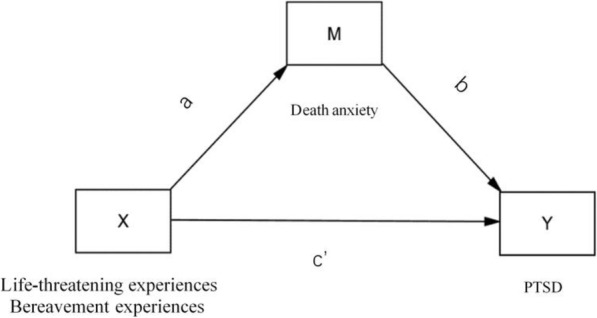
Results: Our findings showed that even after the lockdown was lifted, the prevalence of the symptoms of post-traumatic stress disorder (PTSD) and death anxiety remained significantly high in the general population affected by the outbreak. Regression model analysis showed that PTSD was significantly associated with age > 50 years, contact history/living community, poor health status of participants, past traumatic experience (PTE), and medical occupation. Moreover, death anxiety mediated the relationship between life-threatening PTE and PTSD, indicating that reducing death anxiety could buffer the negative effects of PTE on PTSD.
Conclusions: Despite the lifting of the lockdown, long-term adverse psychological effects remain in the affected general population. The management of mental health after major public health events is important, and high-risk groups such as the elderly and healthcare workers should receive targeted interventions. In addition, the study suggests that methods for alleviating death anxiety must be included in plans to manage the psychological impact of public health emergencies.
Keywords: COVID-19; Death anxiety; Mental; PTSD; Psychological.
© 2021. The Author(s).
Conflict of interest statement
The authors declare that they have no competing interests.
Figures
References
-
- Mahase E. China coronavirus: WHO declares international emergency as death toll exceeds 200. BMJ (Clinical research ed) 2020;368:m408. - PubMed
-
- Salari N, Hosseinian-Far A, Jalali R, Vaisi-Raygani A, Rasoulpoor S, Mohammadi M, Rasoulpoor S, Khaledi-Paveh B. Prevalence of stress, anxiety, depression among the general population during the COVID-19 pandemic: a systematic review and meta-analysis. Glob Health. 2020;16(1):57. doi: 10.1186/s12992-020-00589-w. - DOI - PMC - PubMed
-
- Wu P, Fang YY, Guan ZQ, Fan B, Kong JH, Yao ZL, Liu X, Fuller CJ, Susser E, Lu J, Hoven CW. The psychological impact of the SARS epidemic on hospital employees in China: exposure, risk perception, and altruistic acceptance of risk. Can J Psychiatry. 2009;54(5):302–311. doi: 10.1177/070674370905400504. - DOI - PMC - PubMed
Publication types
MeSH terms
Grants and funding
LinkOut - more resources
Full Text Sources
Medical
Research Materials
Miscellaneous
