Generalizability of Polygenic Risk Scores for Breast Cancer Among Women With European, African, and Latinx Ancestry
- PMID: 34347061
- PMCID: PMC8339934
- DOI: 10.1001/jamanetworkopen.2021.19084
Generalizability of Polygenic Risk Scores for Breast Cancer Among Women With European, African, and Latinx Ancestry
Abstract
Importance: Multiple polygenic risk scores (PRSs) for breast cancer have been developed from large research consortia; however, their generalizability to diverse clinical settings is unknown.
Objective: To examine the performance of previously developed breast cancer PRSs in a clinical setting for women of European, African, and Latinx ancestry.
Design, setting, and participants: This cohort study using the Electronic Medical Records and Genomics (eMERGE) network data set included 39 591 women from 9 contributing medical centers in the US that had electronic medical records (EMR) linked to genotype data. Breast cancer cases and controls were identified through a validated EMR phenotyping algorithm.
Main outcomes and measures: Multivariable logistic regression was used to assess the association between breast cancer risk and 7 previously developed PRSs, adjusting for age, study site, breast cancer family history, and first 3 ancestry informative principal components.
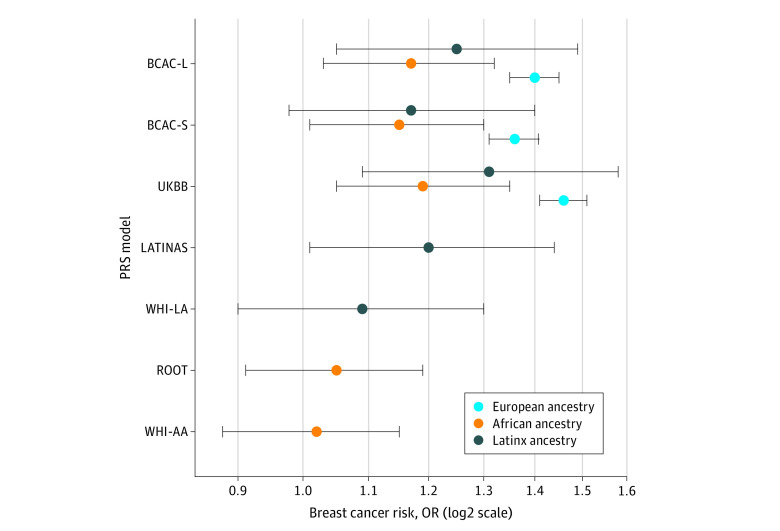
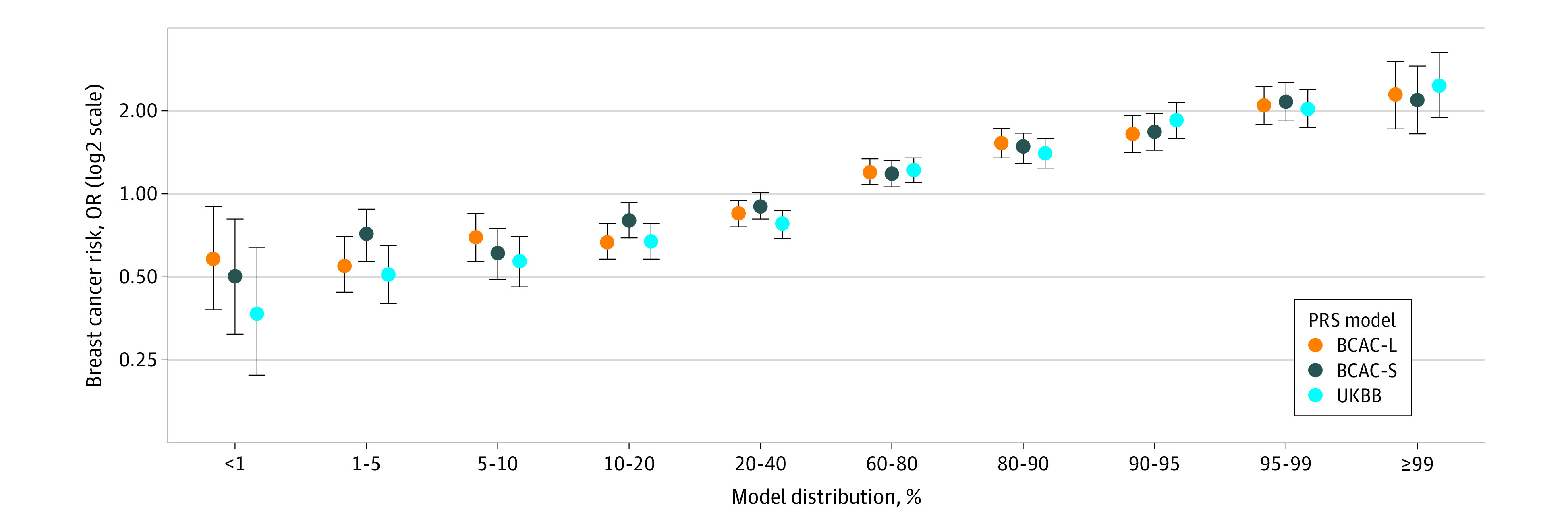
Results: This study included 39 591 women: 33 594 with European, 3801 with African, and 2196 with Latinx ancestry. The mean (SD) age at breast cancer diagnosis was 60.7 (13.0), 58.8 (12.5), and 60.1 (13.0) years for women with European, African, and Latinx ancestry, respectively. PRSs derived from women with European ancestry were associated with breast cancer risk in women with European ancestry (highest odds ratio [OR] per 1-SD increase, 1.46; 95% CI, 1.41-1.51), women with Latinx ancestry (highest OR, 1.31; 95% CI, 1.09-1.58), and women with African ancestry (OR, 1.19; 95% CI, 1.05-1.35). For women with European ancestry, this association with breast cancer risk was largest in the extremes of the PRS distribution, with ORs ranging from 2.19 (95% CI, 1.84-2.53) to 2.48 (95% CI, 1.89-3.25) for the 3 different PRSs examined for those in the highest 1% of the PRS compared with those in the middle quantile. Among women with Latinx and African ancestries at the extremes of the PRS distribution, there were no statistically significant associations.
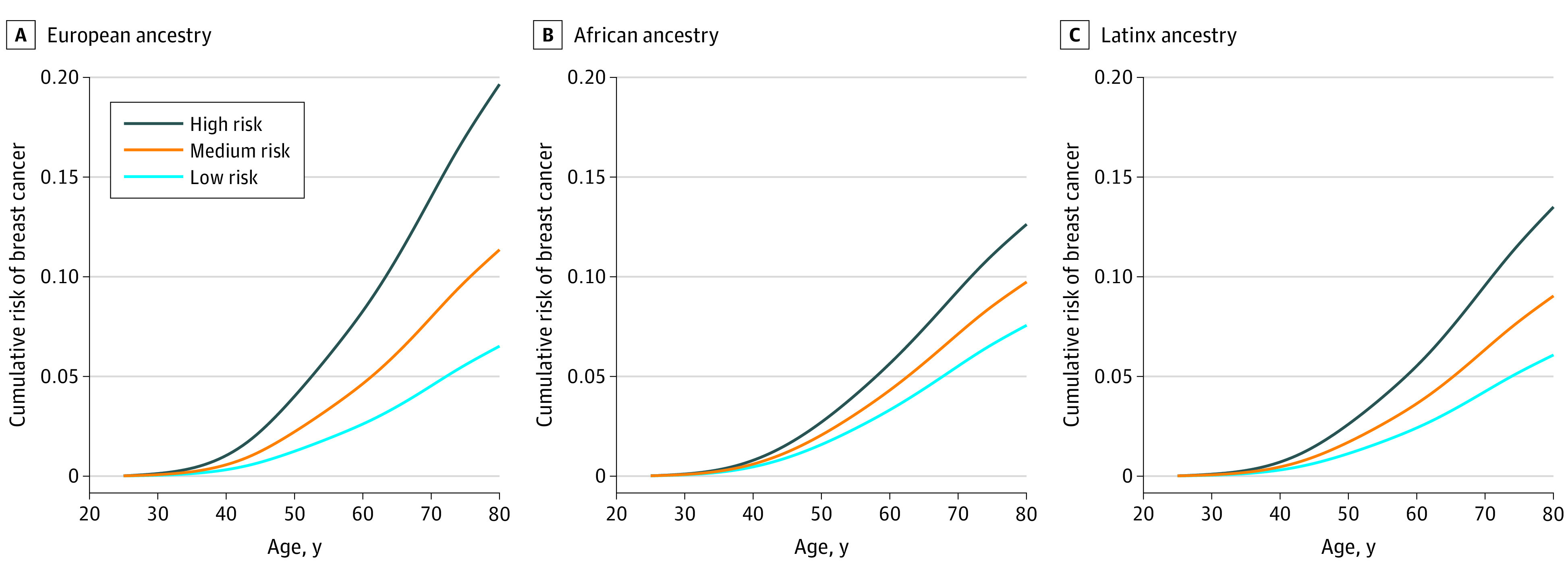
Conclusions and relevance: This cohort study found that PRS models derived from women with European ancestry for breast cancer risk generalized well for women with European, Latinx, and African ancestries across different clinical settings, although the effect sizes for women with African ancestry were smaller, likely because of differences in risk allele frequencies and linkage disequilibrium patterns. These results highlight the need to improve representation of diverse population groups, particularly women with African ancestry, in genomic research cohorts.
Conflict of interest statement
Figures
Comment in
-
Polygenic Risk Scores for Breast Cancer-Can They Deliver on the Promise of Precision Medicine?JAMA Netw Open. 2021 Aug 2;4(8):e2119333. doi: 10.1001/jamanetworkopen.2021.19333. JAMA Netw Open. 2021. PMID: 34347063 No abstract available.
References
Publication types
MeSH terms
Grants and funding
LinkOut - more resources
Full Text Sources
Medical