


The Persistence of the Impact of COVID-19-Related Distress, Mood Inertia, and Loneliness on Mental Health During a Postlockdown Period in Germany: An Ecological Momentary Assessment Study
- PMID: 34347622
- PMCID: PMC8396535
- DOI: 10.2196/29419
The Persistence of the Impact of COVID-19-Related Distress, Mood Inertia, and Loneliness on Mental Health During a Postlockdown Period in Germany: An Ecological Momentary Assessment Study
Abstract
Background: The first wave of the COVID-19 pandemic in early 2020 increased mental health problems globally. However, little is known about mental health problems during a low-incidence period of the pandemic without strict public health measures.
Objective: We aim to investigate whether COVID-19-related risk factors for mental health problems persist beyond lockdown measures. We targeted a vulnerable population that is at risk of developing low mental health and assessed their daily dynamics of mood and emotion regulation after a strict lockdown.
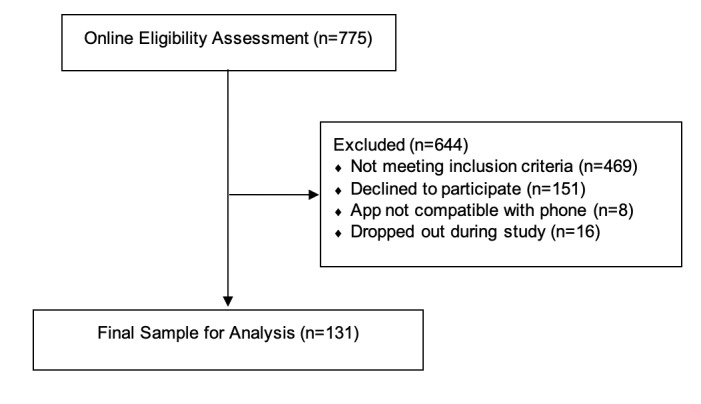
Methods: During a postlockdown period in Germany (between August 8, 2020, and November 1, 2020), we conducted an ecological momentary assessment with 131 participants who experienced at least mild COVID-19-related distress and loneliness. To estimate negative mood inertia, we built a lag-1 three-level autoregressive model.
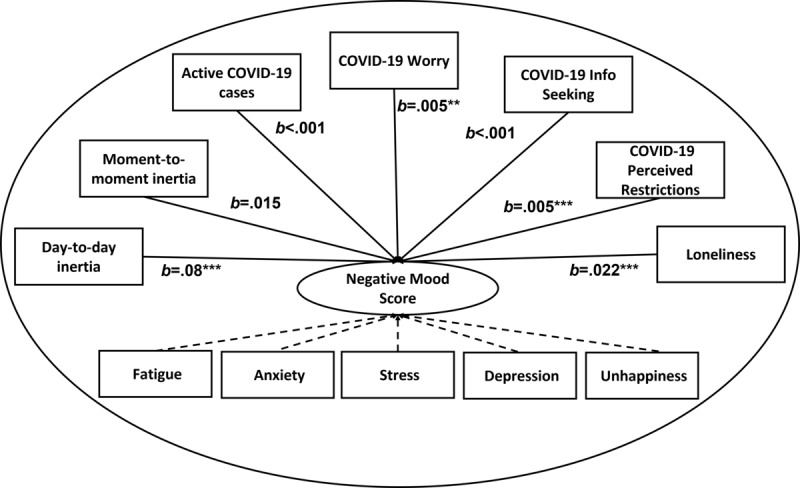
Results: We found that information exposure and active daily COVID-19 cases did not have an impact on negative mood amid a postlockdown period. However, there was a day-to-day carryover effect of negative mood. In addition, worrying about COVID-19, feeling restricted by COVID-19, and feeling lonely increased negative mood.
Conclusions: The mental health of a vulnerable population is still challenged by COVID-19-related stressors after the lifting of a strict lockdown. This study highlights the need to protect mental health during postpandemic periods.
Keywords: COVID-19; ecological momentary assessment; epidemics; low incidence and restrictions; outbreaks; pandemics; psychological responses and emotional well-being; risk and protective factors.
©Matthias Haucke, Shuyan Liu, Stephan Heinzel. Originally published in JMIR Mental Health (https://mental.jmir.org), 26.08.2021.
Conflict of interest statement
Conflicts of Interest: None declared.
Figures
References
-
- Jacobson NC, Lekkas D, Price G, Heinz MV, Song M, O'Malley AJ, Barr PJ. Flattening the Mental Health Curve: COVID-19 Stay-at-Home Orders Are Associated With Alterations in Mental Health Search Behavior in the United States. JMIR Ment Health. 2020 Jun 01;7(6):e19347. doi: 10.2196/19347. https://mental.jmir.org/2020/6/e19347/ - DOI - PMC - PubMed
-
- Nelson BW, Pettitt A, Flannery JE, Allen NB. Rapid assessment of psychological and epidemiological correlates of COVID-19 concern, financial strain, and health-related behavior change in a large online sample. PLoS One. 2020 Nov 11;15(11):e0241990. doi: 10.1371/journal.pone.0241990. https://dx.plos.org/10.1371/journal.pone.0241990 - DOI - PMC - PubMed
-
- Cao W, Fang Z, Hou G, Han M, Xu X, Dong J, Zheng J. The psychological impact of the COVID-19 epidemic on college students in China. Psychiatry Res. 2020 May;287:112934. doi: 10.1016/j.psychres.2020.112934. http://europepmc.org/abstract/MED/32229390 - DOI - PMC - PubMed
-
- Saha K, Torous J, Caine ED, De Choudhury M. Psychosocial Effects of the COVID-19 Pandemic: Large-scale Quasi-Experimental Study on Social Media. J Med Internet Res. 2020 Nov 24;22(11):e22600. doi: 10.2196/22600. https://www.jmir.org/2020/11/e22600/ - DOI - PMC - PubMed
LinkOut - more resources
Full Text Sources
