Review
. 2021 Jul 17:14:17562864211031100.
doi: 10.1177/17562864211031100. eCollection 2021.

Review of the treatment options for epilepsy in tuberous sclerosis complex: towards precision medicine

Affiliations
Review

Review of the treatment options for epilepsy in tuberous sclerosis complex: towards precision medicine

Susanne Schubert-Bast et al. Ther Adv Neurol Disord. .

Abstract

Tuberous sclerosis complex (TSC) is a rare genetic disorder caused by mutations in the TSC1 or TSC2 genes, which encode proteins that antagonise the mammalian isoform of the target of rapamycin complex 1 (mTORC1) - a key mediator of cell growth and metabolism. TSC is characterised by the development of benign tumours in multiple organs, together with neurological manifestations including epilepsy and TSC-associated neuropsychiatric disorders (TAND). Epilepsy occurs frequently and is associated with significant morbidity and mortality; however, the management is challenging due to the intractable nature of the seizures. Preventative epilepsy treatment is a key aim, especially as patients with epilepsy may be at a higher risk of developing severe cognitive and behavioural impairment. Vigabatrin given preventatively reduces the risk and severity of epilepsy although the benefits for TAND are inconclusive. These promising results could pave the way for evaluating other treatments in a preventative capacity, especially those that may address the underlying pathophysiology of TSC, including everolimus, cannabidiol and the ketogenic diet (KD). Everolimus is an mTOR inhibitor approved for the adjunctive treatment of refractory TSC-associated seizures that has demonstrated significant reductions in seizure frequency compared with placebo, improvements that were sustained after 2 years of treatment. Highly purified cannabidiol, recently approved in the US as Epidiolex® for TSC-associated seizures in patients ⩾1 years of age, and the KD, may also participate in the regulation of the mTOR pathway. This review focusses on the pivotal clinical evidence surrounding these potential targeted therapies that may form the foundation of precision medicine for TSC-associated epilepsy, as well as other current treatments including anti-seizure drugs, vagus nerve stimulation and surgery. New future therapies are also discussed, together with the potential for preventative treatment with targeted therapies. Due to advances in understanding the molecular genetics and pathophysiology, TSC represents a prototypic clinical syndrome for studying epileptogenesis and the impact of precision medicine.

Keywords: Cannabidiol; epilepsy; epileptogenesis; everolimus; ketogenic diet; mTORC1; tuberous sclerosis complex; TSC-associated neuropsychiatric disorders.


Conflict of interest statement

Conflict of interest statement: SS-B reports personal fees from Eisai, Desitin Pharma, GW Pharmaceuticals, LivaNova, UCB Pharma and Zogenix. AS reports personal fees and grants from Arvelle Therapeutics, Desitin Arzneimittel, Eisai, GW Pharmaceuticals, LivaNova, Marinus Pharmaceuticals, Medtronic, UCB Pharma and Zogenix.

Figures
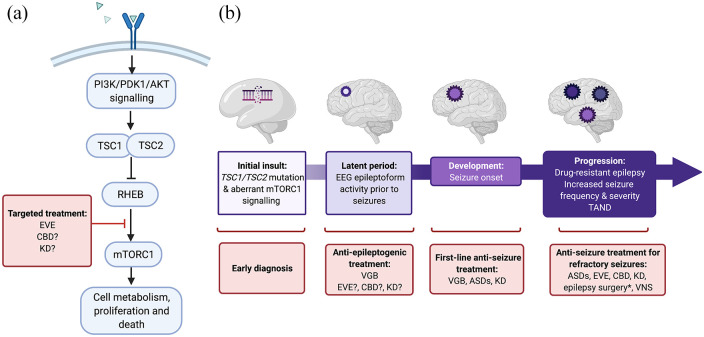
Figure 1.
Figure 1.
Simplified schematic of (a) targeted treatment in the mTOR pathway (b) the concept of epileptogenesis and the potential for early intervention in the treatment of TSC. Epileptogenesis describes the complex process by which the normal brain undergoes molecular, structural and functional changes that result in abnormal neuronal activity that promotes seizures (Jozwiak et al., 2020); it encompasses the evolution from the initial insult (in the case of TSC, mutation of the TSC1 or TSC2 gene), through what is known as a ‘latent period’ that occurs before the onset of seizures, to the development and progression of seizures. *Epilepsy surgery is indicated for carefully selected patients that underwent presurgical diagnostics; ? = possible, being/to be investigated. Created with BioRender.com. AKT, protein kinase B; ASD, anti-seizure drugs; CBD, cannabidiol; EEG, electroencephalogram; EVE, everolimus; KD, ketogenic diet, including the medium-chain triglyceride (MCT) KD; mTOR, mammalian target of rapamycin; mTORC1, mammalian/mechanistic target of rapamycin complex 1; PDK1, phosphoinositide-dependent protein kinase-1; PI3K, phosphoinositide 3-kinase; RHEB, Ras homolog enriched in brain; TAND, TSC-associated neuropsychiatric disorders; TSC, tuberous sclerosis complex; TSC1/TSC2, hamartin-tuberin complex; VGB, vigabatrin; VNS, vagus nerve stimulation.
Figure 2.
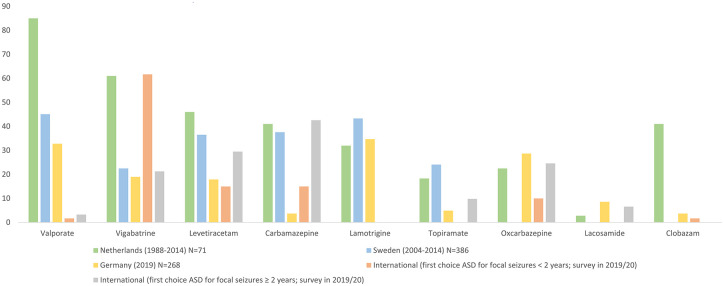
Figure 2.
ASD treatment patterns in TSC patients. Data from Overwater et al. 2015 (Netherlands), Welin et al. 2017 (Sweden), Strzelczyk et al. 2021 (Germany) and Słowińska et al. 2020 (International).,,, ASD, anti-seizure drugs; TSC, tuberous sclerosis complex.
Figure 3.
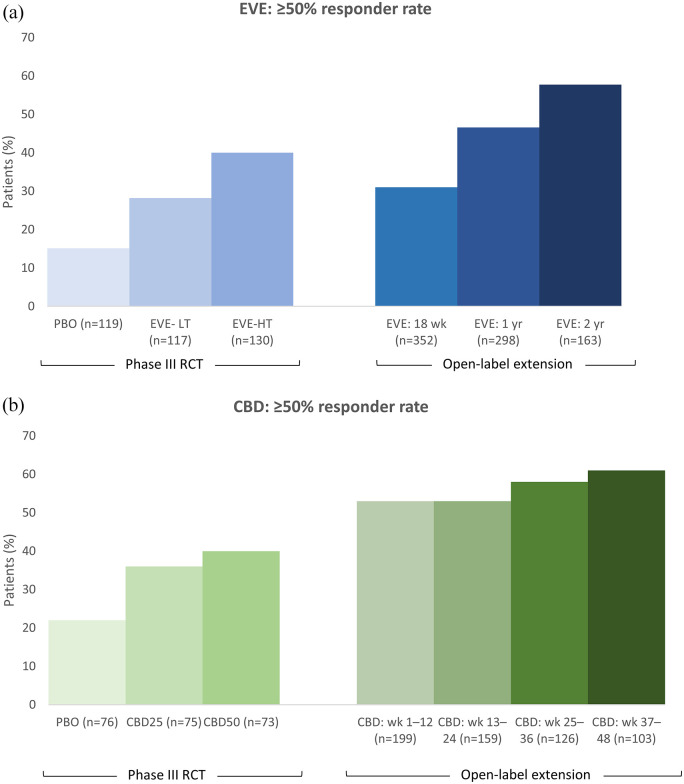
Figure 3.
Responder rates for (a) EVE and (b) CBD from the pivotal RCTs and OLE studies for TSC-associated epilepsy. There are no head-to-head trials of EVE versus CBD, nor any published indirect comparisons. Therefore, any comparisons of the efficacy of the two treatments should be made with caution due to differences in baseline patient demographics and clinical characteristics in the trial populations, and a difference in the placebo effect. CBD, cannabidiol; CBD25, CBD 25 mg/kg/day; CBD50, CBD 50 mg/kg/day; EVE, everolimus; HT, high trough (range 9–15 ng/ml); LT, low trough (range 3–7 ng/ml); OLE, open-label extension trial; RCT, randomised controlled trial; wk, week; yr, year. The recommended dosage in the OLE trial for EVE was a target trough concentration of 3–15 ng/ml (median dose intensity: 6.76 mg/m2/day [range, 1.1–27.8]) and for CBD it was 25 mg/kg/day with titration up to 50 mg/kg/day (mean modal dose: 27 mg/kg/day).
Figure 4.
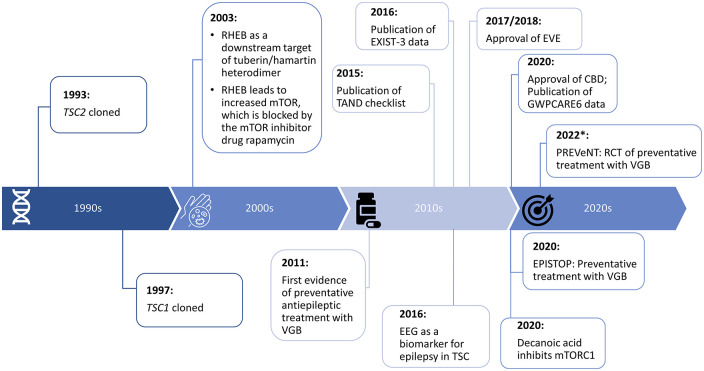
Figure 4.
Key milestones towards precision medicine for the amelioration and prevention of TSC-associated epilepsy and TAND. *PREVeNT; Estimated primary completion date of May 2022, and study completion date of December 2022. CBD, cannabidiol; EVE, everolimus; RHEB, Ras homolog enriched in brain; mTOR, mammalian/mechanistic target of rapamycin; RCT, randomised controlled trial; TAND, TSC-associated neuropsychiatric disorders; TSC, tuberous sclerosis complex; VGB, vigabatrin.

References

    1. Laplante M, Sabatini DM. mTOR signaling at a glance. J Cell Sci 2009; 122: 3589. - PMC - PubMed
    1. Saxton RA, Sabatini DM. mTOR signaling in growth, metabolism, and disease. Cell 2017; 168: 960–976. - PMC - PubMed
    1. Napolioni V, Curatolo P. Genetics and molecular biology of tuberous sclerosis complex. Curr Genomics 2008; 9: 475–487. - PMC - PubMed
    1. Jóźwiak S, Kotulska K, Wong M, et al.. Modifying genetic epilepsies – results from studies on tuberous sclerosis complex. Neuropharmacology 2020; 166: 107908. - PubMed
    1. Zöllner JP, Franz DN, Hertzberg C, et al.. A systematic review on the burden of illness in individuals with tuberous sclerosis complex (TSC). Orphanet J Rare Dis 2020; 15: 23. - PMC - PubMed

LinkOut - more resources