. 2021 Jun 3;12(29):9952-9961.
doi: 10.1039/d1sc02199k. eCollection 2021 Jul 28.

An intramolecularly self-templated synthesis of macrocycles: self-filling effects on the formation of prismarenes

Affiliations

An intramolecularly self-templated synthesis of macrocycles: self-filling effects on the formation of prismarenes

Paolo Della Sala et al. Chem Sci. .

Abstract

Ethyl- and propyl-prism[6]arenes are obtained in high yields and in short reaction times, independent of the nature and size of the solvent, in the cyclization of 2,6-dialkoxynaphthalene with paraformaldehyde. PrS[6]Et or PrS[6]nPr adopt, both in solution and in the solid state, a folded cuboid-shaped conformation, in which four inward oriented alkyl chains fill the cavity of the macrocycle. On these bases, we proposed that the cyclization of PrS[6]Et or PrS[6]nPr occurs through an intramolecular thermodynamic self-templating effect. In other words, the self-filling of the internal cavity of PrS[6]Et or PrS[6]nPr stabilizes their cuboid structure, driving the equilibrium toward their formation. Molecular recognition studies, both in solution and in the solid state, show that the introduction of guests into the macrocycle cavity forces the cuboid scaffold to open, through an induced-fit mechanism. An analogous conformational change from a closed to an open state occurs during the endo-cavity complexation process of the pentamer, PrS[5]. These results represent a rare example of a thermodynamically controlled cyclization process driven through an intramolecular self-template effect, which could be exploited in the synthesis of novel macrocycles.


Conflict of interest statement

There are no conflicts to declare.

Figures
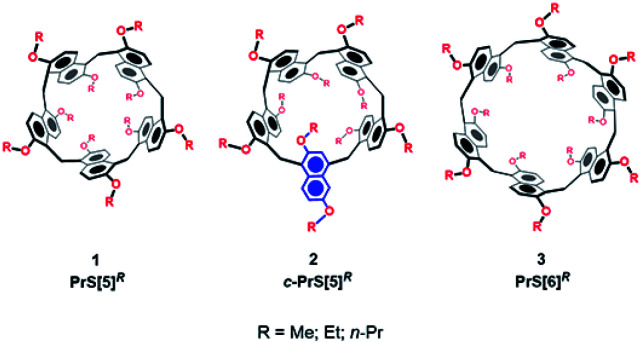
Fig. 1
Fig. 1. The prism[n]arene family.
Scheme 1
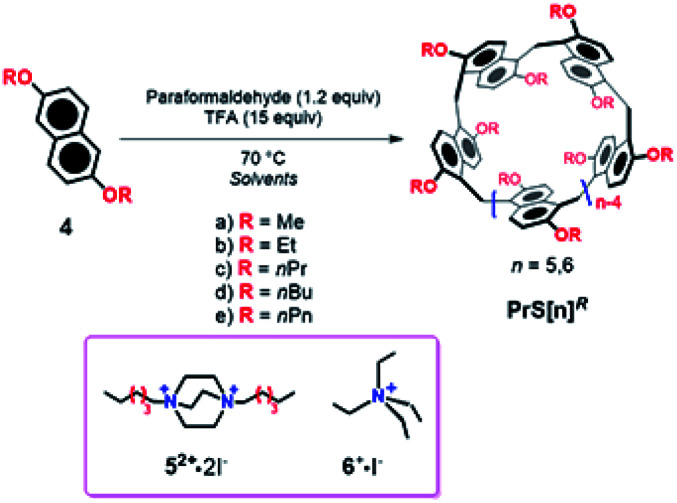
Scheme 1. Synthesis of PrS[n]R prismarenes.
Fig. 2
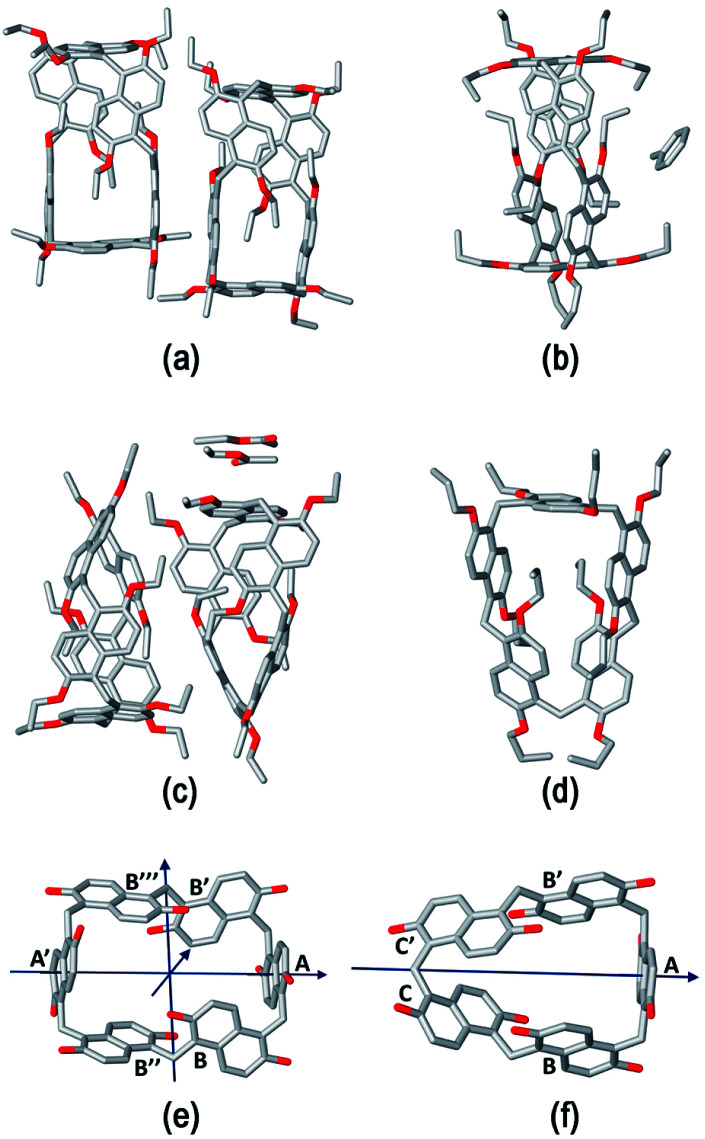
Fig. 2. Stick representation of the asymmetric units of (a) PrS[6]Et, (b) PrS[6]nPr, (c) PrS[5]Et, and (d) PrS[5]nPr. Hydrogen atoms and one orientation of the disordered alkyl groups and a toluene molecule are omitted for clarity. For PrS[6]nPr, the entire molecule generated by a crystallographic two-fold axis is shown. (e) and (f) Stick representation of (e) the D2 symmetric PrS[6]R and (f) the C2 symmetric PrS[5]R scaffolds. The pseudo-two-fold symmetry axes are represented with arrows. For each molecule, the same letter indicates symmetry equivalent naphthalene rings. The alkyl groups are omitted for clarity.
Fig. 3
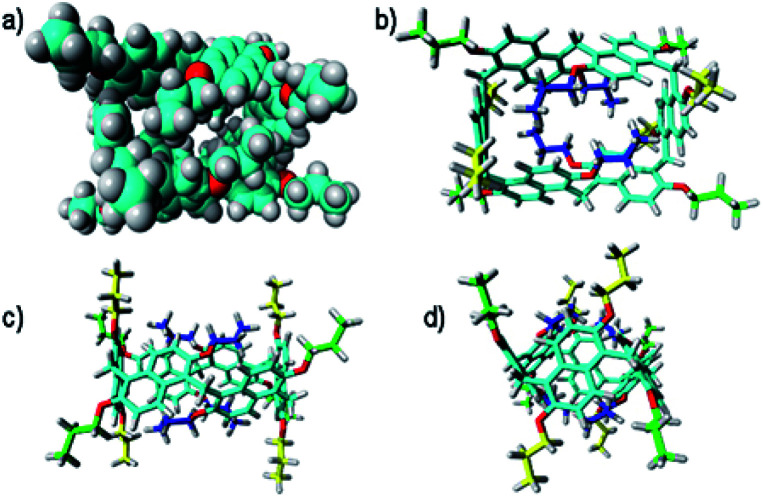
Fig. 3. Different views of the DFT optimized structure of Pr[6]nPr. Top views of the CPK (a) and tube (b) structure. Side views (c) and (d). In blue are the propoxy chains inward oriented and filling the cavity, in green are the propoxy chains outside oriented, and in yellow are the propoxy chains on the parallel naphthalene rings.
Fig. 4
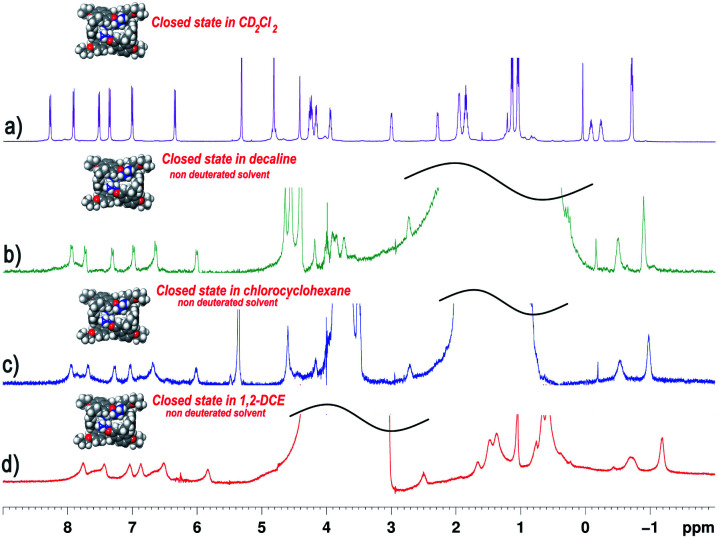
Fig. 4. 1H NMR spectra of Pr[6]nPr in: (a) CD2Cl2 at 243 K (600 MHz); (b) non-deuterated decaline (298 K); (c) non-deuterated chlorocyclohexane (298 K); (d) non-deuterated 1,2-dichloroethane (298 K). The spectra are consistent with the D2 symmetry of the cuboid structure of the prism[6]arene.
Fig. 5
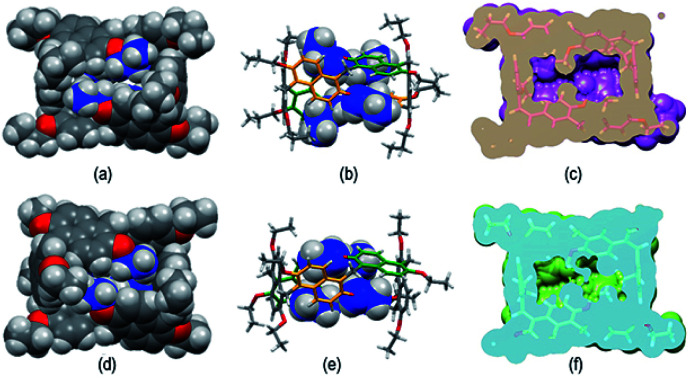
Fig. 5. Self-filling of the cavities of prism[6]arenes as obtained by X-ray structures. (a) and (b) Different views of PrS[6]nPr. (d) and (e) Different views of PrS[6]Et. (c) and (f) Self-filling of the cuboid cavity. Cross sections of the PrS[6]Et (f) and PrS[6]nPr (c) molecules. An enclosed internal cavity was obtained from accessible surface area calculations using a 0.4 Å probe. The free cavity volume is 49 Å3 and 77 Å3 for PrS[6]Et and PrS[6]nPr, respectively.
Scheme 2
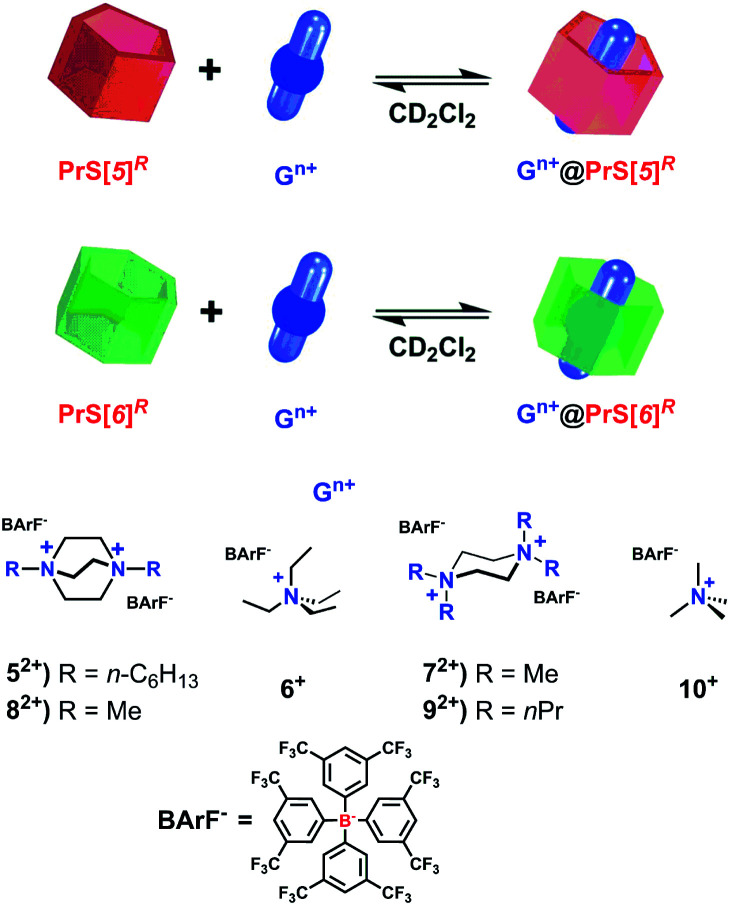
Scheme 2. Schematic complexation equilibrium of PrS[n]R with ammonium guests 52+–10+ as barfate salts.
Fig. 6
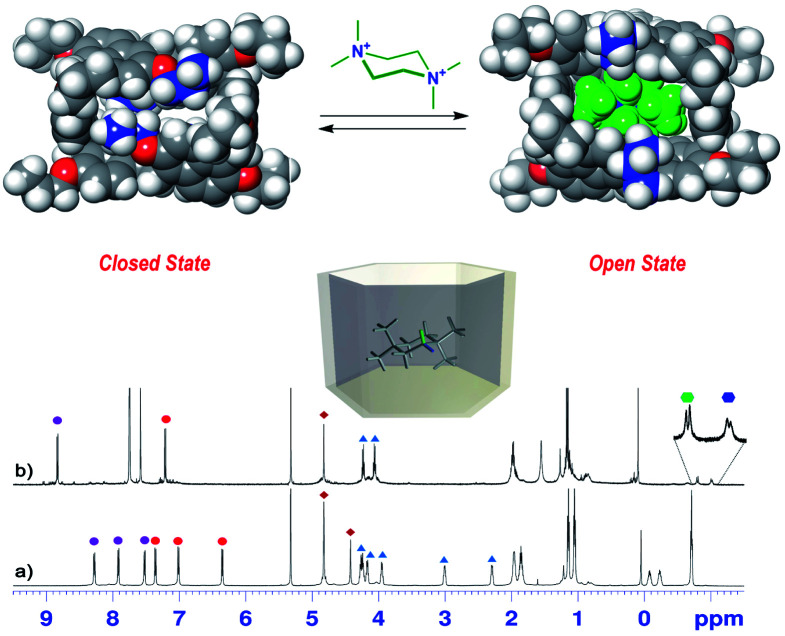
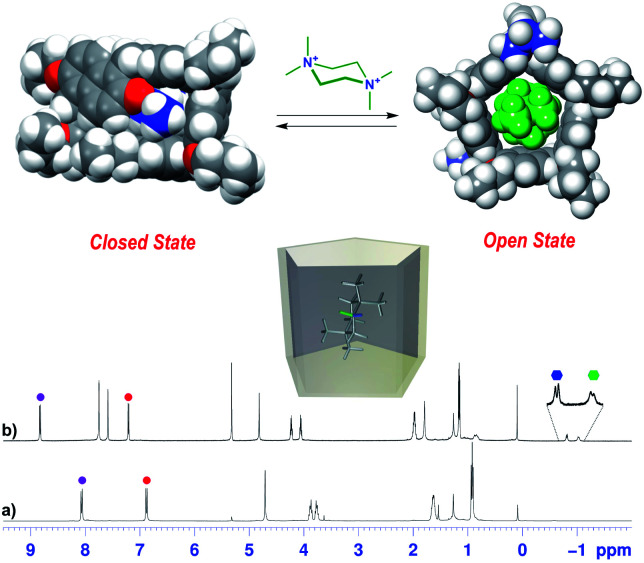
Fig. 6. 1H NMR spectra of (a) PrS[6]nPr in CD2Cl2 at 243 K (600 MHz) and (b) a 1 : 1 mixture of PrS[6]nPr and 72+·(BArF)2 (3 mM). The correspondence between the marked signals (red and purple circles for aromatic H-atoms and blue triangles for OCH2 groups) indicates the conformational change from a closed state to an open state upon complexation with 72+. The blue and green hexagons indicate the diastereotopic methylene H atoms of 72+ shielded inside the macrocycle. (Top) DFT optimized structure of PrS[6]nPr in the closed state and of its complex with 72+ (72+@PrS[6]nPr).
Fig. 7
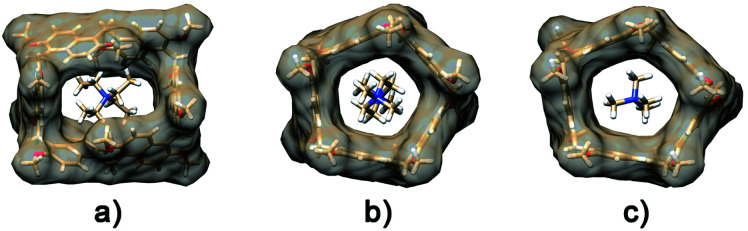
Fig. 7. X-ray structural models of the host–guest complexes: (a) 6+@PrS[6]Me, (b) 72+@PrS[5]Me, and (c) 10+@PrS[5]Me. The transparent van der Waals surface of the host is shown to illustrate the effective prismarene cavities. Counter ions, solvents, and disordered guest atoms are omitted for clarity.
Fig. 8
Fig. 8. 1H NMR spectra of (a) PrS[5]nPr in CD2Cl2 at 298 K (600 MHz) and (b) a 1 : 1 mixture of PrS[5]nPr and 72+·(BArF)2 (3 mM). The circles indicate the signals of aromatic H atoms, while the hexagons indicate the diastereotopic methylene H atoms of 72+ shielded inside the macrocycle. The correspondence between the marked signals (red and purple circles for aromatic H atoms) indicates the conformational change from a closed state to an open state upon complexation with 72+. The blue and green hexagons indicate the diastereotopic methylene H atoms of 72+ shielded inside the macrocycle. (Top) DFT optimized structure of PrS[5]nPr in the closed state and of its complex with 72+ (72+@PrS[5]nPr).

References

    1. Diederich F., Stang P. J. and Tykwinski R. R., Modern Supramolecular Chemistry: Strategies for Macrocycle Synthesis, Wiley-VCH, Weinheim, 2008
    1. Gaeta C. Wang D.-X. Front. Chem. 2020;8:128. doi: 10.3389/fchem.2020.00128. - DOI - PMC - PubMed
    1. Benyus J. M., Biomimicry: Innovation Inspired by Nature, Harper Perennial, 2002
    1. Cram D. J. Angew. Chem., Int. Ed. Engl. 1988;27:1009–1020.
    1. Lehn J. M. Angew. Chem., Int. Ed. Engl. 1988;27:89–112.