


Feasibility of Early Intervention Through Home-Based and Parent-Delivered Infant Massage in Infants at High Risk for Cerebral Palsy
- PMID: 34350144
- PMCID: PMC8328146
- DOI: 10.3389/fped.2021.673956
Feasibility of Early Intervention Through Home-Based and Parent-Delivered Infant Massage in Infants at High Risk for Cerebral Palsy
Abstract
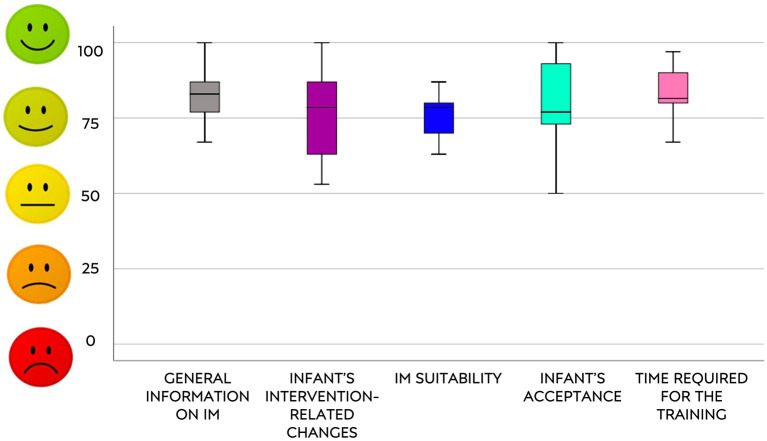
Infant massage (IM) can be considered an early intervention program that leads to the environmental enrichment framework. The effectiveness of IM to promote neurodevelopment in preterm infants has been proved, but studies on infants with early brain damage are still lacking. The main aim of this study was to assess the feasibility, acceptability and usability of IM, carried out by parents at home, on infants at high risk for Cerebral Palsy. An IM daily diary and an ad hoc questionnaire, called Infant Massage Questionnaire Parent-Infant Experiences (IMQPE), were developed. IMQPE consisted of a total of 30 questions, divided into 5 areas. The parents were trained to carry out the IM with a home-based course, conducted by an expert therapist. The intensive IM program was set according to a defined daily length of at least 20 min, with a frequency of at least 5 days per week for a total of 8 weeks. Data collection consisted in the selection of the variables around the characteristics, both of the infants and the mothers, IM dosage and frequency, different body parts of the infants involved and IMQPE scores. Variable selection was carried out by minimizing the Bayesian Information Criteria (BIC) over all possible variable subsets. Nineteen high-risk infants, aged 4.83 ± 1.22 months, received IM at home for 8 weeks. The massage was given by the infants' mothers with a mean daily session dose of 27.79 ± 7.88 min and a total of 21.04 ± 8.49 h. 89.74% and 100% of mothers performed the IM for the minimum daily dosage and the frequency recommended, respectively. All the families filled in the IMQPE, with a Total mean score of 79.59% and of 82.22% in General Information on IM, 76.30% in Infant's intervention-related changes, 76.85% in IM Suitability, 79.07% in Infant's acceptance and 83.52% in Time required for the training. Different best predictors in mothers and in infants have been found. These data provide evidence of the feasibility of performing IM at home on infants at high risk for CP. Study registration: www.clinicaltrial.com (NCT03211533 and NCT03234959).
Keywords: cerebral palsy; early intervention; family-centered intervention; home-based intervention; infant massage.
Copyright © 2021 Menici, Antonelli, Beani, Mattiola, Giampietri, Martini, Rizzi, Cecchi, Cioni, Cioni, Sgandurra and Caretoy-R Consortium.
Conflict of interest statement
The authors declare that the research was conducted in the absence of any commercial or financial relationships that could be construed as a potential conflict of interest.
Figures

References
Associated data
LinkOut - more resources
Full Text Sources
Medical
Miscellaneous
