


Knowledge, Attitude, and Practices Toward SARS-COV-2 Infection in the United Arab Emirates Population: An Online Community-Based Cross-Sectional Survey
- PMID: 34350152
- PMCID: PMC8326444
- DOI: 10.3389/fpubh.2021.687628
Knowledge, Attitude, and Practices Toward SARS-COV-2 Infection in the United Arab Emirates Population: An Online Community-Based Cross-Sectional Survey
Abstract
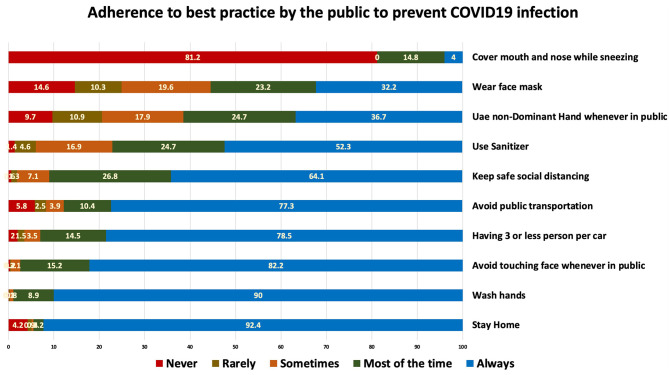
Population's preventive practices and self-isolation is determinantal in the prevention and mitigation. This study explored the adult population's knowledge, attitude, and practice toward COVID-19 in UAE between the 4th and 14th of April 2020. The study was a community-based, cross-sectional study using a self-administered electronic questionnaire covering five different aspects: demographics, knowledge, practice, attitude, source, and trust of information, and a patient health questionnaire (PHQ-2) for depression screening. Results were analyzed using frequencies, cross-tabulation, and regression analysis. A total of 1,867 people responded to the survey. The mean age of participants was 36.0 years S.D. 10.8. Males were 19.3% and female (80.7%). Knowledge was significantly better in people with higher educational levels (B 0.17, P-value < 0.001), good preventive practice (B 0.12, P-value < 0.001), and higher perceived risk scores (B 0.053, P-value = 0.025). The best practice scores were shown by participants with older age (B 0.097, P-value < 0.05), with good knowledge (B 0.086, P-value < 0.05), were of non-UAE nationalities (B -0.08, P-value < 0.05), with jobs that cannot be practiced from home, military and health care employees (B -0.104, P-value < 0.05), had a personal history of contact with COVID-19 patients (B 0.053, P-value < 0.05), higher educational levels (B 0.052, P-value < 0.05), and a positive attitude toward taking a vaccine (B 0.088, P-value < 0.05). Depression risk was significantly higher in men, non-UAE nationals, in those with lower knowledge scores, and younger ages. The most followed practices were staying home, handwashing, avoiding social gatherings, limiting three people per vehicle, and avoiding public transportation. The least practiced measures were covering the face while sneezing or coughing and wearing masks. Although staying home was reported by 92.5% of participants, 22.6% mentioned that they were visited by more than two people and visited others in 18.4% during the last week. Social media was the source of information for 82.1% of the participants and most trusted doctors and healthcare providers. Depression risk was present in 18.9% of the participants, and most respondents (89%) agreed that SARS-COV-2 infection would be finally be successfully controlled. An encouraging finding is the willingness of two-third of the participants (64.5%) to take the COVID-19 vaccine and if it was developed, although it was very early in the pandemic. Only 14.6% said they would not take the vaccine, and 20.9% were not sure. The obtained results on knowledge and practices, although satisfactory, could be insufficient to prevent this pandemic from being contained. Therefore, we recommend the intensification of awareness programs and good practices. In addition, mental health is an area worth further studies.
Keywords: SARS-CoV-2 infection; attitude; knowledge; practices; preventive measures.
Copyright © 2021 Alremeithi, Alghefli, Almadhani and Baynouna AlKetbi.
Conflict of interest statement
The authors declare that the research was conducted in the absence of any commercial or financial relationships that could be construed as a potential conflict of interest.
Figures
References
-
- Wadhwa Paulblakedivyanshi. 2020 Year in Review: The Impact of COVID-19 in 12 Charts (2020).
-
- WHO . Novel Coronavirus (2019-nCoV) Situation Reports. (2021).
-
- WHO . Covid-19-Significantly-Impacts-Health-Services-for-Noncommunicable-Diseases (2020).
MeSH terms
Substances
LinkOut - more resources
Full Text Sources
Medical
Miscellaneous
