


Prevalence and Predictors of Persistence of COVID-19 Symptoms in Older Adults: A Single-Center Study
- PMID: 34352201
- PMCID: PMC8286874
- DOI: 10.1016/j.jamda.2021.07.003
Prevalence and Predictors of Persistence of COVID-19 Symptoms in Older Adults: A Single-Center Study
Abstract
Objectives: Symptom persistence weeks after laboratory-confirmed severe acute respiratory syndrome coronavirus 2 (SARS-CoV-2) clearance is a relatively common long-term complication of Coronavirus disease 2019 (COVID-19). Little is known about this phenomenon in older adults. The present study aimed at determining the prevalence of persistent symptoms among older COVID-19 survivors and identifying symptom patterns.
Design: Cross-sectional study.
Setting and participants: We analyzed data collected in people 65 years and older (n = 165) who were hospitalized for COVID-19 and then admitted to the Day Hospital Post-COVID 19 of the Fondazione Policlinico Universitario "Agostino Gemelli" IRCCS (Rome, Italy) between April and December 2020. All patients tested negative for SARS-CoV-2 and met the World Health Organization criteria for quarantine discontinuation.
Measures: Patients were offered multidisciplinary individualized assessments. The persistence of symptoms was evaluated on admission using a standardized questionnaire.
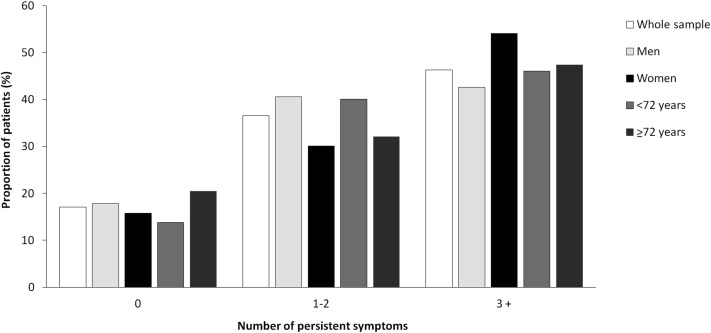
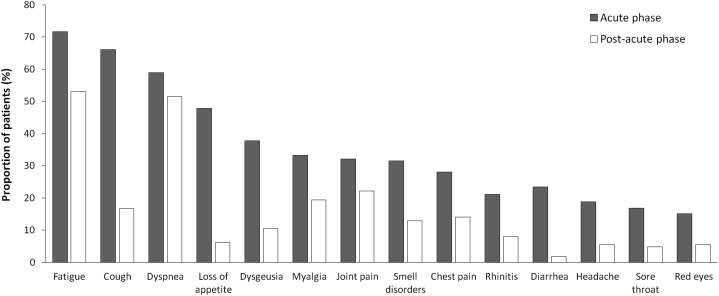
Results: The mean age was 73.1 ± 6.2 years (median 72, interquartile range 27), and 63 (38.4%) were women. The average time elapsed from hospital discharge was 76.8 ± 20.3 days (range 25-109 days). On admission, 137 (83%) patients reported at least 1 persistent symptom. Of these, more than one-third reported 1 or 2 symptoms and 46.3% had 3 or more symptoms. The rate of symptom persistence was not significantly different when patients were stratified according to median age. Compared with those with no persistent symptoms, patients with symptom persistence reported a greater number of symptoms during acute COVID-19 (5.3 ± 3.0 vs 3.3 ± 2.0; P < .001). The most common persistent symptoms were fatigue (53.1%), dyspnea (51.5%), joint pain (22.2%), and cough (16.7%). The likelihood of symptom persistence was higher in those who had experienced fatigue during acute COVID-19.
Conclusions and implications: Persistent symptoms are frequently experienced by older adults who have been hospitalized for COVID-19. Follow-up programs should be implemented to monitor and care for long-term COVID-19-related health issues.
Keywords: COVID-19; SARS-CoV-2; aging; fatigue; geriatrics; long COVID.
Copyright © 2021 AMDA – The Society for Post-Acute and Long-Term Care Medicine. Published by Elsevier Inc. All rights reserved.
Figures
References
-
- Wiersinga W.J., Rhodes A., Cheng A.C. Pathophysiology, transmission, diagnosis, and treatment of Coronavirus Disease 2019 (COVID-19): A review. JAMA. 2020;324:782–793. - PubMed
MeSH terms
LinkOut - more resources
Full Text Sources
Medical
Miscellaneous
