


Discrimination of non-infectious SARS-CoV-2 particles from fomites by viability RT-qPCR
- PMID: 34352235
- PMCID: PMC8327643
- DOI: 10.1016/j.envres.2021.111831
Discrimination of non-infectious SARS-CoV-2 particles from fomites by viability RT-qPCR
Abstract
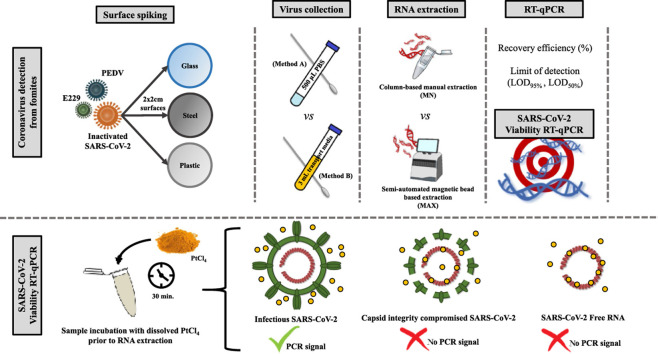
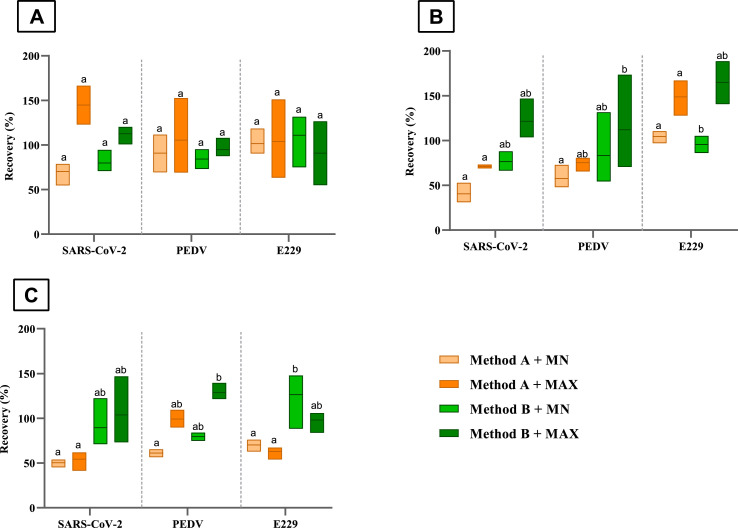
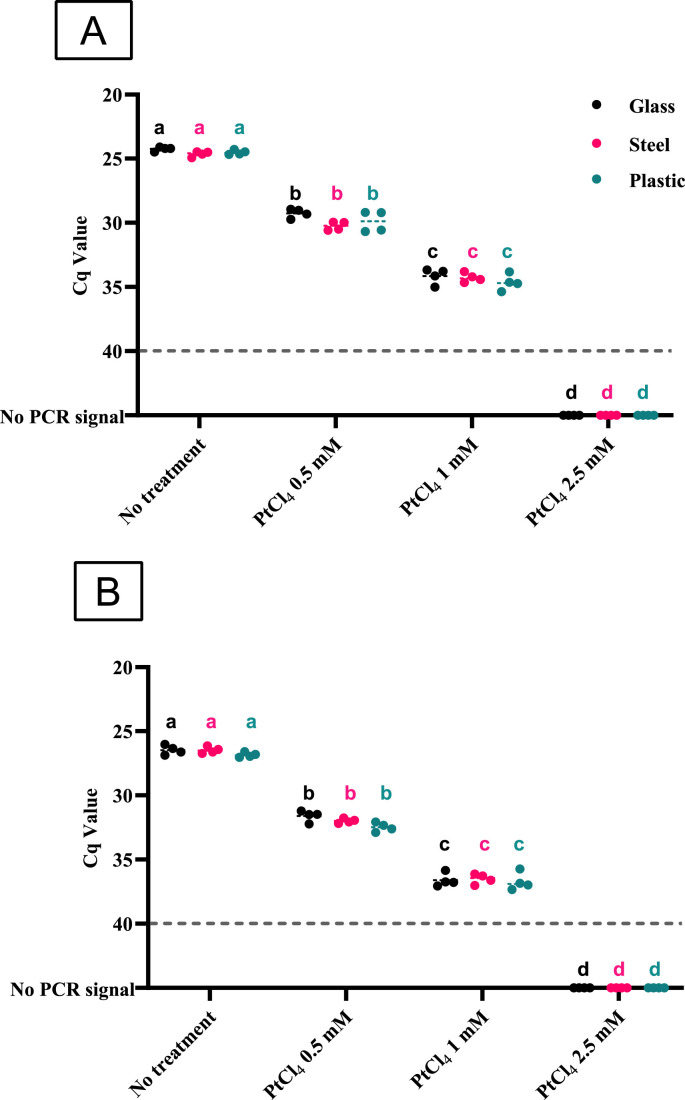
The ongoing coronavirus 2019 (COVID-19) pandemic constitutes a concerning global threat to public health and economy. In the midst of this pandemic scenario, the role of environment-to-human COVID-19 spread is still a matter of debate because mixed results have been reported concerning SARS-CoV-2 stability on high-touch surfaces in real-life scenarios. Up to now, no alternative and accessible procedures for cell culture have been applied to evaluate SARS-CoV-2 infectivity on fomites. Several strategies based on viral capsid integrity have latterly been developed using viability markers to selectively remove false-positive qPCR signals resulting from free nucleic acids and damaged viruses. These have finally allowed an estimation of viral infectivity. The present study aims to provide a rapid molecular-based protocol for detection and quantification of viable SARS-CoV-2 from fomites based on the discrimination of non-infectious SARS-CoV-2 particles by platinum chloride (IV) (PtCl4) viability RT-qPCR. An initial assessment compared two different swabbing procedures to recover inactivated SARS-CoV-2 particles from fomites coupled with two RNA extraction methods. Procedures were validated with human (E229) and porcine (PEDV) coronavirus surrogates, and compared with inactivated SARS-CoV-2 suspensions on glass, steel and plastic surfaces. The viability RT-qPCR efficiently removed the PCR amplification signals from heat and gamma-irradiated inactivated SARS-CoV-2 suspensions that had been collected from specified surfaces. This study proposes a rapid viability RT-qPCR that discriminates non-infectious SARS-CoV-2 particles on surfaces thus helping researchers to better understand the risk of contracting COVID-19 through contact with fomites and to develop more efficient epidemiological measures.
Keywords: COVID-19; Fomites; SARS-CoV-2; Transmission risk; Viability RT-qPCR.
Copyright © 2021 Elsevier Inc. All rights reserved.
Conflict of interest statement
The authors declare that they have no known competing financial interests or personal relationships that could have appeared to influence the work reported in this paper.
Figures
References
-
- Ahmed W., Bertsch P.M., Bibby K., Haramoto E., Hewitt J., Huygens F., Gyawali P., Korajkic A., Riddell S., Sherchan S.P., Simpson S.L., Sirikanchana K., Symonds E.M., Verhagen R., Vasan S.S., Kitajima M., Bivins A. Decay of SARS-CoV-2 and surrogate murine hepatitis virus RNA in untreated wastewater to inform application in wastewater-based epidemiology. Environ. Res. 2020;191 doi: 10.1016/j.envres.2020.110092. - DOI - PMC - PubMed
-
- Ahmed W., Bertsch P.M., Bivins A., Bibby K., Farkas K., Gathercole A., Haramoto E., Gyawali P., Korajkic A., McMinn B.R., Mueller J.F., Simpson S.L., Smith W.J.M., Symonds E.M., Thomas K.V., Verhagen R., Kitajima M. Comparison of virus concentration methods for the RT-qPCR-based recovery of murine hepatitis virus, a surrogate for SARS-CoV-2 from untreated wastewater. Sci. Total Environ. 2020;739 doi: 10.1016/j.scitotenv.2020.139960. - DOI - PMC - PubMed
-
- Ahn J.Y., An S., Sohn Y., Cho Y., Hyun J.H., Baek Y.J., Kim M.H., Jeong S.J., Kim J.H., Ku N.S., Yeom J.S., Smith D.M., Lee H., Yong D., Lee Y.J., Kim J.W., Kim H.R., Hwang J., Choi J.Y. Environmental contamination in the isolation rooms of COVID-19 patients with severe pneumonia requiring mechanical ventilation or high-flow oxygen therapy. J. Hosp. Infect. 2020;106:570–576. doi: 10.1016/j.jhin.2020.08.014. - DOI - PMC - PubMed
-
- Bäuerl C., Randazzo W., Sánchez G., Selma-Royo M., Garcia-Verdevio E., Martínez-Rodríguez L., Parra-Llorca A., Lerin C., Fumadó V., Crovetto F., Crispi F., Pérez-Cano F.J., Rodríguez G., Ruíz-Redondo G., Campoy C., Martínez-Costa C., Collado M.C. SARS-CoV-2 RNA and antibody detection in human milk from a prospective multicenter study in Spain. medRxiv. 2021 doi: 10.1101/2021.05.06.21256766. 2021. 05.06.21256766. - DOI - PMC - PubMed
-
- Ben-Shmuel A., Brosh-Nissimov T., Glinert I., Bar-David E., Sittner A., Poni R., Cohen R., Achdout H., Tamir H., Yahalom-Ronen Y., Politi B., Melamed S., Vitner E., Cherry L., Israeli O., Beth-Din A., Paran N., Israely T., Yitzhaki S., Levy H., Weiss S. Detection and infectivity potential of severe acute respiratory syndrome coronavirus 2 (SARS-CoV-2) environmental contamination in isolation units and quarantine facilities. Clin. Microbiol. Infect. 2020;26:1658–1662. doi: 10.1016/j.cmi.2020.09.004. - DOI - PMC - PubMed
Publication types
MeSH terms
Substances
LinkOut - more resources
Full Text Sources
Medical
Miscellaneous
