Multicenter Study
. 2021 Dec;100(6):1303-1315.
doi: 10.1016/j.kint.2021.07.015. Epub 2021 Aug 3.

A multi-center retrospective cohort study defines the spectrum of kidney pathology in Coronavirus 2019 Disease (COVID-19)

Affiliations
Multicenter Study

A multi-center retrospective cohort study defines the spectrum of kidney pathology in Coronavirus 2019 Disease (COVID-19)

Rebecca M May et al. Kidney Int. 2021 Dec.

Abstract

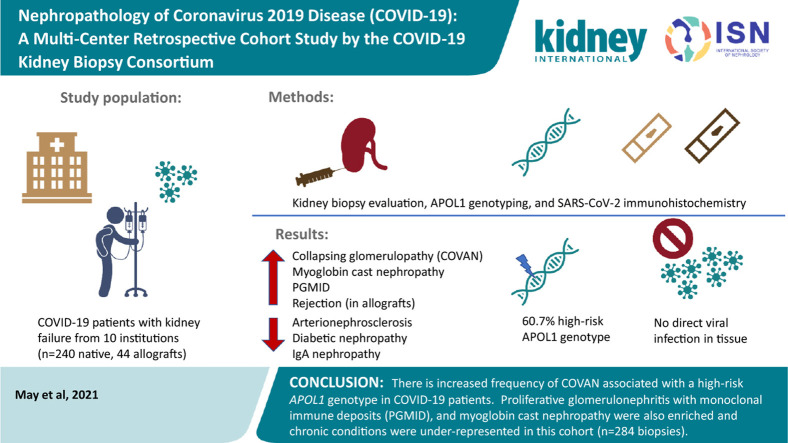
Kidney failure is common in patients with Coronavirus Disease-19 (COVID-19), resulting in increased morbidity and mortality. In an international collaboration, 284 kidney biopsies were evaluated to improve understanding of kidney disease in COVID-19. Diagnoses were compared to five years of 63,575 native biopsies prior to the pandemic and 13,955 allograft biopsies to identify diseases that have increased in patients with COVID-19. Genotyping for APOL1 G1 and G2 alleles was performed in 107 African American and Hispanic patients. Immunohistochemistry for SARS-CoV-2 was utilized to assess direct viral infection in 273 cases along with clinical information at the time of biopsy. The leading indication for native biopsy was acute kidney injury (45.4%), followed by proteinuria with or without concurrent acute kidney injury (42.6%). There were more African American patients (44.6%) than patients of other ethnicities. The most common diagnosis in native biopsies was collapsing glomerulopathy (25.8%), which was associated with high-risk APOL1 genotypes in 91.7% of cases. Compared to the five-year biopsy database, the frequency of myoglobin cast nephropathy and proliferative glomerulonephritis with monoclonal IgG deposits was also increased in patients with COVID-19 (3.3% and 1.7%, respectively), while there was a reduced frequency of chronic conditions (including diabetes mellitus, IgA nephropathy, and arterionephrosclerosis) as the primary diagnosis. In transplants, the leading indication was acute kidney injury (86.4%), for which rejection was the predominant diagnosis (61.4%). Direct SARS-CoV-2 viral infection was not identified. Thus, our multi-center large case series identified kidney diseases that disproportionately affect patients with COVID-19 and demonstrated a high frequency of APOL1 high-risk genotypes within this group, with no evidence of direct viral infection within the kidney.

Keywords: COVID-19; SARS-CoV-2; acute kidney injury; coronavirus; kidney biopsy; renal pathology.


Figures

None
Graphical abstract
Figure 1
Figure 1
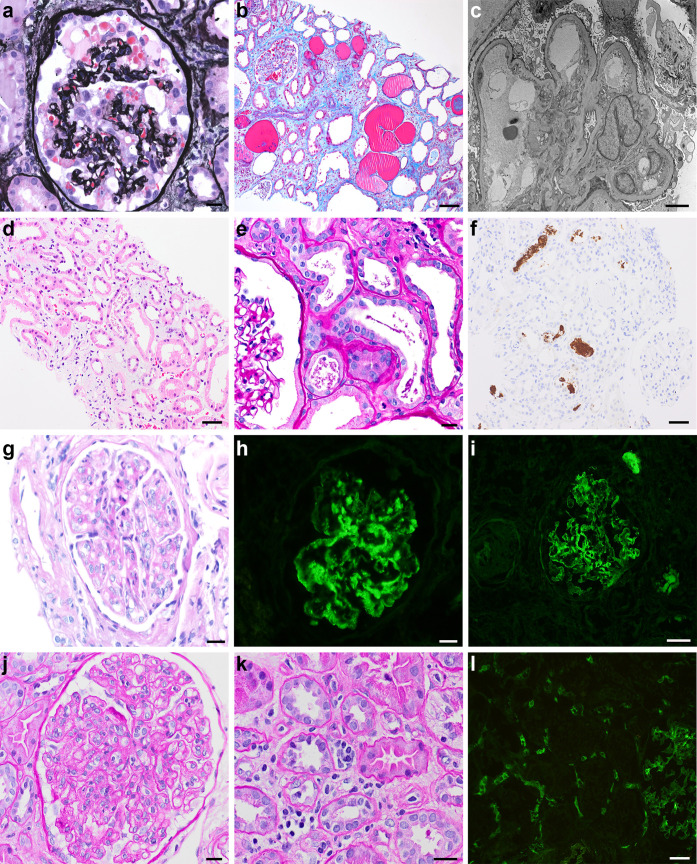
Representative histopathology of kidney biopsy diagnoses enriched in coronavirus disease 2019 (COVID-19) patients. (a–c) Collapsing glomerulopathy: (a) Jones methenamine silver stain showing glomerular tuft collapse with an overlying epithelial cell proliferation; bar = 20 μm; (b) Masson trichrome stain showing microcystic tubular dilation; bar = 50 μm; (c) electron photomicrograph showing podocyte foot process effacement, original magnification ×1500; (d–f) myoglobin cast nephropathy; (d) hematoxylin and eosin stain showing tubular epithelial simplification and dilation with interstitial edema; bar = 100 μm; (e) periodic acid–Schiff stain showing beaded and granular casts; bar = 20 μm; (f) myoglobin immunohistochemical stain showing positivity within intratubular casts; bar = 100 μm; (g–i): proliferative glomerulonephritis with monoclonal Ig deposits (PGMID); (g) hematoxylin and eosin stain showing mesangial expansion and endocapillary hypercellularity within a glomerulus; bar = 20 μm; (h) granular mesangial and segmental capillary loop staining for IgG; bar = 20 μm; (i) granular mesangial and segmental capillary loop staining for kappa light chain; bar = 20 μm; (j–l) acute antibody-mediated rejection in kidney allograft; (j) periodic acid–Schiff stain showing glomerulitis; bar = 20 μm; (k) periodic acid–Schiff stain showing peritubular capillaritis; bar = 20 μm; and (l) C4d immunofluorescence positive in peritubular capillaries; bar = 100 μm. To optimize viewing of this image, please see the online version of this article at www.kidney-international.org.
Figure 2
Figure 2
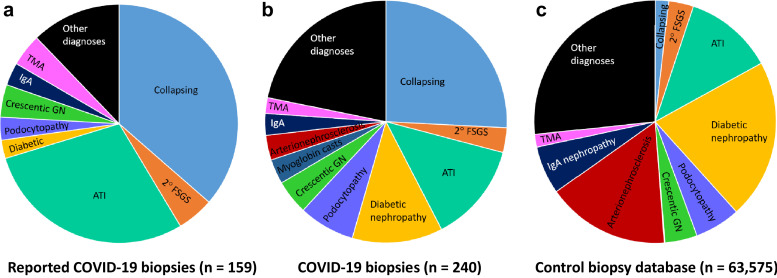
Frequencies of diagnosis in coronavirus disease 2019 (COVID-19) kidney biopsies compared to the pre-pandemic biopsied population. (a) Frequencies of diagnosis of COVID-19 kidney biopsies reported in the literature (n = 159 patients). (b) Frequencies of diagnosis of COVID-19 kidney biopsies in our multi-institutional cohort (n = 240 patients). (c) Comparison of diagnostic frequencies in the 5-year pre-pandemic biopsy cohort (n = 63,575 patients). ATI, acute tubular injury; FSGS, focal segmental glomerular sclerosis; GN, glomerulonephritis; TMA, thrombotic microangiopathy.

References

    1. Hirsch J.S., Ng J.H., Ross D.W., et al. Acute kidney injury in patients hospitalized with COVID-19. Kidney Int. 2020;98:209–218. - PMC - PubMed
    1. Sandhu S., Chand S., Bhatnagar A., et al. Possible association between IgA vasculitis and COVID-19. Dermatol Ther. 2020:e14551. - PMC - PubMed
    1. Cheng Y., Luo R., Wang K., et al. Kidney disease is associated with in-hospital death of patients with COVID-19. Kidney Int. 2020;97:829–838. - PMC - PubMed
    1. Garg S., Kim L., Whitaker M., et al. Hospitalization rates and characteristics of patients hospitalized with laboratory-confirmed coronavirus disease 2019—COVID-NET, 14 states, March 1-30, 2020. MMWR Morb Mortal Wkly Rep. 2020;69:458–464. - PMC - PubMed
    1. Goldfarb D.S., Benstein J.A., Zhdanova O., et al. Impending shortages of kidney replacement therapy for COVID-19 patients. Clin J Am Soc Nephrol. 2020;15:880–882. - PMC - PubMed

Publication types