. 2021 Aug 5;25(1):281.
doi: 10.1186/s13054-021-03717-z.

Dexamethasone and tocilizumab treatment considerably reduces the value of C-reactive protein and procalcitonin to detect secondary bacterial infections in COVID-19 patients

Affiliations

Dexamethasone and tocilizumab treatment considerably reduces the value of C-reactive protein and procalcitonin to detect secondary bacterial infections in COVID-19 patients

Emma J Kooistra et al. Crit Care. .

Abstract

Background: Procalcitonin (PCT) and C-reactive protein (CRP) were previously shown to have value for the detection of secondary infections in critically ill COVID-19 patients. However, since the introduction of immunomodulatory therapy, the value of these biomarkers is unclear. We investigated PCT and CRP kinetics in critically ill COVID-19 patients treated with dexamethasone with or without tocilizumab, and assessed the value of these biomarkers to detect secondary bacterial infections.

Methods: In this prospective study, 190 critically ill COVID-19 patients were divided into three treatment groups: no dexamethasone, no tocilizumab (D-T-), dexamethasone, no tocilizumab (D+T-), and dexamethasone and tocilizumab (D+T+). Serial data of PCT and CRP were aligned on the last day of dexamethasone treatment, and kinetics of these biomarkers were analyzed between 6 days prior to cessation of dexamethasone and 10 days afterwards. Furthermore, the D+T- and D+T+ groups were subdivided into secondary infection and no-secondary infection groups to analyze differences in PCT and CRP kinetics and calculate detection accuracy of these biomarkers for the occurrence of a secondary infection.

Results: Following cessation of dexamethasone, there was a rebound in PCT and CRP levels, most pronounced in the D+T- group. Upon occurrence of a secondary infection, no significant increase in PCT and CRP levels was observed in the D+T- group (p = 0.052 and p = 0.08, respectively). Although PCT levels increased significantly in patients of the D+T+ group who developed a secondary infection (p = 0.0003), this rise was only apparent from day 2 post-infection onwards. CRP levels remained suppressed in the D+T+ group. Receiver operating curve analysis of PCT and CRP levels yielded area under the curves of 0.52 and 0.55, respectively, which are both markedly lower than those found in the group of COVID-19 patients not treated with immunomodulatory drugs (0.80 and 0.76, respectively, with p values for differences between groups of 0.001 and 0.02, respectively).

Conclusions: Cessation of dexamethasone in critically ill COVID-19 patients results in a rebound increase in PCT and CRP levels unrelated to the occurrence of secondary bacterial infections. Furthermore, immunomodulatory treatment with dexamethasone and tocilizumab considerably reduces the value of PCT and CRP for detection of secondary infections in COVID-19 patients.

Keywords: COVID-19; Dexamethasone; Prediction; Procalcitonin; Tocilizumab; c-reactive protein.


Conflict of interest statement

The authors declare that they have no competing interests related to this study.

Figures
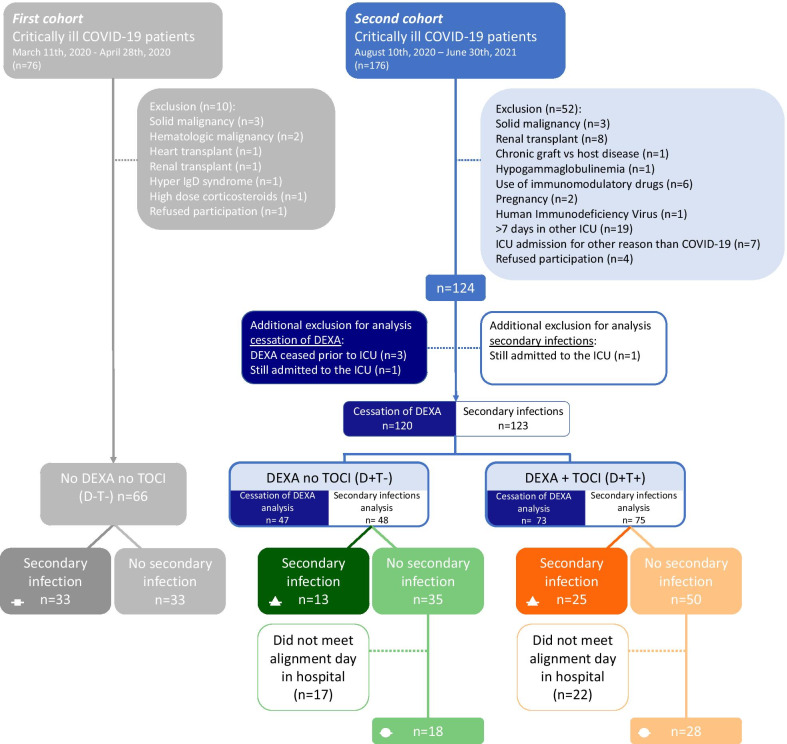
Fig. 1
Fig. 1
Patient flowchart. Patients who were immunocompromised based on pre-existent comorbidity or treatment and patients of the second cohort who stayed in another ICU for ≥ 7 days prior to admission to the ICU were excluded. For the analysis of PCT and CRP kinetics following cessation of dexamethasone (DEXA) treatment, patients in whom the dexamethasone treatment was already completed when admitted to the ICU, were excluded. For the analysis of PCT and CRP kinetics in patients developing a secondary infection, patients who were still admitted to the ICU on moment of data analysis (July 2021) were excluded. The remaining patients were divided into a dexamethasone-only group (D+T−) and a dexamethasone and tocilizumab (TOCI) group (D+T+), which were again subdivided into a secondary infection group and a no-secondary infection group. Following data alignment, patients in the no secondary infection groups who were discharged from the hospital on alignment day were excluded because no data was available
Fig. 2
Fig. 2
Levels of a procalcitonin (PCT) and b C-reactive protein (CRP) over time within 6 days prior to and 10 days following cessation of dexamethasone (DEXA) in the group of patients treated with neither dexamethasone nor tocilizumab (D−T− group) as well as in the D+T− and D+T+ groups. Day of cessation of dexamethasone was designated day 0 (alignment day). Data of the D−T− group were aligned on the median alignment day, which was day 9 following ICU admission. Data are presented as geometric mean with 95% confidence intervals. p values were calculated using mixed-models analyses (time × group interaction factor). p values left and right below each panel reflect between-group differences in kinetics from day − 6 until day 0 and from day 0 until day 10, respectively. Colored diamonds reflect p values of < 0.05 between the corresponding groups (D−T− light blue, D+T− dark blue, D+T+ orange) on the individual timepoint, calculated using Sidak’s post-hoc multiple comparisons tests. D−T−: patients treated with neither dexamethasone nor tocilizumab, D+T−: patients treated with dexamethasone but no tocilizumab, D+T+: patients treated with both drugs
Fig. 3
Fig. 3
Levels of procalcitonin (PCT) and C-reactive protein (CRP) over time within 10 days prior to and 10 days following the day of secondary infection in the group of patients treated with dexamethasone (TOCI) but not with tocilizumab (TOCI, D+T− group, a and b, and in the D+T+ group (c and d). Day of secondary infection was designated day 0 (alignment day). Data of the no secondary infection groups were aligned on the median alignment day, which was day 14 following ICU admission. The light grey line indicates previously reported data of D−T− patients as a reference [5]. Data are presented as geometric mean with 95% confidence intervals. p values were calculated using mixed-models analyses (time × group interaction factor). p values in left and right parts of each panel reflect between-group differences in kinetics from day − 10 until day 0 and from day 0 until day 10, respectively. Colored diamonds reflect p values of < 0.05 on the individual timepoints, calculated using Sidak’s post-hoc multiple comparisons tests. D−T−: patients treated with neither dexamethasone nor tocilizumab, D+T−: patients treated with dexamethasone but no tocilizumab, D+T+: patients treated with both drugs
Fig. 4
Fig. 4
Receiver operating curves (ROC) of procalcitonin (PCT) and C-reactive protein (CRP) in the group of patients treated with dexamethasone but not with tocilizumab (D+T− group, a and b), the D+T+ group (c and d), and in all patients of the second cohort (D+T−/+ group, e and f) to illustrate sensitivity and specificity to predict the occurrence of a secondary infection in critically ill COVID-19 patients. Binned data of PCT and CRP of days − 1 and 0 were used for these analyses. The grey lines illustrate the previously published ROCs of D−T− patients [5]. p values reflect differences between the two areas under the receiver operating curves (AUROCs). Positive predictive value (PPV) and negative predictive value (NPV) are provided for the concentrations of PCT and CRP indicated by the arrows

References

    1. Hodges G, Pallisgaard J, Schjerning Olsen AM, McGettigan P, Andersen M, Krogager M, et al. Association between biomarkers and COVID-19 severity and mortality: a nationwide Danish cohort study. BMJ Open. 2020;10(12):e041295. doi: 10.1136/bmjopen-2020-041295. - DOI - PMC - PubMed
    1. Hu R, Han C, Pei S, Yin M, Chen X. Procalcitonin levels in COVID-19 patients. Int J Antimicrob Agents. 2020;56(2):106051. doi: 10.1016/j.ijantimicag.2020.106051. - DOI - PMC - PubMed
    1. Lippi G, Plebani M. Procalcitonin in patients with severe coronavirus disease 2019 (COVID-19): a meta-analysis. Clin Chim Acta. 2020;505:190–191. doi: 10.1016/j.cca.2020.03.004. - DOI - PMC - PubMed
    1. Schuetz P, Beishuizen A, Broyles M, Ferrer R, Gavazzi G, Gluck EH, et al. Procalcitonin (PCT)-guided antibiotic stewardship: an international experts consensus on optimized clinical use. Clin Chem Lab Med. 2019;57(9):1308–1318. doi: 10.1515/cclm-2018-1181. - DOI - PubMed
    1. van Berkel M, Kox M, Frenzel T, Pickkers P, Schouten J. Biomarkers for antimicrobial stewardship: a reappraisal in COVID-19 times? Crit Care. 2020;24(1):600. doi: 10.1186/s13054-020-03291-w. - DOI - PMC - PubMed

Publication types
