


Predictors of cognitive impairment in primary age-related tauopathy: an autopsy study
- PMID: 34353357
- PMCID: PMC8340493
- DOI: 10.1186/s40478-021-01233-3
Predictors of cognitive impairment in primary age-related tauopathy: an autopsy study
Abstract
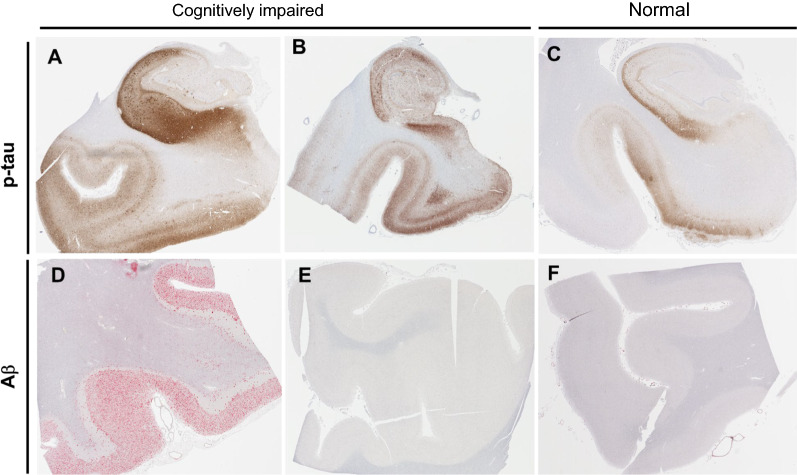
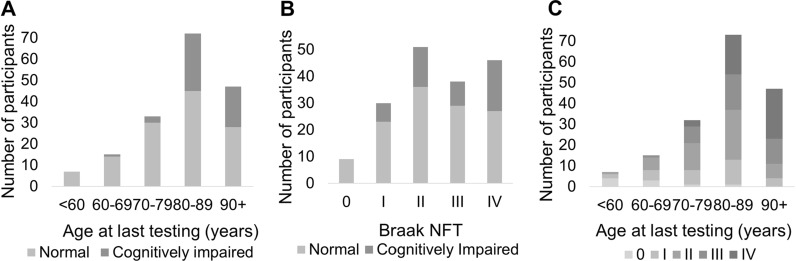
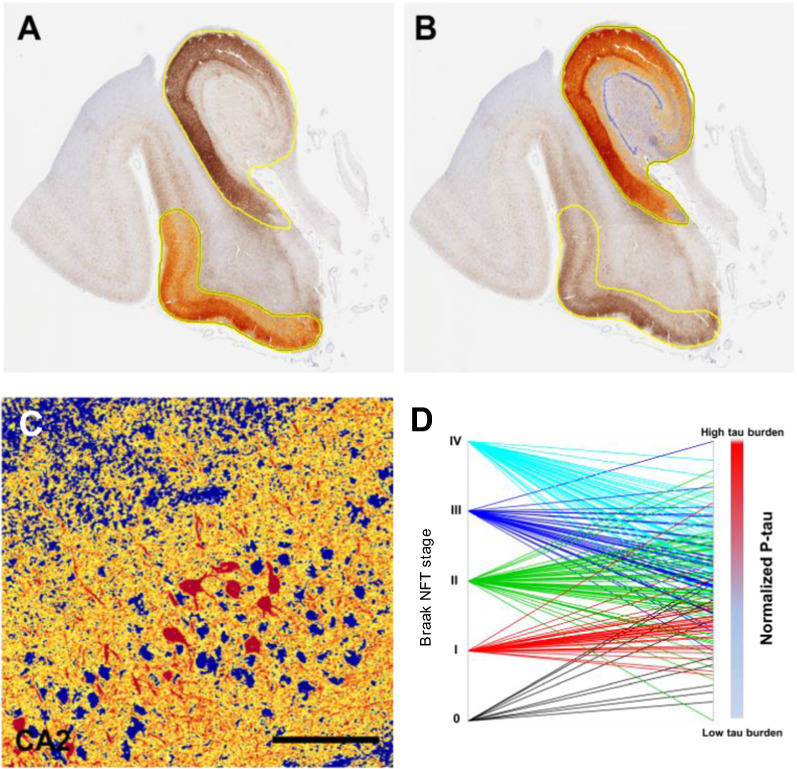
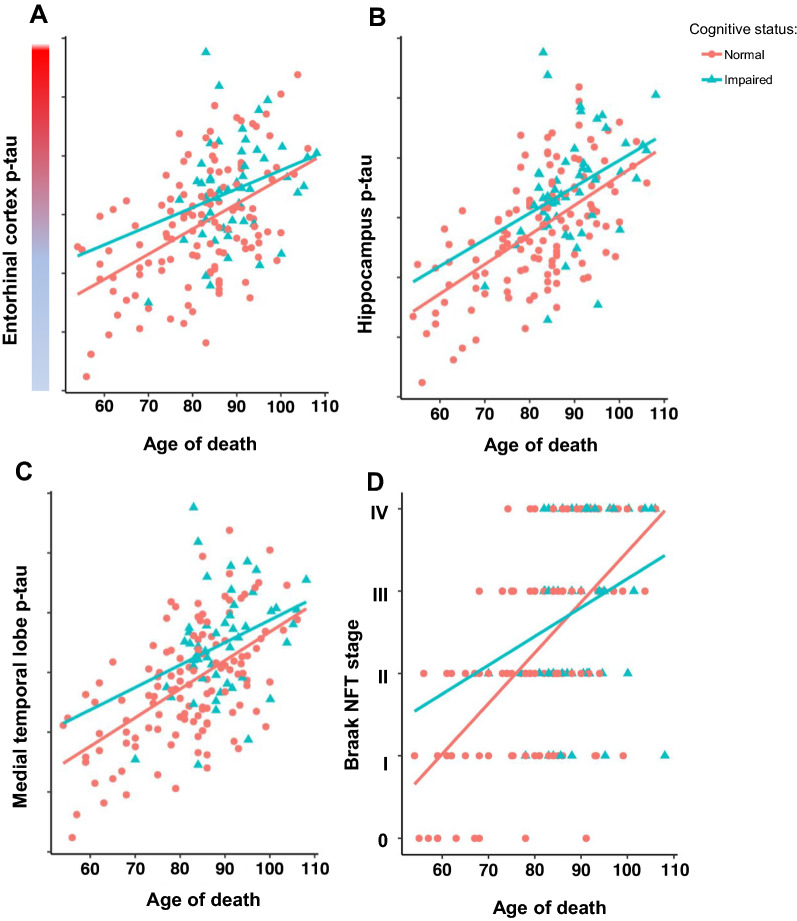
Primary age-related tauopathy (PART) is a form of Alzheimer-type neurofibrillary degeneration occurring in the absence of amyloid-beta (Aβ) plaques. While PART shares some features with Alzheimer disease (AD), such as progressive accumulation of neurofibrillary tangle pathology in the medial temporal lobe and other brain regions, it does not progress extensively to neocortical regions. Given this restricted pathoanatomical pattern and variable symptomatology, there is a need to reexamine and improve upon how PART is neuropathologically assessed and staged. We performed a retrospective autopsy study in a collection (n = 174) of post-mortem PART brains and used logistic regression to determine the extent to which a set of clinical and neuropathological features predict cognitive impairment. We compared Braak staging, which focuses on hierarchical neuroanatomical progression of AD tau and Aβ pathology, with quantitative assessments of neurofibrillary burden using computer-derived positive pixel counts on digitized whole slide images of sections stained immunohistochemically with antibodies targeting abnormal hyperphosphorylated tau (p-tau) in the entorhinal region and hippocampus. We also assessed other factors affecting cognition, including aging-related tau astrogliopathy (ARTAG) and atrophy. We found no association between Braak stage and cognitive impairment when controlling for age (p = 0.76). In contrast, p-tau burden was significantly correlated with cognitive impairment even when adjusting for age (p = 0.03). The strongest correlate of cognitive impairment was cerebrovascular disease, a well-known risk factor (p < 0.0001), but other features including ARTAG (p = 0.03) and hippocampal atrophy (p = 0.04) were also associated. In contrast, sex, APOE, psychiatric illness, education, argyrophilic grains, and incidental Lewy bodies were not. These findings support the hypothesis that comorbid pathologies contribute to cognitive impairment in subjects with PART. Quantitative approaches beyond Braak staging are critical for advancing our understanding of the extent to which age-related tauopathy changes impact cognitive function.
Keywords: ARTAG; Aging; Braak; Dementia; PART.
© 2021. The Author(s).
Conflict of interest statement
The authors declare that they have no conflicts of interest.
Figures
References
-
- Abner EL, Neltner JH, Jicha GA, Patel E, Anderson SL, Wilcock DM, Van Eldik LJ, Nelson PT. Diffuse amyloid-beta plaques, neurofibrillary tangles, and the Impact of APOE in elderly persons' brains lacking neuritic amyloid plaques. J Alzheimers Dis. 2018;64:1307–1324. doi: 10.3233/JAD-180514. - DOI - PMC - PubMed
-
- Alafuzoff I, Arzberger T, Al-Sarraj S, Bodi I, Bogdanovic N, Braak H, Bugiani O, Del-Tredici K, Ferrer I, Gelpi E, et al. Staging of neurofibrillary pathology in Alzheimer's disease: a study of the BrainNet Europe Consortium. Brain Pathol. 2008;18:484–496. doi: 10.1111/j.1750-3639.2008.00147.x. - DOI - PMC - PubMed
-
- Bell WR, An Y, Kageyama Y, English C, Rudow GL, Pletnikova O, Thambisetty M, O'Brien R, Moghekar AR, Albert MS, et al. Neuropathologic, genetic, and longitudinal cognitive profiles in primary age-related tauopathy (PART) and Alzheimer's disease. Alzheimers Dement. 2019;15:8–16. doi: 10.1016/j.jalz.2018.07.215. - DOI - PMC - PubMed
Publication types
MeSH terms
Substances
Grants and funding
- P30 AG013854/AG/NIA NIH HHS/United States
- P30 AG010124/AG/NIA NIH HHS/United States
- P30 AG066518/AG/NIA NIH HHS/United States
- R01 AG062348/AG/NIA NIH HHS/United States
- 75N95019C00049/DA/NIDA NIH HHS/United States
- P30 AG008017/AG/NIA NIH HHS/United States
- R01 NS086736/NS/NINDS NIH HHS/United States
- P50 AG005133/AG/NIA NIH HHS/United States
- P30 AG019610/AG/NIA NIH HHS/United States
- P30 AG066514/AG/NIA NIH HHS/United States
- R01 AG054008/AG/NIA NIH HHS/United States
- P30 AG066511/AG/NIA NIH HHS/United States
- P01 AG017586/AG/NIA NIH HHS/United States
- U54 NS115266/NS/NINDS NIH HHS/United States
- R01 AG066152/AG/NIA NIH HHS/United States
- R01 NS095252/NS/NINDS NIH HHS/United States
- P50 AG025688/AG/NIA NIH HHS/United States
- P01 AG066597/AG/NIA NIH HHS/United States
- P30 AG066546/AG/NIA NIH HHS/United States
- P50 AG005138/AG/NIA NIH HHS/United States
- U19 AG062418/AG/NIA NIH HHS/United States
- RF1 AG060961/AG/NIA NIH HHS/United States
- U24 NS072026/NS/NINDS NIH HHS/United States
- P30 AG066468/AG/NIA NIH HHS/United States
- RF1 NS095252/NS/NINDS NIH HHS/United States
- F32 AG056098/AG/NIA NIH HHS/United States
- P30 NS055077/NS/NINDS NIH HHS/United States
- P30 AG072979/AG/NIA NIH HHS/United States
LinkOut - more resources
Full Text Sources
Medical
Miscellaneous
