Review
. 2021 Aug 5;16(1):12.
doi: 10.1186/s13062-021-00297-4.

Lifestyle-dependent microglial plasticity: training the brain guardians

Affiliations
Review

Lifestyle-dependent microglial plasticity: training the brain guardians

Marcus Augusto-Oliveira et al. Biol Direct. .

Abstract

Lifestyle is one of the most powerful instruments shaping mankind; the lifestyle includes many aspects of interactions with the environment, from nourishment and education to physical activity and quality of sleep. All these factors taken in complex affect neuroplasticity and define brain performance and cognitive longevity. In particular, physical exercise, exposure to enriched environment and dieting act through complex modifications of microglial cells, which change their phenotype and modulate their functional activity thus translating lifestyle events into remodelling of brain homoeostasis and reshaping neural networks ultimately enhancing neuroprotection and cognitive longevity.

Keywords: Diet; Enriched environment; Lifestyle modifications; Microglia; Neuroplasticity; Physical exercise.


Conflict of interest statement

No completing interests.

Figures
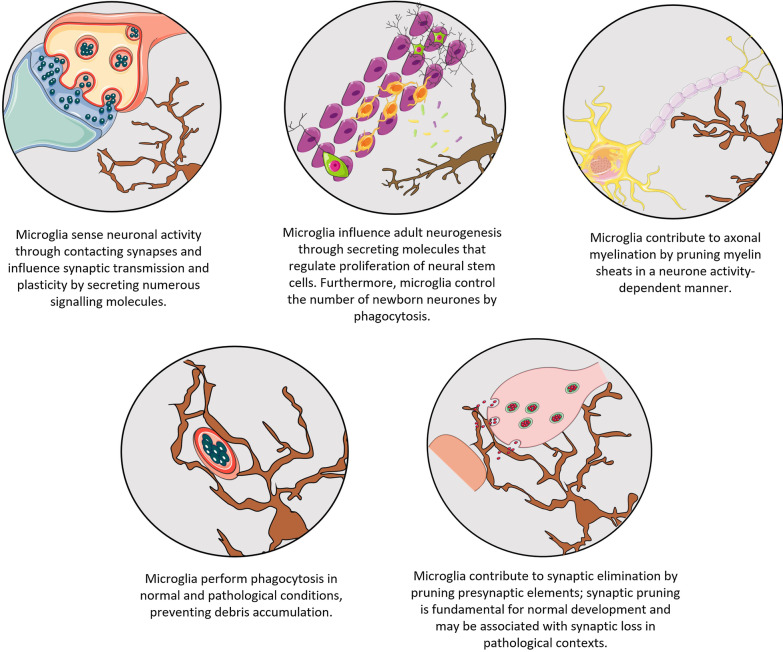
Fig. 1
Fig. 1
Microglial functions in physiology and pathophysiology
Fig. 2
Fig. 2
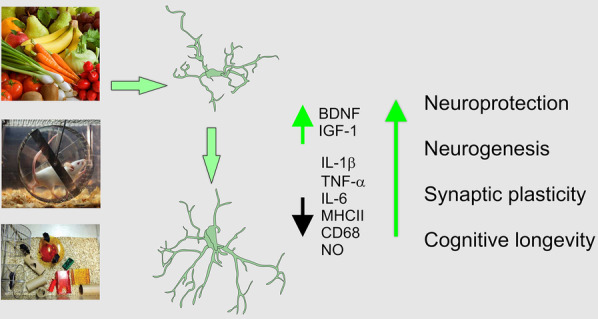
Microglia translate lifestyle into the neuroprotection and cognitive longevity. The adoption of friendly lifestyle induces morphological and functional plasticity of microglia, these plastic changes translate, at least in part, intellectual engagement, physical exercise and healthy diets into the brain health through enhanced neuroprotection, neurogenesis, and synaptic plasticity. Images of microglia has been re-drawn from ref [86] with permission

References

    1. van Praag H, Christie BR, Sejnowski TJ, Gage FH. Running enhances neurogenesis, learning, and long-term potentiation in mice. Proc Natl Acad Sci USA. 1999;96:13427–13431. doi: 10.1073/pnas.96.23.13427. - DOI - PMC - PubMed
    1. Yu Q, Li X, Wang J, Li Y. Effect of exercise training on long-term potentiation and NMDA receptor channels in rats with cerebral infarction. Exp Ther Med. 2013;6:1431–1436. doi: 10.3892/etm.2013.1319. - DOI - PMC - PubMed
    1. Eadie BD, Redila VA, Christie BR. Voluntary exercise alters the cytoarchitecture of the adult dentate gyrus by increasing cellular proliferation, dendritic complexity, and spine density. J Comp Neurol. 2005;486:39–47. doi: 10.1002/cne.20493. - DOI - PubMed
    1. Stranahan AM, Khalil D, Gould E. Running induces widespread structural alterations in the hippocampus and entorhinal cortex. Hippocampus. 2007;17:1017–1022. doi: 10.1002/hipo.20348. - DOI - PMC - PubMed
    1. Phillips C, Baktir MA, Srivatsan M, Salehi A. Neuroprotective effects of physical activity on the brain: a closer look at trophic factor signaling. Front Cell Neurosci. 2014;8:170. doi: 10.3389/fncel.2014.00170. - DOI - PMC - PubMed

LinkOut - more resources