


Assessing the potential correlation of polymorphisms in the IL6R with relative IL6 elevation in severely ill COVID-19 patients'
- PMID: 34353696
- PMCID: PMC8318728
- DOI: 10.1016/j.cyto.2021.155662
Assessing the potential correlation of polymorphisms in the IL6R with relative IL6 elevation in severely ill COVID-19 patients'
Erratum in
-
Corrigendum to "Assessing the potential correlation of polymorphisms in the IL6R with relative IL6 elevation in severely ill COVID-19 patients" [Cytokine 148 (2021) 155662].Cytokine. 2022 Jan;149:155752. doi: 10.1016/j.cyto.2021.155752. Epub 2021 Oct 29. Cytokine. 2022. PMID: 34756793 Free PMC article. No abstract available.
Abstract
Background: Elevated Interleukin-6 (IL-6) may play an important role in the pathophysiology of COVID-19 yet attenuated response is not seen across all severe patients. We aimed to determine the effect of IL-6 baseline levels and other clinical variables on mortality and outcomes in hospitalized COVID-19 patients as well as to explore genetic variants associated with attenuated IL-6 response.
Methods: Baseline IL-6 cytokine levels were measured in hospitalized patients participating in ongoing ODYSSEY phase 3 randomized study of tradipitant and placebo in hospitalized patients with severe COVID-19 who are receiving supplemental oxygen support. Furthermore blood samples for whole genome sequencing analysis were collected from 150 participants.
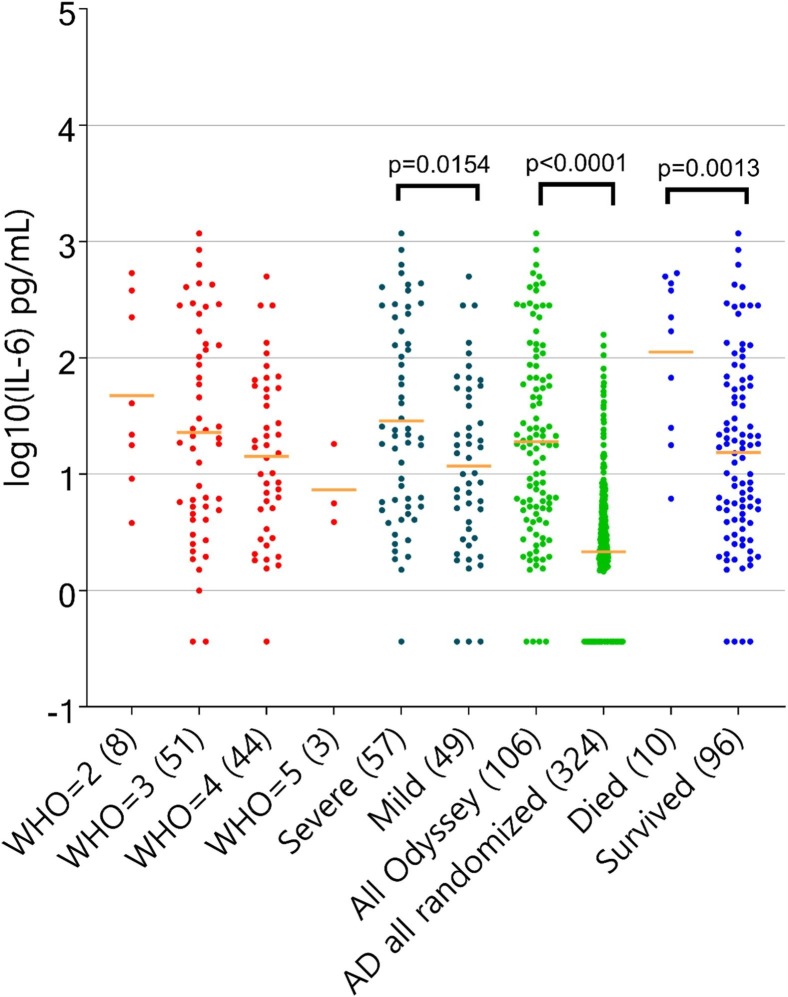
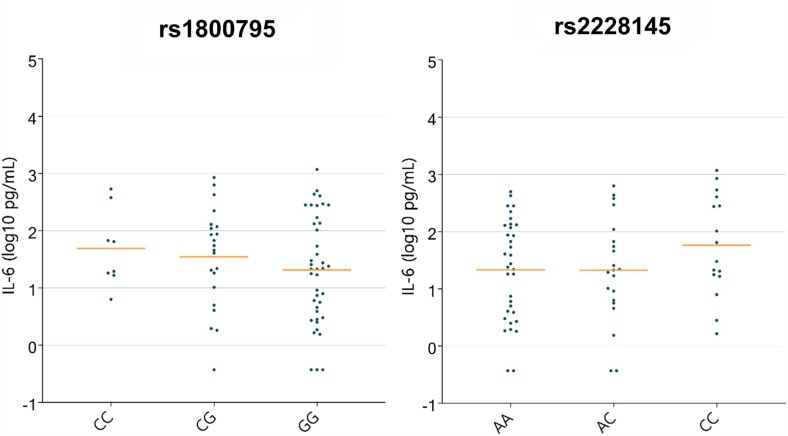
Results: We report significantly elevated IL-6 in COVID-19 infected hospitalized patients, n = 100 (p-value < 0.0001) when compared to controls n = 324. We also report a significantly increased level of IL-6 (p-value < 0.01) between the severe and mild COVID-19 patients with severity defined on a WHO scale. Excessive IL-6 plasma levels correlate with higher mortality (p-value 0.001). Additionally, based on our classification analysis, combination of IL-6 elevation and high levels of serum glucose can identify highest risk-group of COVID19 patients. Furthermore, we explore the role of genetic regulatory variants affecting baseline IL-6 levels specifically in COVID-19 patients. We have directly tested the association between variants in the IL6 and IL6R gene region and IL6 plasma levels. We provide results for a common IL-6 variant previously associated with pneumonia, rs1800795, and rs2228145 that was previously shown to affect IL-6 plasma levels, as well as report on novel variants associated with IL-6 plasma levels detected in our study patients.
Conclusions: While it is unlikely that "cytokine storm" is the norm in severe COVID19, baseline elevations above 150 pg/ml may be associated with worst outcomes and as such may warrant treatment considerations. So far no clinical studies used IL-6 baseline assessment to stratify the patient population participating in clinical studies. We believe that careful examination and interpretation of the IL-6 levels and genetic variants can help to determine a patient population with a potentially very robust clinical response to IL-6 inhibition.
Trial registration: Clinicaltrials.gov: NCT04326426.
Copyright © 2021 The Author(s). Published by Elsevier Ltd.. All rights reserved.
Conflict of interest statement
The authors declare that they have no known competing financial interests or personal relationships that could have appeared to influence the work reported in this paper.
Figures
Comment in
-
Hemoperfusion during veno-venous ECMO in severe COVID-19 with IL-6 elevation.Cytokine. 2022 Apr;152:155813. doi: 10.1016/j.cyto.2022.155813. Epub 2022 Feb 1. Cytokine. 2022. PMID: 35123303 Free PMC article. No abstract available.
References
-
- Sinha P., Matthay M.A., Calfee C.S. Is a ‘cytokine Storm’ relevant to COVID-19? JAMA Int. Med. 2020;180:E1–E3. - PubMed
Publication types
MeSH terms
Substances
Associated data
LinkOut - more resources
Full Text Sources
Medical
Research Materials
