


Ventromedial prefrontal cortex/anterior cingulate cortex Glx, glutamate, and GABA levels in medication-free major depressive disorder
- PMID: 34354048
- PMCID: PMC8342485
- DOI: 10.1038/s41398-021-01541-1
Ventromedial prefrontal cortex/anterior cingulate cortex Glx, glutamate, and GABA levels in medication-free major depressive disorder
Abstract
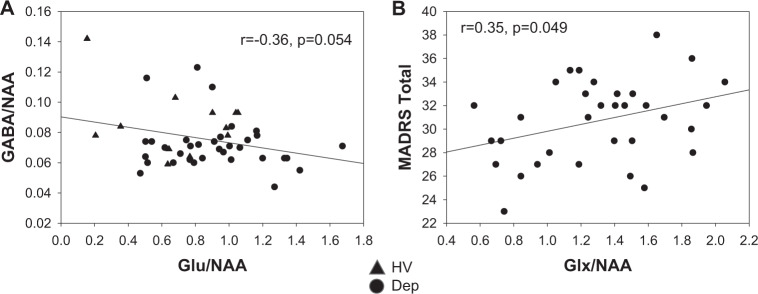
Glutamate (Glu) and gamma-aminobutyric acid (GABA) are implicated in the pathophysiology of major depressive disorder (MDD). GABA levels or GABAergic interneuron numbers are generally low in MDD, potentially disinhibiting Glu release. It is unclear whether Glu release or turnover is increased in depression. Conversely, a meta-analysis of prefrontal proton magnetic resonance spectroscopy (1H MRS) studies in MDD finds low Glx (combination of glutamate and glutamine) in medicated MDD. We hypothesize that elevated Glx or Glu may be a marker of more severe, untreated MDD. We examined ventromedial prefrontal cortex/anterior cingulate cortex (vmPFC/ACC) Glx and glutamate levels using 1H MRS in 34 medication-free, symptomatic, chronically ill MDD patients and 32 healthy volunteers, and GABA levels in a subsample. Elevated Glx and Glu were observed in MDD compared with healthy volunteers, with the highest levels seen in males with MDD. vmPFC/ACC GABA was low in MDD. Higher Glx levels correlated with more severe depression and lower GABA. MDD severity and diagnosis were both linked to higher Glx in vmPFC/ACC. Low GABA in a subset of these patients is consistent with our hypothesized model of low GABA leading to glutamate disinhibition in MDD. This finding and model are consistent with our previously reported findings that the NMDAR-antagonist antidepressant effect is proportional to the reduction of vmPFC/ACC Glx or Glu levels.
© 2021. The Author(s).
Conflict of interest statement
JTK reports having received consulting payments within the last 24 months from Alphasights, Charles River Associates, Medscape, Putnam, techspert.io, Third Bridge, MEDACorp, Parexel, GroupH, Simon Kucher, ECRI Institute, ExpertConnect, Parexel, Schlesinger Group, CelloHealth, Acsel Health, Strafluence, Guidepoint, L.E.K. and System Analytic. He serves on the MedinCell Psychiatry and Karuna Mechanism of Action (MOA) Advisory Boards. He has conducted clinical research supported by the NIMH, Sunovion, Roche, Alkermes, Cerevance, Takeda, Taisho, Lundbeck, Boehringer Ingelheim, NeuroRX and Teva within the last 24 months. JTK was a co-investigator on a study that receives lumeteperone and reimbursement for safety testing for an investigator-initiated research from Intra-Cellular Therapies Inc. He owns a small number of shares of common stock from GSK. JJM receives royalties for commercial use of the C-SSRS from the Research Foundation for Mental Hygiene. DCJ reports Intellectual property for NMDAR agonists in schizophrenia, NMDAR antagonist in depression, fMRI for prediction of ECT response, and ERP biomarkers for diagnosis of mental disorders. Equity in Glytech, AASI, and NeuroRx. Scientific advisory board NeuroRx, Promentis, Consultant payments Autifony, BI, SK Life Sciences, Biogen, Cadence, and Pfizer. JAL does not accept any personal financial remuneration for consulting, speaking, or research activities from any pharmaceutical, biotechnology, or medical device companies. He receives funding and medication supplies for investigator-initiated research from Denovo, Taisho, and Cerevel, and company-sponsored phase II, III, and IV studies from Alkermes, Sunovion, and Boehringer Ingelheim, which does not contribute to his compensation. He is a consultant or advisory board member of Intracellular Therapies, Takeda, Karuna, Pear Therapeutics, Systems-1, and Psychogenics for which he receives no remuneration. He is a paid consultant for Signant Health, a clinical research technology and services organization, and holds a patent from Repligen that yields no royalties. The remaining authors declare no competing interests.
Figures
References
-
- Hasler G, van der Veen JW, Tumonis T, Meyers N, Shen J, Drevets WC. Reduced prefrontal glutamate/glutamine and gamma-aminobutyric acid levels in major depression determined using proton magnetic resonance spectroscopy. Arch Gen Psychiatry. 2007;64:193–200. doi: 10.1001/archpsyc.64.2.193. - DOI - PubMed
Publication types
MeSH terms
Substances
Grants and funding
LinkOut - more resources
Full Text Sources
