. 2021 Jul 20:12:680005.
doi: 10.3389/fphys.2021.680005. eCollection 2021.

Involvement of Sirtuins and Klotho in Cardioprotective Effects of Exercise Training Against Waterpipe Tobacco Smoking-Induced Heart Dysfunction

Affiliations

Involvement of Sirtuins and Klotho in Cardioprotective Effects of Exercise Training Against Waterpipe Tobacco Smoking-Induced Heart Dysfunction

Samaneh Sadat Alavi et al. Front Physiol. .

Abstract

Despite its negative effect on the cardiovascular system, waterpipe smoking (WPS) is currently popular worldwide, especially among youth. This study investigated the effects of moderate endurance exercise on heart function of rats exposed to WPS and its possible mechanism. The animals were randomly divided into four groups: control group (CTL), the exercise group (Ex) which trained for 8 weeks, the waterpipe tobacco smoking group (S) exposed to smoke inhalation (30 min per day, 5 days each week, for 8 weeks), and the group that did exercise training and received waterpipe tobacco smoke inhalation together (Ex + S). One day after the last session of Ex and WPS, cardiac pressures and functional indices were recorded and calculated. The levels of SIRT1, SIRT3, Klotho, Bax, and Bcl-2 in the serum and heart, the expression of phosphorylated GSK3β of heart tissue, and cardiac histopathological changes were assessed. WPS reduced systolic pressure, +dP/dt max, -dP/dt max, and heart contractility indices (P < 0.001 vs. CTL) and increased cardiac tissue lesions (P < 0.05 vs. CTL) and end diastolic pressure and Tau index (P < 0.001 vs. CTL) of the left ventricle. Exercise training normalized the left ventricular end diastolic pressure, +dP/dt max, and contractility index. Also, exercise improved the levels of SIRT1, SIRT3, Klotho, and Bcl-2 and reduced Bax level in the heart. The findings showed that WPS causes left ventricular dysfunction. Moderate exercise prevented WPS-induced heart dysfunction partly through its anti-apoptotic features and activation of the sirtuins and Klotho pathways.

Keywords: Klotho; apoptosis; cardiac function; exercise training; sirtuins; waterpipe tobacco smoking.


Conflict of interest statement

The authors declare that the research was conducted in the absence of any commercial or financial relationships that could be construed as a potential conflict of interest.

Figures
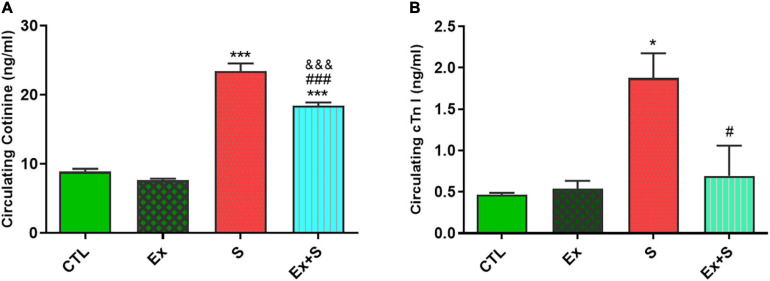
FIGURE 1
FIGURE 1
Effects of waterpipe smoke inhalation on serum cardiac troponin I (A) and cotinine levels (B) in experimental groups. CTL, control group; Ex, group subjected to exercise training for 8 weeks; S, group subjected to waterpipe tobacco smoke inhalation for 8 weeks; Ex + S, group subjected to exercise training and waterpipe tobacco smoke inhalation for 8 weeks. The results are presented as mean ± SEM, n = 7.*P < 0.05; ***P < 0.001 vs. CTL; #P < 0.05, ###P < 0.001 vs. S; &&&P < 0.001 vs. Ex.
FIGURE 2
FIGURE 2
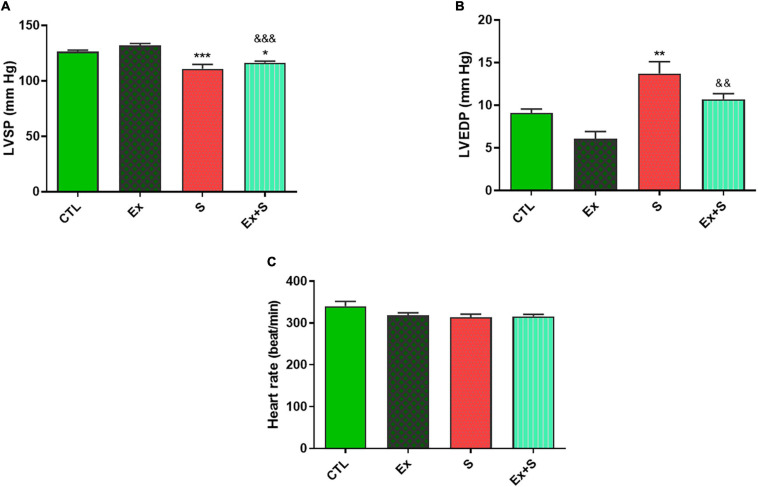
Effects of waterpipe smoke inhalation on left ventricular systolic pressure (LVSP) (A), left ventricular end diastolic pressure (LVEDP) (B), and heart rate (C) in experimental groups. CTL, control group; Ex, group subjected to exercise training for 8 weeks; S, group subjected to waterpipe tobacco smoke inhalation for 8 weeks; Ex + S, group subjected to exercise training and waterpipe tobacco smoke inhalation for 8 weeks. The results are presented as mean ± SEM, n = 7. *P < 0.05; **P < 0.01; ***P < 0.001 vs. CTL; &&P < 0.01, &&&P<0.001 vs. Ex.
FIGURE 3
FIGURE 3
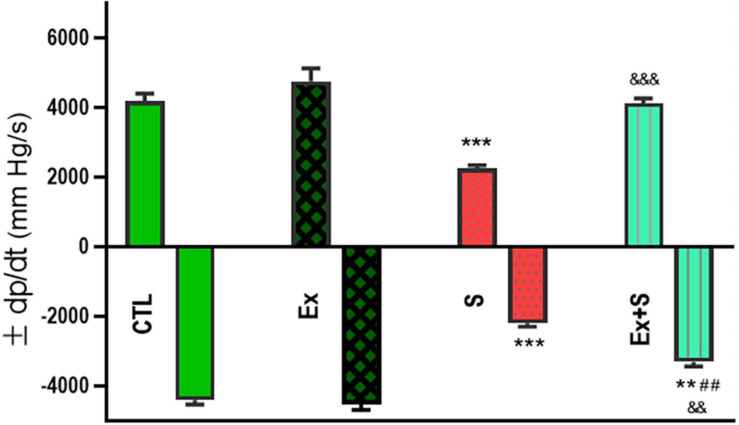
Effects of waterpipe smoke inhalation on positive dP/dt max (+dP/dt max) and negative dP/dt max (-dP/dt max) in experimental groups. CTL, control group; Ex, group subjected to exercise training for 8 weeks; S, group subjected to waterpipe tobacco smoke inhalation for 8 weeks; Ex + S, group subjected to exercise training and waterpipe tobacco smoke inhalation for 8 weeks. The results are presented as mean ± SEM, n = 7. **P < 0.01; ***P < 0.001 vs. CTL; ##P < 0.01 vs. S; &&P < 0.01; &&&P < 0.001 vs. Ex.
FIGURE 4
FIGURE 4
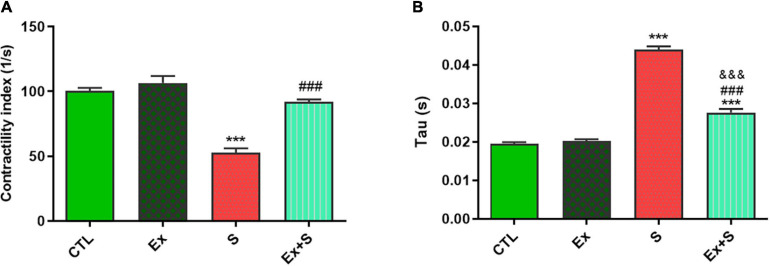
Effects of waterpipe smoke inhalation on contractility index (A) and Tau index (B) in experimental groups. CTL, control group; Ex, group subjected to exercise training for 8 weeks; S, group subjected to waterpipe tobacco smoke inhalation for 8 weeks; Ex + S, group subjected to exercise training and waterpipe tobacco smoke inhalation for 8 weeks. The results are presented as mean ± SEM, n = 7. ***P < 0.001 vs. CTL; ###P < 0.001 vs. S; &&&P < 0.001 vs. Ex.
FIGURE 5
FIGURE 5
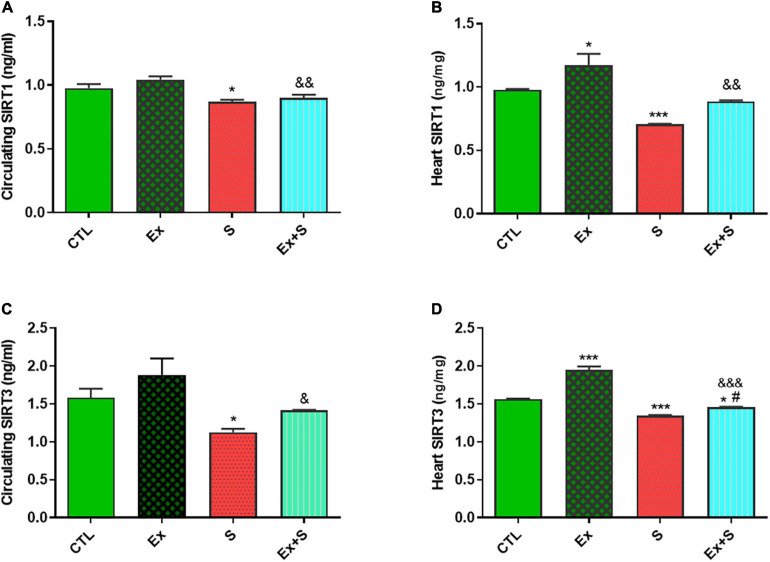
Effects of waterpipe smoke inhalation on sirtuin 1 (SIRT1) levels in serum (A) and in the heart (B), and sirtuin 3 (SIRT3) levels in serum (C) and in the heart (D) in experimental groups. CTL, control group; Ex, group subjected to exercise training for 8 weeks; S, group subjected to waterpipe tobacco smoke inhalation for 8 weeks; Ex + S, group subjected to exercise training and waterpipe tobacco smoke inhalation for 8 weeks. The results are presented as mean ± SEM, n = (6–7). *P < 0.05; ***P < 0.001 vs. CTL; #P < 0.05 vs. S; &P < 0.05; &&P < 0.01; &&&P < 0.001 vs. Ex.
FIGURE 6
FIGURE 6
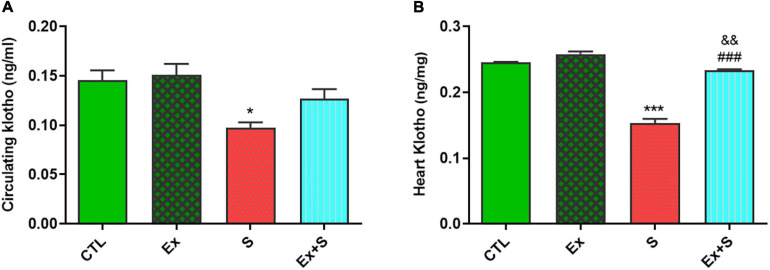
Effects of waterpipe smoke inhalation on α-Klotho levels in serum (A) and in the heart (B) in experimental groups. CTL, control group; Ex, group subjected to exercise training for 8 weeks; S, group subjected to waterpipe tobacco smoke inhalation for 8 weeks; Ex + S, group subjected to exercise training and waterpipe tobacco smoke inhalation for 8 weeks. The results are presented as mean ± SEM, n = (6–7). *P < 0.05; ***P < 0.001 vs. CTL; ###P < 0.001 vs. S; &&P < 0.01 vs. Ex.
FIGURE 7
FIGURE 7
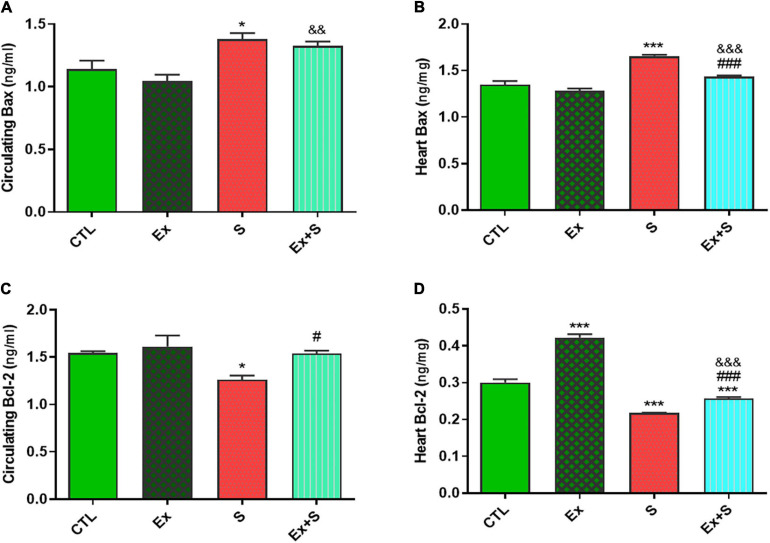
Effects of waterpipe smoke inhalation on Bax levels in serum (A) and in the heart (B), and Bcl-2 levels in serum (C) and in the heart (D) in experimental groups. CTL, control group; Ex, group subjected to exercise training for 8 weeks; S, group subjected to waterpipe tobacco smoke inhalation for 8 weeks; Ex + S, group subjected to exercise training and waterpipe tobacco smoke inhalation for 8 weeks. The results are presented as mean ± SEM, n = (6–7). *P < 0.05, ***P < 0.001 vs. CTL; #P < 0.05, ###P < 0.001 vs. S; &&P < 0.01, &&&P < 0.001 vs. Ex.
FIGURE 8
FIGURE 8
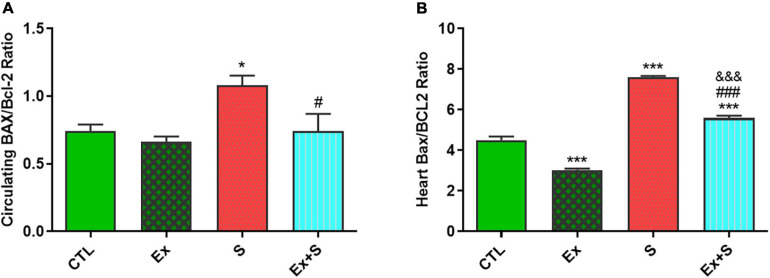
Effects of waterpipe smoke inhalation on Bax/Bcl-2 ratio in serum (A) and in the heart (B) in experimental groups. CTL, control group; Ex, group subjected to exercise training for 8 weeks; S, group subjected to waterpipe tobacco smoke inhalation for 8 weeks; Ex + S, group subjected to exercise training and waterpipe tobacco smoke inhalation for 8 weeks. The results are presented as mean ± SEM, n (6–7). *P < 0.05, ***P < 0.001 vs. CTL; #P < 0.05, ###P < 0.001 vs. S; &&&P < 0.001 vs. Ex.
FIGURE 9
FIGURE 9
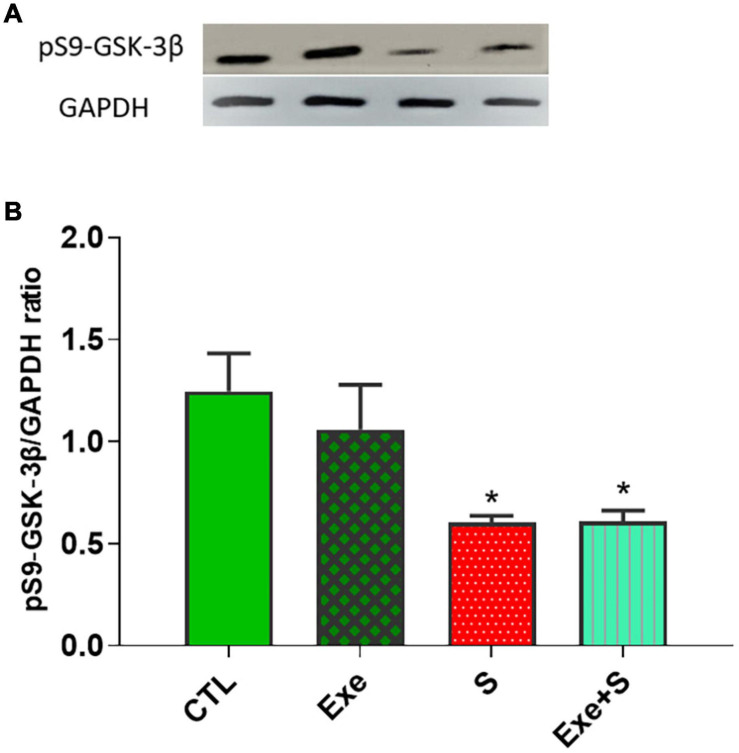
Effects of waterpipe smoke inhalation on the expression of cardiac pS9-GSK-3β proteins (A) and pS9-GSK-3β/ GAPDH ratio (B) in different experimental groups. CTL, control group; Ex, group subjected to exercise training for 8 weeks; S, group subjected to waterpipe tobacco smoke inhalation for 8 weeks; Ex + S, group subjected to exercise training and waterpipe tobacco smoke inahaltion for 8 weeks. The results are presented as mean ± SEM, n = (6–7). *P < 0.05 vs. CTL.
FIGURE 10
FIGURE 10
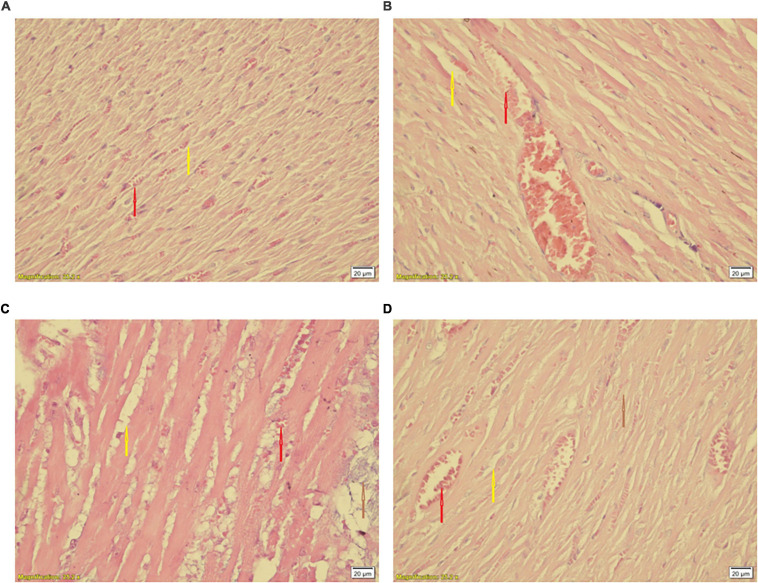
Histological changes of the heart in experimental groups. (A) CTL, (B) Ex, (C) S, and (D) Ex + S. Heart tissues were stained with hematoxylin and eosin and visualized under a light microscope. CTL, control group; Ex, group subjected to exercise training for 8 weeks; S, group subjected to waterpipe tobacco smoke inhalation for 8 weeks; Ex + S, group subjected to exercise training and waterpipe tobacco smoke inhalation for 8 weeks. Histopathological examination was performed under light microscopy at a magnification of ×40. Yellow arrow: interstitial edema, red arrow: congestion, brown arrow: cellular degeneration.

References

    1. al’Absi M., Hatsukami D., Davis G. L., Wittmers L. E. (2004). Prospective examination of effects of smoking abstinence on cortisol and withdrawal symptoms as predictors of early smoking relapse. Drug Alcohol Depend. 73 267–278. 10.1016/j.drugalcdep.2003.10.014 - DOI - PubMed
    1. Al-Awaida W., Akash M., Aburubaiha Z., Talib W. H., Shehadeh H. (2014). Chinese green tea consumption reduces oxidative stress, inflammation and tissues damage in smoke exposed rats. Iran. J. Basic Med. Sci. 17 740–746. - PMC - PubMed
    1. Al-Awaida W., Najjar H., Shraideh Z. (2015). Structural characterization of rat ventricular tissue exposed to the smoke of two types of waterpipe. Iran. J. Basic Med. Sci. 18 942–949. - PMC - PubMed
    1. Al-Eisa E., Alghadir A. H., Gabr S. A., Iqbal Z. A. (2016). Exercise intervention as a protective modulator against metabolic disorders in cigarette smokers. J. Phys. Ther. Sci. 28 983–991. 10.1589/jpts.28.983 - DOI - PMC - PubMed
    1. Baghaiee B., Karimi P., Siahkouhian M., Pescatello L. S. (2018). Moderate aerobic exercise training decreases middle-aged induced pathologic cardiac hypertrophy by improving Klotho expression, MAPK signaling pathway, and oxidative stress status in Wistar rats. Iran. J. Basic Med. Sci. 21:911. - PMC - PubMed