


Effect of a strategy of comprehensive vasodilation versus usual care on health-related quality of life among patients with acute heart failure
- PMID: 34355538
- PMCID: PMC8497201
- DOI: 10.1002/ehf2.13543
Effect of a strategy of comprehensive vasodilation versus usual care on health-related quality of life among patients with acute heart failure
Abstract
Aims: We aimed to assess the long-term effect of a strategy of comprehensive vasodilation versus usual care on health-related quality of life (HRQL) among patients with acute heart failure (AHF).
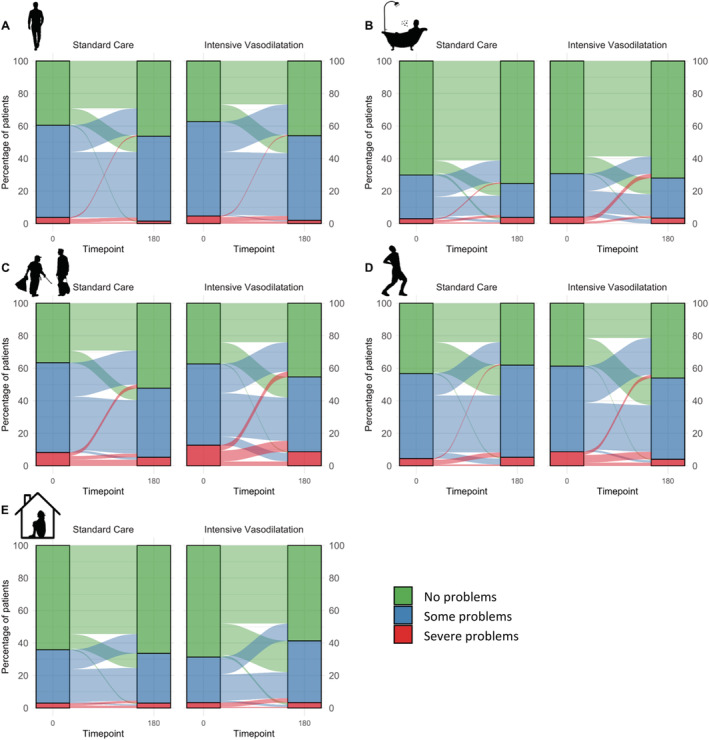
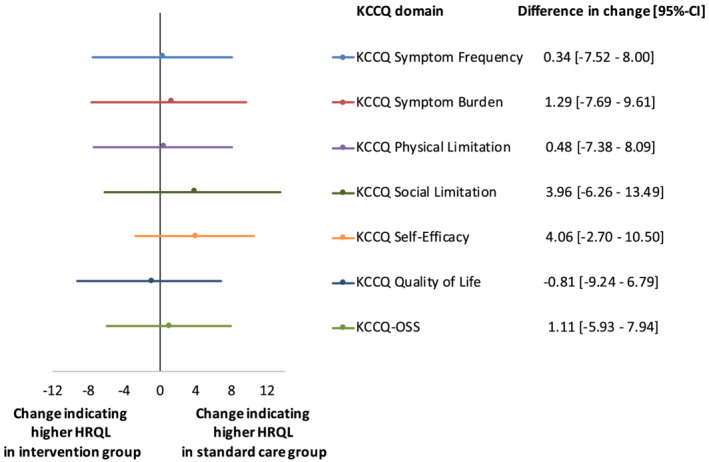
Methods and results: Health-related quality of life was prospectively assessed by the generic 3-levelled EQ-5D and the disease-specific Kansas City Cardiomyopathy Questionnaire (KCCQ) among adult AHF patients enrolled in an international, multicentre, randomised, open-label blinded-end-point trial of a strategy that emphasized early intensive and sustained vasodilation using maximally tolerated doses of established oral and transdermal vasodilators according to systolic blood pressure. Changes in EQ-5D and KCCQ from admission to 180 day follow-up were individually compared between the intensive vasodilatation and the usual care group. Among 666 patients eligible for 180 day follow-up, 284 (43%, median age 79 years, 35% women) and 198 (30%, median age 77 years, 35% women) had completed the EQ-5D and KCCQ at baseline and follow-up, respectively. There was a significant improvement in HRQL as quantified by both, EQ-5D and KCCQ, from hospitalization to 180 day follow-up, with no significant differences in the change of HRQL between both treatment strategies. For instance, 39 (26%) versus 33 (25%) patients had an improvement by at least one level in at least two categories in the EQ-5D. Median increase in KCCQ overall summary score (KCCQ-OSS) was 17.6 (IQR 2.0-42.6) in the intervention group versus 18.5 (IQR 3.9-39.3) in the usual care group (P < 0.001 vs. baseline, P = 0.945 between groups).
Conclusions: Among patients with AHF, long-term HRQL quantified by EQ-5D and KCCQ improved substantially, with overall no significant differences between a strategy of comprehensive vasodilation versus usual care.
Keywords: Acute heart failure; Health-related quality of life; Sustained vasodilatation.
© 2021 The Authors. ESC Heart Failure published by John Wiley & Sons Ltd on behalf of European Society of Cardiology.
Conflict of interest statement
Dr. Gualandro reported receiving personal fees from Servier. Dr. Walter has received research grants from the Swiss Heart Foundation (FF19097 and F18111) as well as the Swiss Academy of Medical Sciences and the Gottfried and Julia Bangerter‐Rhyner Foundation. Dr. Goudev reported receiving personal fees (speaking honoraria and advisory board membership) from Pfizer, Novartis, AstraZeneca, and Amge. Dr. Kozhuharov has received research grants from the Swiss National Science Foundation (P400PM‐194477), Gottfried und Julia Bangerter‐Rhyner‐Stiftung, and the European Society of Cardiology. Dr. Kobza received institutional grants from Abbott, Biosense‐Webster, Biotronik, Boston‐scientific, Medtronic and SIS‐Medical. Dr. Münzel reported being the principal investigator of the DZHK (German Center for Cardiovascular Research) Partner Site Rhine‐Main. Dr. Mueller has received research support from the Swiss National Science Foundation, the Swiss Heart Foundation, the KTI, the University Hospital Basel, Basel University, Abbott, Beckman Coulter, BRAHMS, Idorsia, LSI Medience, Norvartis, Ortho Clinical Diagnostics, Quidel, Roche, Siemens, and Singulex, as well as speaker/consulting honoraria from Acon, Amgen, Astra Zeneca, Bayer, BMS, Boehringer Ingelheim, Daiichi Sankyo, Idorsia, Osler, Novartis, Roche, and Sanofi. All other authors declare that they have no conflict of interest with this study.
Figures
References
-
- Ponikowski P, Voors AA, Anker SD, Bueno H, Cleland JGF, Coats AJS, Falk V, González‐Juanatey JR, Harjola V‐P, Jankowska EA, Jessup M, Linde C, Nihoyannopoulos P, Parissis JT, Pieske B, Riley JP, Rosano GMC, Ruilope LM, Ruschitzka F, Rutten FH, van der Meer P, ESC Scientific Document Group . 2016 ESC Guidelines for the diagnosis and treatment of acute and chronic heart failure: The Task Force for the diagnosis and treatment of acute and chronic heart failure of the European Society of Cardiology (ESC)Developed with the special contribution of the Heart Failure Association (HFA) of the ESC. Eur Heart J 2016; 37: 2129–2200. - PubMed
-
- Yancy CW, Mariell J, Biykem B, Javed B, Casey DE, Colvin MM, Drazner MH, Filippatos GS, Fonarow GC, Givertz MM, Hollenberg SM, JoAnn L, Masoudi FA, McBride PE, Peterson PN, Warner SL, Cheryl W. 2017 ACC/AHA/HFSA Focused Update of the 2013 ACCF/AHA Guideline for the Management of Heart Failure: A Report of the American College of Cardiology/American Heart Association Task Force on Clinical Practice Guidelines and the Heart Failure Society of America. Circulation 2017; 136: e137–e161. - PubMed
-
- Kozhuharov N, Goudev A, Flores D, Maeder MT, Walter J, Shrestha S, Gualandro DM, de Oliveira Junior MT, Sabti Z, Müller B, Noveanu M, Socrates T, Ziller R, Bayés‐Genís A, Sionis A, Simon P, Michou E, Gujer S, Gori T, Wenzel P, Pfister O, Conen D, Kapos I, Kobza R, Rickli H, Breidthardt T, Münzel T, Erne P, Mueller C. Effect of a strategy of comprehensive vasodilation vs usual care on mortality and heart failure rehospitalization among patients with acute heart failure: the GALACTIC randomized clinical trial. JAMA 2019; 322: 2292–2302. - PMC - PubMed
-
- Breidthardt T, Noveanu M, Potocki M, Reichlin T, Egli P, Hartwiger S, Socrates T, Gayat E, Christ M, Mebazaa A, Mueller C. Impact of a high‐dose nitrate strategy on cardiac stress in acute heart failure: a pilot study. J Intern Med 2010; 267: 322–330. - PubMed
-
- Rumsfeld JS, Alexander KP, Goff DC, Graham MM, Ho PM, Masoudi FA, Moser DK, Roger VL, Slaughter MS, Smolderen KG, Spertus JA, Sullivan MD, Treat‐Jacobson D, Zerwic JJ. Cardiovascular health: the importance of measuring patient‐reported health status. Circulation 2013; 127: 2233–2249. - PubMed
Publication types
MeSH terms
Substances
LinkOut - more resources
Full Text Sources
Medical
