


Trends in cancer imaging by indication, care setting, and hospital type during the COVID-19 pandemic and recovery at four hospitals in Massachusetts
- PMID: 34355873
- PMCID: PMC8420511
- DOI: 10.1002/cam4.4183
Trends in cancer imaging by indication, care setting, and hospital type during the COVID-19 pandemic and recovery at four hospitals in Massachusetts
Abstract
Background: We aimed to investigate the effects of COVID-19 on computed tomography (CT) imaging of cancer.
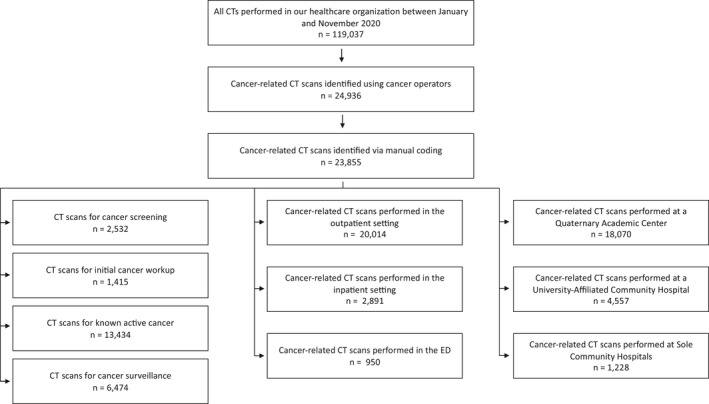
Methods: Cancer-related CTs performed at one academic hospital and three affiliated community hospitals in Massachusetts were retrospectively analyzed. Three periods of 2020 were considered as follows: pre-COVID-19 (1/5/20-3/14/20), COVID-19 peak (3/15/20-5/2/20), and post-COVID-19 peak (5/3/20-11/14/20). 15 March 2020 was the day a state of emergency was declared in MA; 3 May 2020 was the day our hospitals resumed to non-urgent imaging. The volumes were assessed by (1) Imaging indication: cancer screening, initial workup, active cancer, and surveillance; (2) Care setting: outpatient and inpatient, ED; (3) Hospital type: quaternary academic center (QAC), university-affiliated community hospital (UACH), and sole community hospitals (SCHs).
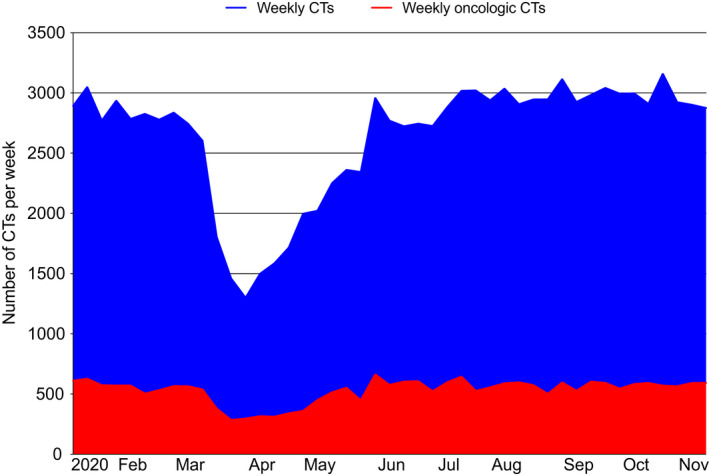
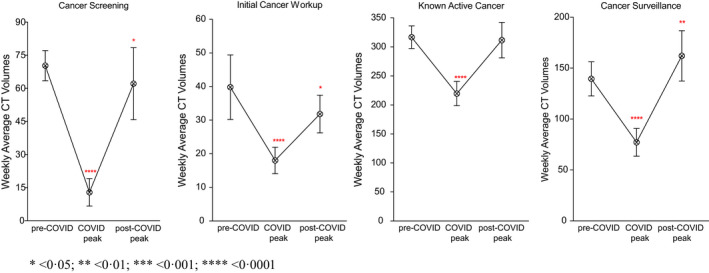
Results: During the COVID-19 peak, a significant drop in CT volumes was observed (-42.2%, p < 0.0001), with cancer screening, initial workup, active cancer, and cancer surveillance declining by 81.7%, 54.8%, 30.7%, and 44.7%, respectively (p < 0.0001). In the post-COVID-19 peak period, cancer screening and initial workup CTs did not recover (-11.7%, p = 0.037; -20.0%, p = 0.031), especially in the outpatient setting. CT volumes for active cancer recovered, but inconsistently across hospital types: the QAC experienced a 9.4% decline (p = 0.022) and the UACH a 41.5% increase (p < 0.001). Outpatient CTs recovered after the COVID-19 peak, but with a shift in utilization away from the QAC (-8.7%, p = 0.020) toward the UACH (+13.3%, p = 0.013). Inpatient and ED-based oncologic CTs increased post-peak (+20.0%, p = 0.004 and +33.2%, p = 0.009, respectively).
Conclusions: Cancer imaging was severely impacted during the COVID-19 pandemic. CTs for cancer screening and initial workup did not recover to pre-COVID-19 levels well into 2020, a finding that suggests more patients with advanced cancers may present in the future. A redistribution of imaging utilization away from the QAC and outpatient settings, toward the community hospitals and inpatient setting/ED was observed.
Keywords: COVID-19 pandemic; X-ray computed; cancer; imaging; medical; neoplasms; tomography.
© 2021 The Authors. Cancer Medicine published by John Wiley & Sons Ltd.
Conflict of interest statement
The authors declare no relevant conflict of interest.
Figures
References
-
- The Commonwealth of Massachusetts. Memorandum: Nonessential, Elective Invasive Procedures in Hospitals and Ambulatory Surgical Centers during the COVID‐19 Outbreak. Executive Office of Health and Human Services DoPH, Bureau of Health Care Safety and, Quality ed. MA The Government of Massachusetts; 2020.
-
- Park R, Lee SA, Kim SY, de Melo AC, Kasi A. Association of active oncologic treatment and risk of death in cancer patients with COVID‐19: a systematic review and meta‐analysis of patient data. Acta Oncol. 2020;60(1):13‐19. - PubMed
MeSH terms
LinkOut - more resources
Full Text Sources
Medical
Research Materials
