


Genomic Mosaicism Formed by Somatic Variation in the Aging and Diseased Brain
- PMID: 34356087
- PMCID: PMC8305509
- DOI: 10.3390/genes12071071
Genomic Mosaicism Formed by Somatic Variation in the Aging and Diseased Brain
Abstract
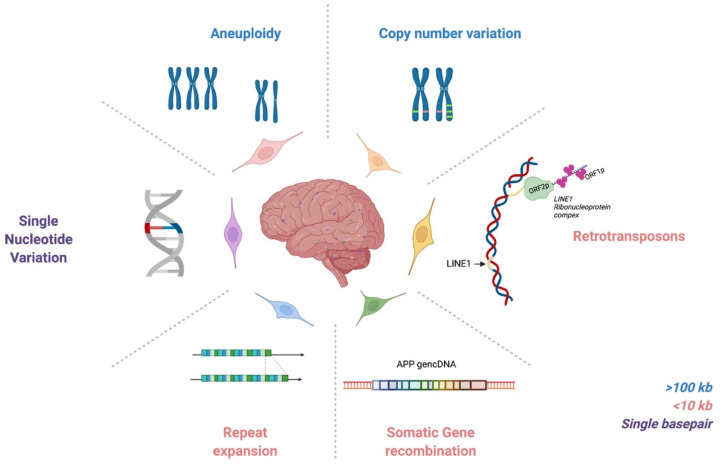
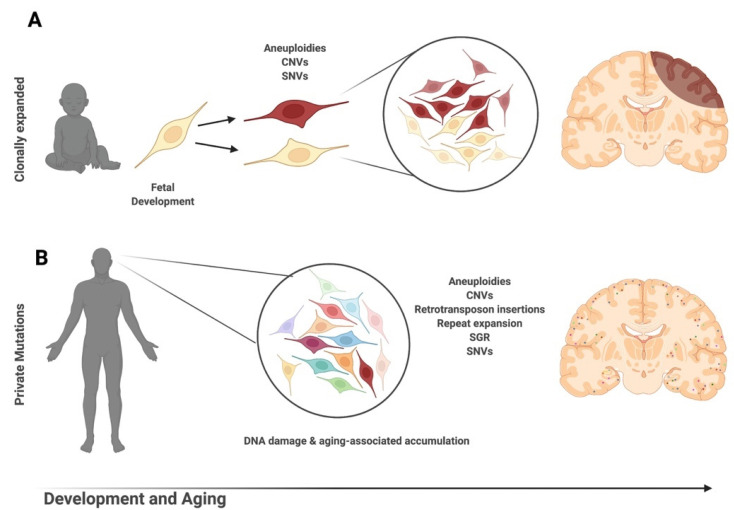
Over the past 20 years, analyses of single brain cell genomes have revealed that the brain is composed of cells with myriad distinct genomes: the brain is a genomic mosaic, generated by a host of DNA sequence-altering processes that occur somatically and do not affect the germline. As such, these sequence changes are not heritable. Some processes appear to occur during neurogenesis, when cells are mitotic, whereas others may also function in post-mitotic cells. Here, we review multiple forms of DNA sequence alterations that have now been documented: aneuploidies and aneusomies, smaller copy number variations (CNVs), somatic repeat expansions, retrotransposons, genomic cDNAs (gencDNAs) associated with somatic gene recombination (SGR), and single nucleotide variations (SNVs). A catch-all term of DNA content variation (DCV) has also been used to describe the overall phenomenon, which can include multiple forms within a single cell's genome. A requisite step in the analyses of genomic mosaicism is ongoing technology development, which is also discussed. Genomic mosaicism alters one of the most stable biological molecules, DNA, which may have many repercussions, ranging from normal functions including effects of aging, to creating dysfunction that occurs in neurodegenerative and other brain diseases, most of which show sporadic presentation, unlinked to causal, heritable genes.
Keywords: Alzheimer’s disease; Parkinson’s disease; amyotrophic lateral sclerosis; aneuploidy; copy number variation; repeat expansion; retrotransposons; single-nucleotide variation; somatic gene recombination; somatic variation.
Conflict of interest statement
J.C. is a co-founder of Mosaic Pharmaceuticals.
Figures
References
-
- Cajal S.R.y. Studies on the Cerebral Cortex. Volume 1 University of Madrid; Madrid, Spain: 1901.
-
- Cajal S.R.y. Histologie du Système Nerveux de L’homme et des Vertébrés. Maloine; Paris, French: 1909.
-
- Cajal S.R.y. In: Studies on Vertebrate Neurogenesis. Thomas C.C., editor. Springfield; Virgina, VA, USA: 1960.
Publication types
MeSH terms
Grants and funding
LinkOut - more resources
Full Text Sources
Medical
Research Materials
Miscellaneous
