. 2021 Jul 3;10(7):1073.
doi: 10.3390/antiox10071073.

Blood Pressure-Lowering Effect of Wine Lees Phenolic Compounds Is Mediated by Endothelial-Derived Factors: Role of Sirtuin 1

Affiliations

Blood Pressure-Lowering Effect of Wine Lees Phenolic Compounds Is Mediated by Endothelial-Derived Factors: Role of Sirtuin 1

Raúl López-Fernández-Sobrino et al. Antioxidants (Basel). .

Abstract

The antihypertensive effect of wine lees powder (WLPW) from a Cabernet grape variety was related to its high content in flavanols and anthocyanins compounds. This study investigates the involvement of endothelial-derived factors and SIRT1 in its bioactivity. Spontaneously hypertensive rats (SHR) were orally administered water or WLPW (125 mg/kg bw). Posteriorly, both groups were intraperitoneally administered saline, Nω-nitro-L-arginine methyl ester (L-NAME), a nitric oxide (NO) synthesis inhibitor, indomethacin, a prostacyclin synthesis inhibitor, or sirtinol, an inhibitor of sirtuins. Blood pressure (BP) was recorded before and 6 h after WLPW administration. In an additional experiment, SHR were administered water or WLPW and endothelial expressions of eNos, Sirt1, Nox4, and Et1 were determined. The BP-lowering properties of WLPW were abolished by L-NAME and partially reduced by indomethacin, demonstrating that WLPW antihypertensive effect was mediated by changes in NO availability, although prostacyclin also contributed to this activity. Moreover, BP-lowering effect was reduced by sirtinol, indicating that WLPW decreased BP in a SIRT1-dependent manner. Furthermore, WLPW upregulated eNos and Sirt1 and downregulated Nox4 and Et1 endothelial gene expression. These results evidence the vasoprotective effect of WLPW and show that its antihypertensive effect in SHR is endothelium dependent and mediated by SIRT1.

Keywords: NADPH oxidase; endothelial function; endothelial nitric oxide synthase; endothelin-1; spontaneously hypertensive rats.


Conflict of interest statement

The authors declare no conflict of interest.

Figures
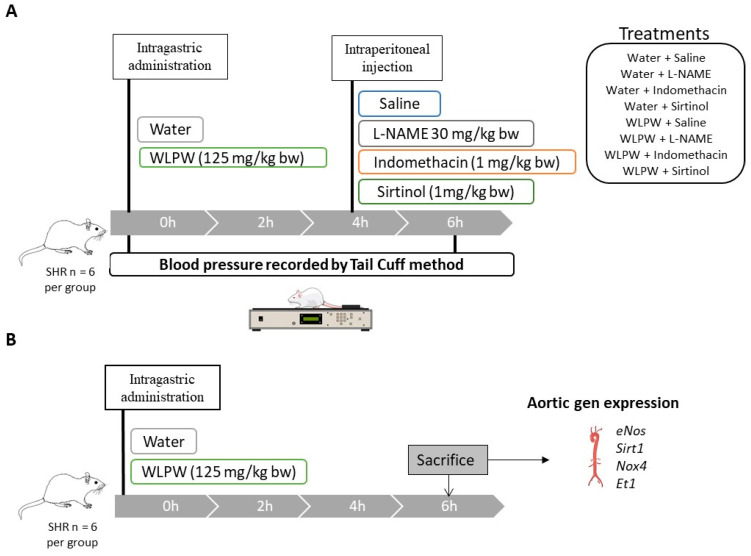
Figure 1
Figure 1
Graphical representation of the experimental design for Nω-nitro-L-arginine methyl ester hydrochloride (L-NAME), indomethacin and sirtinol study in spontaneously hypertensive rats (SHR) (A), and graphical representation of the experimental design used to study the effects of wine lees powder (WLPW) on the endothelial function (B).
Figure 2
Figure 2
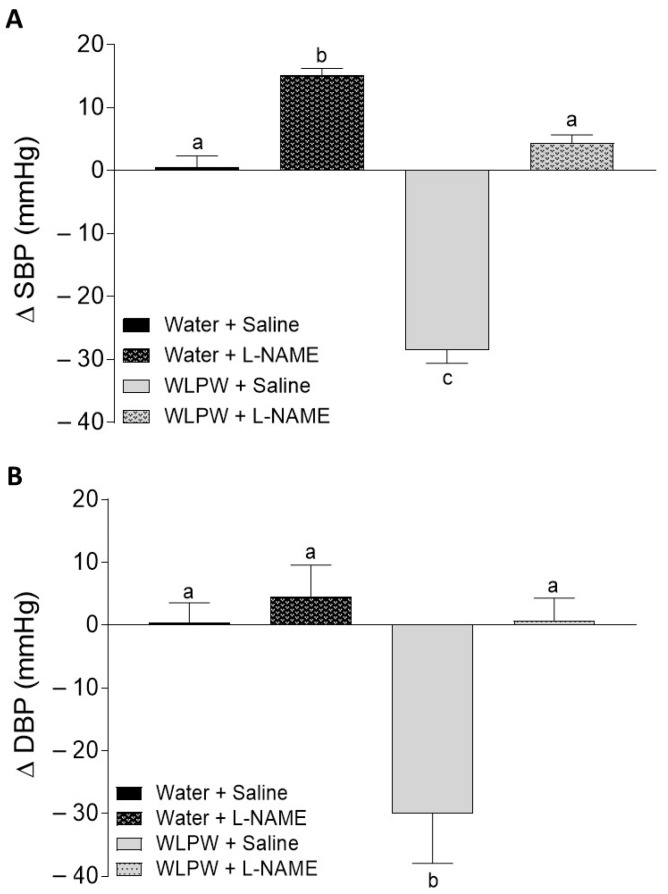
Changes in systolic blood pressure (SBP) (A) and diastolic blood pressure (DBP) (B) caused in spontaneously hypertensive rats 6 h post-administration by different treatments: oral administration of water or wine lees powder (WLPW) and intraperitoneal injection of Saline or Nω-nitro-L-arginine methyl ester hydrochloride (L-NAME). Significant differences (p < 0.05) are represented by different letters and p was estimated by one-way ANOVA.
Figure 3
Figure 3
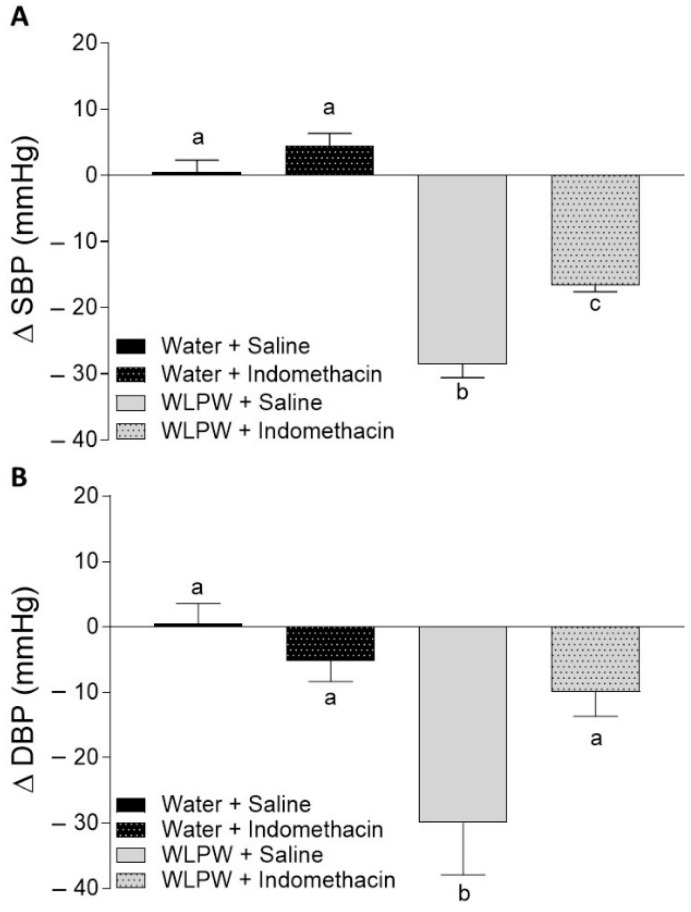
Changes in systolic blood pressure (SBP) (A) and diastolic blood pressure (DBP) (B) caused in spontaneously hypertensive rats 6 h post-administration by different treatments: oral administration of water or wine lees powder (WLPW) and intraperitoneal injection of Saline or Indomethacin. Significant differences (p < 0.05) are represented by different letters and p was estimated by one-way ANOVA.
Figure 4
Figure 4
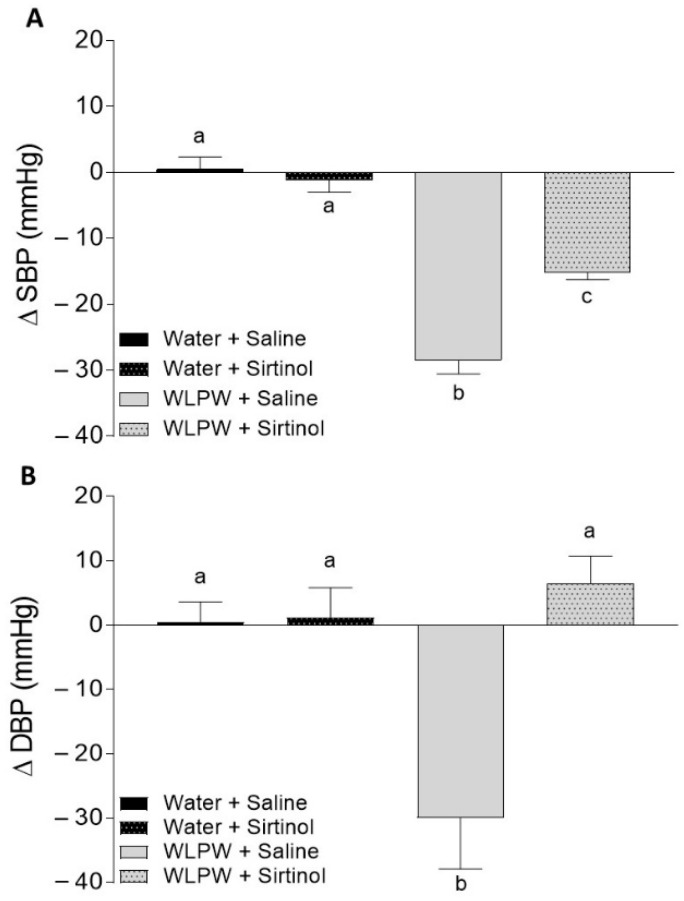
Changes in systolic blood pressure (SBP) (A) and diastolic blood pressure (DBP) (B) caused in spontaneously hypertensive rats 6 h post-administration by different treatments: oral administration of water or wine lees powder (WLPW) and intraperitoneal injection of Saline or Sirtinol. Significant differences (p < 0.05) are represented by different letters and p was estimated by one-way ANOVA.
Figure 5
Figure 5
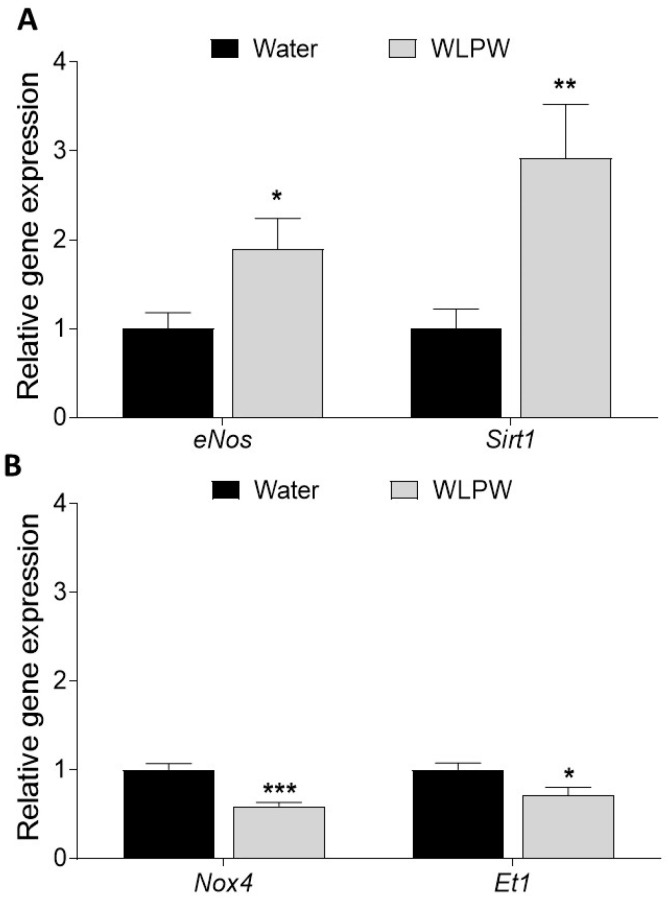
Aortic gene expression of eNos and Sirt1 (A) and Nox4 and Et1 (B) in spontaneously hypertensive rats 6 h after administration with water or wine lees powder (WLPW). Statistical differences between treatments were carried out by Student’s t-test when (*) p < 0.05, (**) p < 0.01 or (***) p > 0.001.
Figure 6
Figure 6
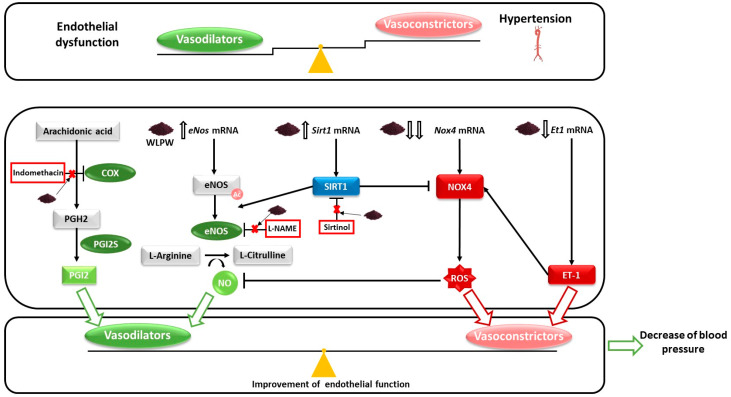
Schematic representation of the molecular mechanisms involved in the blood pressure (BP)-lowering effect of wine lees powder (WLPW) in endothelium. WLPW upregulates endothelial nitric oxide (eNos) mRNA levels, which would lead to higher production of nitric oxide (NO). WLPW increases plasma NO levels [15]. Sirtuin-1 (Sirt1) mRNA levels are also upregulated by WLPW. The enzyme SIRT1, which mediates partially the antihypertensive effect of WLPW, demonstrated after sirtinol administration, is able to increase eNos expression. In addition, SIRT1 deacetylates and activates eNOS and inhibits NADPH oxidase subunit 4 (NOX4). Furthermore, Nox4 mRNA levels were downregulated by WLPW. The decrease in the expression and activity of NOX4 would lead to a decrease in radical oxygen species (ROS) production and consequently, an increase in NO availability. All these events would lead to the increase of NO availability, which mediates the antihypertensive effect of WLPW, as it has been demonstrated after L-NAME administration. WLPW exerts an improvement of oxidative stress since reduces levels of hepatic ROS and plasma malondialdehyde and increases levels of hepatic reduced glutathione [15]. In addition, the indomethacin study has demonstrated that the endothelium-derived vasodilator factor prostaglandin I2 (PGI2) mediates partially the BP-lowering effect of WLPW. Moreover, WLPW also downregulates the expression of the vasoconstrictor endothelin-1 (Et1) mRNA levels, which would lead to lower production of NO. All of these factors lead to a restoration of the imbalance of endothelial-derived vasodilator and vasoconstrictor factors caused by hypertension, improving endothelial function and decreasing BP. Arrows ending in points represent activation and those ending in lines represent inhibition. Red crosses indicate that WLPW antihypertensive effect disappears totally or partially when animals are further treated indomethacin, L-NAME or sirtinol.

References

    1. Spieker L.E., Flammer A.J., Lüscher T.F. Handbook of Experimental Pharmacology. Springer; Berlin/Heidelberg, Germany: 2006. The vascular endothelium in hypertension; pp. 249–283. - DOI - PubMed
    1. Konukoglu D., Uzun H. Advances in Experimental Medicine and Biology. Volume 956. Springer; New York, NY, USA: 2016. Endothelial dysfunction and hypertension; pp. 511–540. - PubMed
    1. Vallance P., Collier J., Moncada S. Effects of Endothelium-Derived Nitric Oxide on Peripheral Arteriolar Tone in Man. Lancet. 1989;334:997–1000. doi: 10.1016/S0140-6736(89)91013-1. - DOI - PubMed
    1. Förstermann U., Sessa W.C. Nitric Oxide Synthases: Regulation and Function. Eur. Heart J. 2012;33:829–837. doi: 10.1093/eurheartj/ehr304. - DOI - PMC - PubMed
    1. Bucci M., Gratton J.-P., Rudic R.D., Acevedo L., Roviezzo F., Cirino G., Sessa W.C. In Vivo Delivery of the Caveolin-1 Scaffolding Domain Inhibits Nitric Oxide Synthesis and Reduces Inflammation. Nat. Med. 2000;6:1362–1367. doi: 10.1038/82176. - DOI - PubMed

LinkOut - more resources