


Bacterial Natural Product Drug Discovery for New Antibiotics: Strategies for Tackling the Problem of Antibiotic Resistance by Efficient Bioprospecting
- PMID: 34356763
- PMCID: PMC8300778
- DOI: 10.3390/antibiotics10070842
Bacterial Natural Product Drug Discovery for New Antibiotics: Strategies for Tackling the Problem of Antibiotic Resistance by Efficient Bioprospecting
Abstract
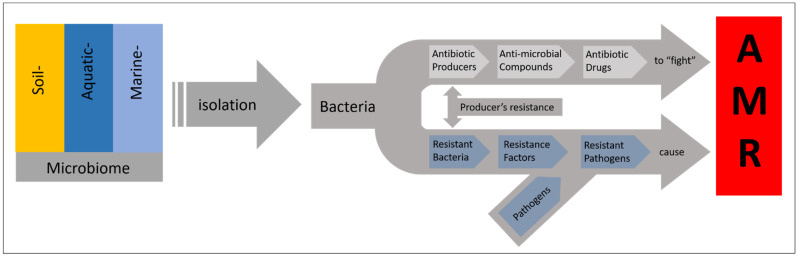
The problem of antibiotic resistance has become a challenge for our public health and society; it has allowed infectious diseases to re-emerge as a risk to human health. New antibiotics that are introduced to the market face the rise of resistant pathogens after a certain period of use. The relatively fast development of resistance against some antibiotics seems to be closely linked to their microbial origin and function in nature. Antibiotics in clinical use are merely products of microorganisms or derivatives of microbial products. The evolution of these antimicrobial compounds has progressed with the evolution of the respective resistance mechanisms in microbes for billions of years. Thus, antimicrobial resistance genes are present within the environment and can be taken up by pathogens through horizontal gene transfer. Natural products from bacteria are an important source of leads for drug development, and microbial natural products have contributed the most antibiotics in current clinical use. Bioprospecting for new antibiotics is a labor-intensive task as obstacles such as redetection of known compounds and low compound yields consume significant resources. The number of bacterial isolates one can theoretically investigate for new secondary metabolites is, on the other hand, immense. Therefore, the available capacity for biodiscovery should be focused on the most promising sources for chemical novelty and bioactivity, employing the appropriate scientific tools. This can be done by first looking into under- or unexplored environments for bacterial isolates and by focusing on the promising candidates to reduce the number of subjects.
Keywords: actinobacteria; antibiotic resistance; antibiotics; bioprospecting; biosynthetic potential; cyanobacteria; drug discovery; myxobacteria; natural products; secondary metabolites.
Conflict of interest statement
The author declares to have no conflict of interest.
Figures
References
-
- Fleming A. Penicillin’s finder assays its future. N. Y. Times. 1945;26:21.
-
- World Health Organization . The Evolving Threat of Antimicrobial Resistance: Options for Actions. World Health Organization; Geneva, Switzerland: 2012.
Grants and funding
LinkOut - more resources
Full Text Sources
