Review
. 2021 Jul 7;9(7):785.
doi: 10.3390/biomedicines9070785.

Mesenchymal Stem Cells: Current Concepts in the Management of Inflammation in Osteoarthritis

Affiliations
Review

Mesenchymal Stem Cells: Current Concepts in the Management of Inflammation in Osteoarthritis

Asma Abdullah Nurul et al. Biomedicines. .

Abstract

Osteoarthritis (OA) has traditionally been known as a "wear and tear" disease, which is mainly characterized by the degradation of articular cartilage and changes in the subchondral bone. Despite the fact that OA is often thought of as a degenerative disease, the catabolic products of the cartilage matrix often promote inflammation by activating immune cells. Current OA treatment focuses on symptomatic treatment, with a primary focus on pain management, which does not promote cartilage regeneration or attenuate joint inflammation. Since articular cartilage have no ability to regenerate, thus regeneration of the tissue is one of the key targets of modern treatments for OA. Cell-based therapies are among the new therapeutic strategies for OA. Mesenchymal stem cells (MSCs) have been extensively researched as potential therapeutic agents in cell-based therapy of OA due to their ability to differentiate into chondrocytes and their immunomodulatory properties that can facilitate cartilage repair and regeneration. In this review, we emphasized current knowledge and future perspectives on the use of MSCs by targeting their regeneration potential and immunomodulatory effects in the treatment of OA.

Keywords: cartilage regeneration; extracellular vesicles; inflammation; mesenchymal stem cell; osteoarthritis.


Conflict of interest statement

The authors declare no conflict of interest.

Figures
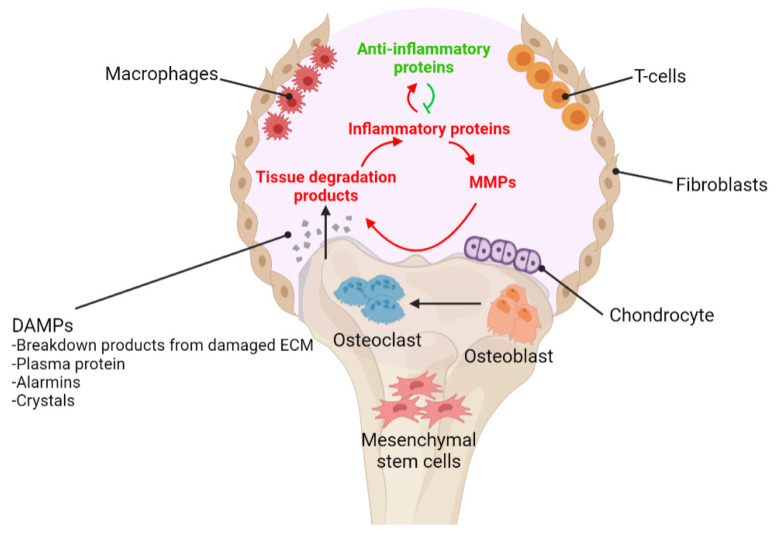
Figure 1
Figure 1
Schematic representation of inflammation process in osteoarthritis. OA is defined by the progressive breakdown of articular cartilage and subchondral bone, and also low-grade inflammation. Following joint injury, cartilage tissue damage causes the production of damage-associated molecular patterns (DAMPs), which include cartilage extracellular matrix (ECM) breakdown products and intracellular alarmins that signal pattern recognition receptors on synovial macrophages, fibroblasts, T cells, or chondrocytes to induce the local release of inflammatory mediators. These activated cells will produce inflammatory factors such as cytokines, chemokines, and catabolic enzymes, either directly or indirectly by inducing proteolytic enzymes which will accelerate cartilage destruction in the progressing osteoarthritis.
Figure 2
Figure 2
The origin and differentiation potential of mesenchymal stem cells.
Figure 3
Figure 3
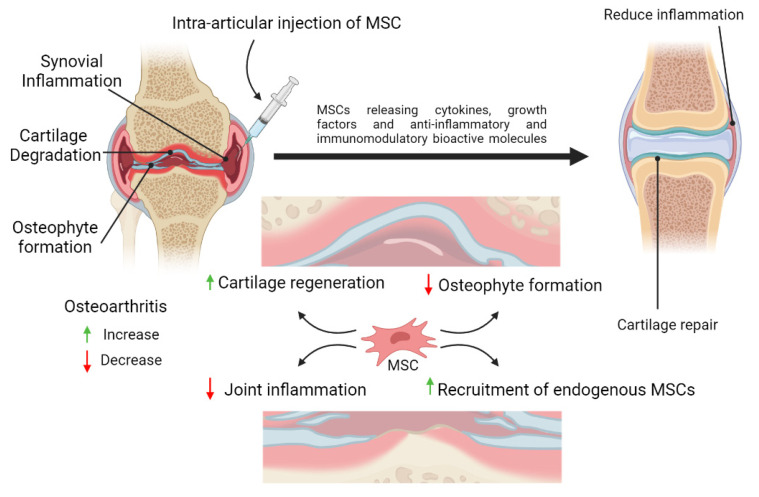
Schematic representation of the potential therapeutic strategies utilizing mesenchymal stem cells (MSCs) therapy for cartilage repair and regeneration. MSCs possess anti-inflammatory and immunomodulatory properties which could reduce inflammation in the joint. MSCs may also assist in the healing process by differentiating into chondrocytes or promoting the proliferation and differentiation of the remaining healthy chondroprogenitors into mature chondrocytes, or both. By releasing trophic factors and cell-to-cell interactions, MSCs may enhance cartilage regeneration and reduce synovial inflammation in the osteoarthritic joint.

References

    1. Kandahari A.M., Yang X., Dighe A.S., Pan D., Cui Q. Recognition of Immune Response for the Early Diagnosis and Treatment of Osteoarthritis. J. Immunol. Res. 2015;2015:1–13. doi: 10.1155/2015/192415. - DOI - PMC - PubMed
    1. Arthritis by the Numbers. [(accessed on 19 December 2020)]; Available online: https://www.arthritis.org/getmedia/e1256607-fa87-4593-aa8a-8db4f291072a/....
    1. Felson D.T. Osteoarthritis of the Knee. N. Engl. J. Med. 2006;354:841–848. doi: 10.1056/NEJMcp051726. - DOI - PubMed
    1. Murphy G., Lee M.H. What are the roles of metalloproteinases in cartilage and bone damage? Ann. Rheum. Dis. 2005;64(Suppl. 4):iv44–iv47. doi: 10.1136/ard.2005.042465. - DOI - PMC - PubMed
    1. Mehana E.-S.E., Khafaga A.F., Elblehi S. The role of matrix metalloproteinases in osteoarthritis pathogenesis: An updated review. Life Sci. 2019;234:116786. doi: 10.1016/j.lfs.2019.116786. - DOI - PubMed

LinkOut - more resources