Review
. 2021 Jul 20;9(7):842.
doi: 10.3390/biomedicines9070842.

Ovarian Telomerase and Female Fertility

Affiliations
Review

Ovarian Telomerase and Female Fertility

Simon Toupance et al. Biomedicines. .

Abstract

Women's fertility is characterized both quantitatively and qualitatively mainly by the pool of ovarian follicles. Monthly, gonadotropins cause an intense multiplication of granulosa cells surrounding the oocyte. This step of follicular development requires a high proliferation ability for these cells. Telomere length plays a crucial role in the mitotic index of human cells. Hence, disrupting telomere homeostasis could directly affect women's fertility. Strongly expressed in ovaries, telomerase is the most effective factor to limit telomeric attrition and preserve ovarian reserve. Considering these facts, two situations of infertility could be correlated with the length of telomeres and ovarian telomerase activity: PolyCystic Ovary Syndrome (PCOS), which is associated with a high density of small antral follicles, and Premature Ovarian Failure (POF), which is associated with a premature decrease in ovarian reserve. Several authors have studied this topic, expecting to find long telomeres and strong telomerase activity in PCOS and short telomeres and low telomerase activity in POF patients. Although the results of these studies are contradictory, telomere length and the ovarian telomerase impact in women's fertility disorders appear obvious. In this context, our research perspectives aimed to explore the stimulation of ovarian telomerase to limit the decrease in the follicular pool while avoiding an increase in cancer risk.

Keywords: female fertility; hTERT; telomerase.


Conflict of interest statement

The authors declare no conflict of interest.

Figures
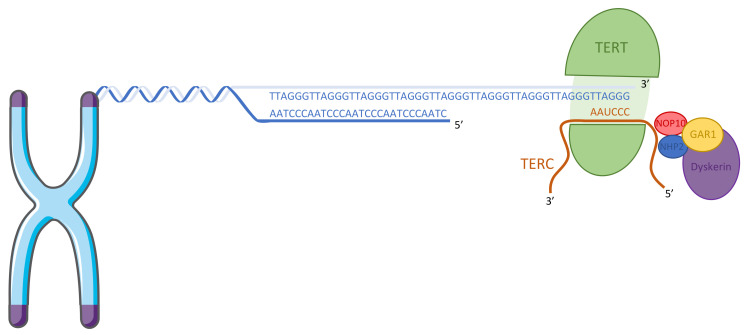
Figure 1
Figure 1
Structure of telomerase. The catalytic reverse transcriptase subunit TERT associate with the template RNA component TERC and is stabilized by the dyskerin complex (NOP10, NHP2, GAR1, and dyskerin).
Figure 2
Figure 2
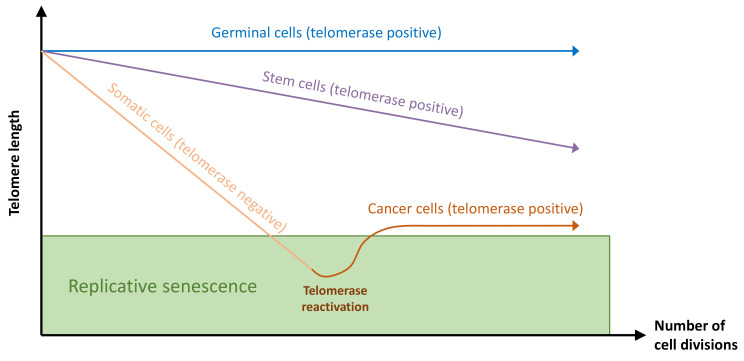
Telomere length dynamics in germinal, stem, somatic, and cancer cells according to the presence of telomerase activity. In germinal and stem cells, active telomerase can offset telomere attrition due to cell divisions. In somatic cells, telomerase is inactive, and telomere length is shortened until it reaches a threshold that triggers replicative senescence. Cancer cells can bypass cell senescence by the reactivation of telomerase.
Figure 3
Figure 3
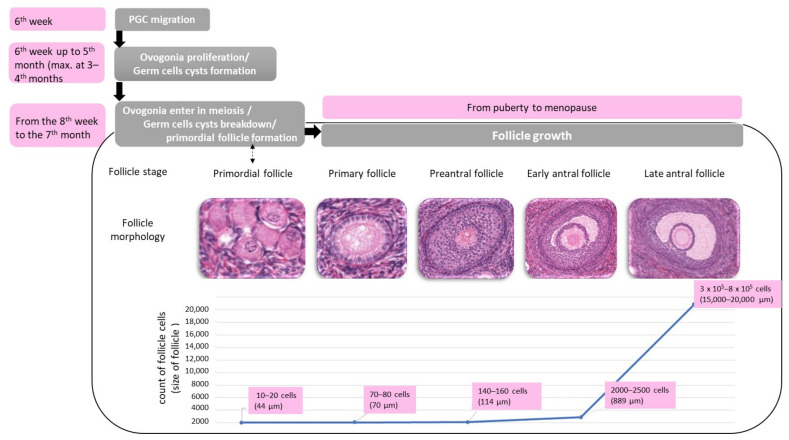
Human folliculogenesis and granulosa cells proliferation. The figure describes the different stages of follicle growth and the corresponding granulosa cell count and follicle size. Granulosa cells need to display a high proliferative potential to accommodate the tremendous proliferation needed during folliculogenesis.

References

    1. López-Otín C., Blasco M.A., Partridge L., Serrano M., Kroemer G. The Hallmarks of Aging. Cell. 2013;153:1194–1217. doi: 10.1016/j.cell.2013.05.039. - DOI - PMC - PubMed
    1. Greider C.W., Blackburn E.H. Identification of a Specific Telomere Terminal Transferase Activity in Tetrahymena Extracts. Cell. 1985;43:405–413. doi: 10.1016/0092-8674(85)90170-9. - DOI - PubMed
    1. Blackburn E.H., Collins K. Telomerase: An RNP Enzyme Synthesizes DNA. Cold Spring Harb. Perspect. Biol. 2011;3 doi: 10.1101/cshperspect.a003558. - DOI - PMC - PubMed
    1. Wright W.E., Piatyszek M.A., Rainey W.E., Byrd W., Shay J.W. Telomerase Activity in Human Germline and Embryonic Tissues and Cells. Dev. Genet. 1996;18:173–179. doi: 10.1002/(SICI)1520-6408(1996)18:2<173::AID-DVG10>3.0.CO;2-3. - DOI - PubMed
    1. Hiyama E., Hiyama K. Telomere and Telomerase in Stem Cells. Br. J. Cancer. 2007;96:1020–1024. doi: 10.1038/sj.bjc.6603671. - DOI - PMC - PubMed

LinkOut - more resources