Review
. 2021 Jul 9;11(7):672.
doi: 10.3390/life11070672.

Inflammation in Metabolic and Cardiovascular Disorders-Role of Oxidative Stress

Affiliations
Review

Inflammation in Metabolic and Cardiovascular Disorders-Role of Oxidative Stress

Ying Sun et al. Life (Basel). .

Abstract

Cardiovascular diseases (CVD) constitute the main cause of death worldwide. Both inflammation and oxidative stress have been reported to be involved in the progress of CVD. It is well known that generation of oxidative stress during the course of CVD is involved in tissue damage and inflammation, causing deleterious effects such as hypertension, dysfunctional metabolism, endothelial dysfunction, stroke, and myocardial infarction. Remarkably, natural antioxidant strategies have been increasingly discovered and are subject to current scientific investigations. Here, we addressed the activation of immune cells in the context of ROS production, as well as how their interaction with other cellular players and further (immune) mediators contribute to metabolic and cardiovascular disorders. We also highlight how a dysregulated complement system contributes to immune imbalance and tissue damage in the context of increases oxidative stress. Additionally, modulation of hypothalamic oxidative stress is discussed, which may offer novel treatment strategies for type-2 diabetes and obesity. Together, we provide new perspectives on therapy strategies for CVD caused by oxidative stress, with a focus on oxidative stress.

Keywords: adipose tissue; cardiovascular diseases; hypothalamic dysfunction; metabolic disorders; oxidative stress.


Conflict of interest statement

The authors declare that no conflict of interest exists.

Figures
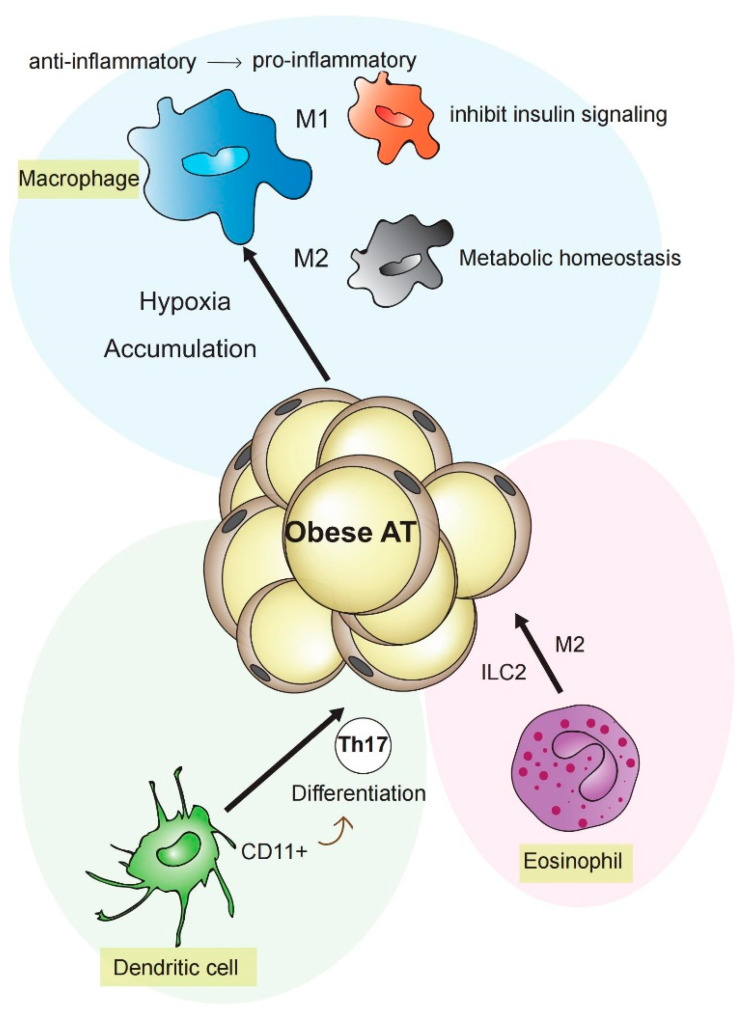
Figure 1
Figure 1
Contribution of different cell types to inflammation in adipose tissue. Mature CD11+DCs induce differentiation of Th17 under obesity-related insulin resistance and contribute to adipose tissue inflammation. Eosinophils, M2 macrophages, and type 2 innate lymphoid cells regulate metabolic homeostasis in adipose tissue by cytokine expression or dependence upon the γc cytokine chain. Under obesity conditions, M1-like macrophages lead to insulin resistance. Following the adipose increase, macrophage phenotype changed from anti-inflammatory M2 to pro-inflammatory M1 type.
Figure 2
Figure 2
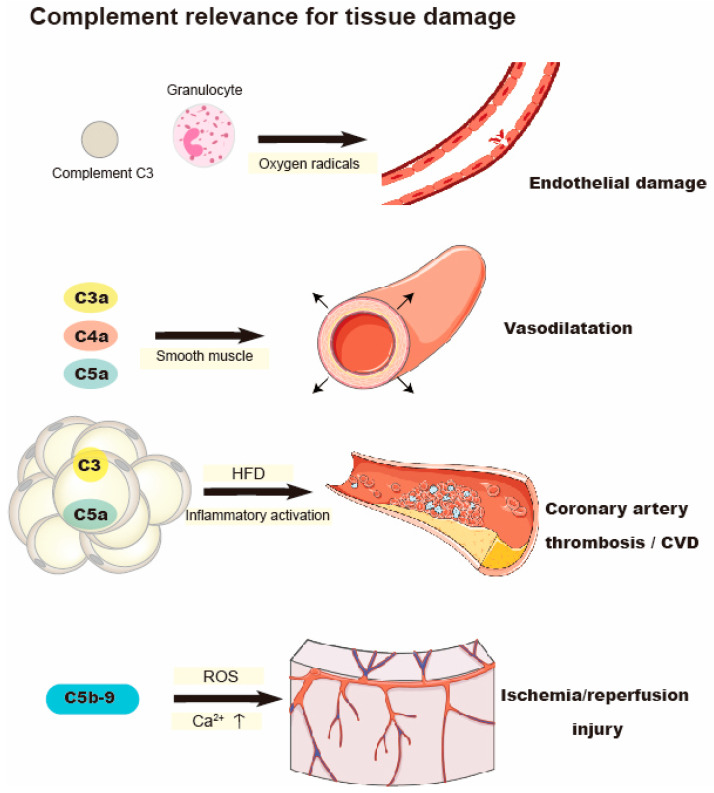
Complement-mediated oxidative stress and its relevance to tissue damage. After exposure to complement C3, oxygen radicals produced by granulocytes contribute to the endothelial damage. C3, C3a, C4a, and C5a are involved in vessel damage in CVD. Activated C5b-9 aggravates ischemia/reperfusion injury.

References

    1. Hotamisligil G.S. Inflammation and metabolic disorders. Nature. 2006;444:860–867. doi: 10.1038/nature05485. - DOI - PubMed
    1. Kelly B., O’Neill L.A. Metabolic reprogramming in macrophages and dendritic cells in innate immunity. Cell Res. 2015;25:771–784. doi: 10.1038/cr.2015.68. - DOI - PMC - PubMed
    1. O’Neill L.A.J., Pearce E.J. Immunometabolism governs dendritic cell and macrophage function. J. Exp. Med. 2016;213:15–23. doi: 10.1084/jem.20151570. - DOI - PMC - PubMed
    1. Mantovani A., Sica A., Sozzani S., Allavena P., Vecchi A., Locati M. The chemokine system in diverse forms of macrophage activation and polarization. Trends Immunol. 2004;25:677–686. doi: 10.1016/j.it.2004.09.015. - DOI - PubMed
    1. Gordon S., Martinez F.O. Alternative Activation of Macrophages: Mechanism and Functions. Immunity. 2010;32:593–604. doi: 10.1016/j.immuni.2010.05.007. - DOI - PubMed

LinkOut - more resources