


ADME and Pharmacokinetic Properties of Remdesivir: Its Drug Interaction Potential
- PMID: 34358081
- PMCID: PMC8308800
- DOI: 10.3390/ph14070655
ADME and Pharmacokinetic Properties of Remdesivir: Its Drug Interaction Potential
Abstract
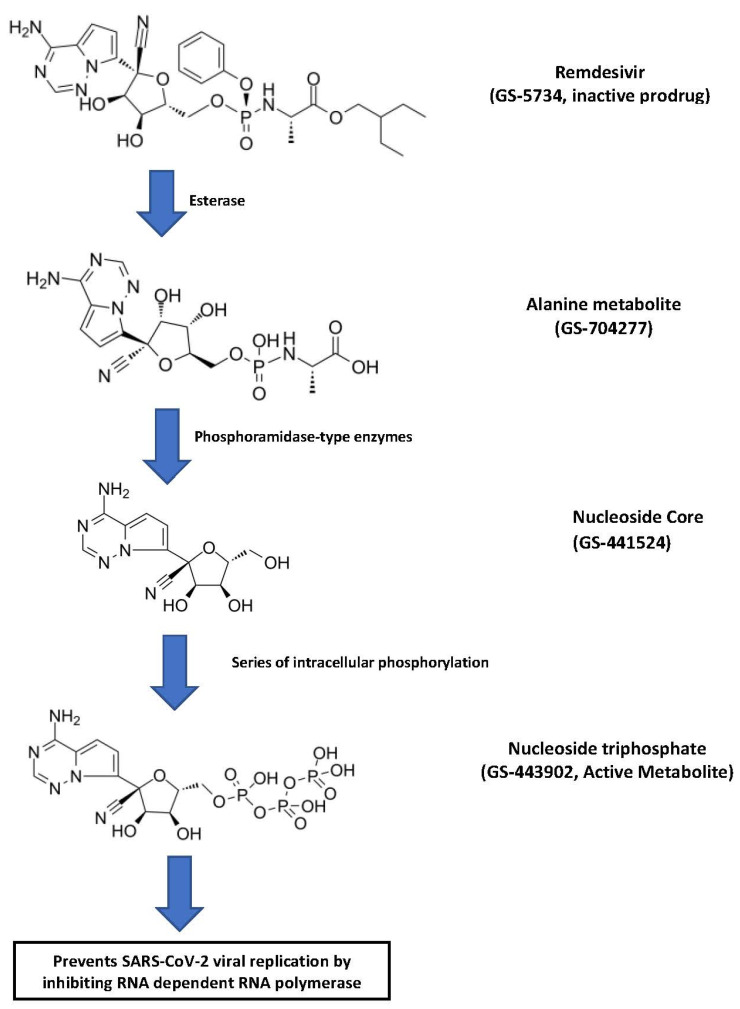
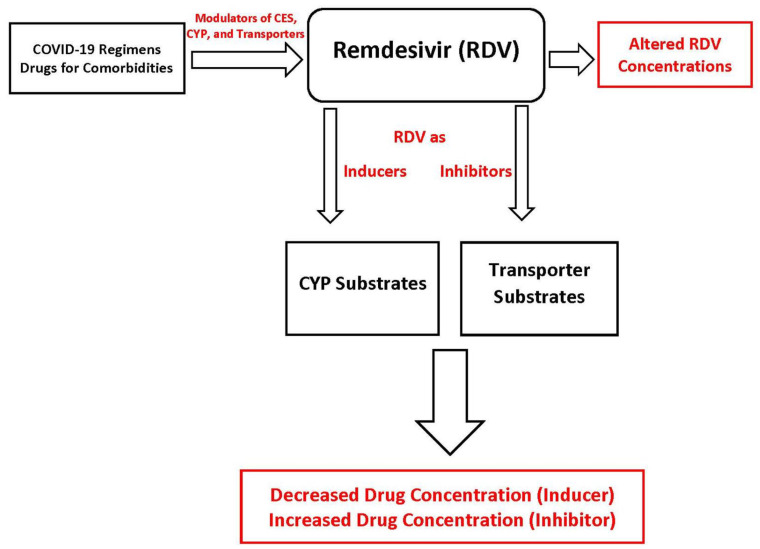
On 11 March 2020, the World Health Organization (WHO) classified the Coronavirus Disease 2019 (COVID-19) as a global pandemic, which tested healthcare systems, administrations, and treatment ingenuity across the world. COVID-19 is caused by the novel beta coronavirus Severe Acute Respiratory Syndrome Coronavirus 2 (SARS-CoV-2). Since the inception of the pandemic, treatment options have been either limited or ineffective. Remdesivir, a drug originally designed to be used for Ebola virus, has antiviral activity against SARS-CoV-2 and has been included in the COVID-19 treatment regimens. Remdesivir is an adenosine nucleotide analog prodrug that is metabolically activated to a nucleoside triphosphate metabolite (GS-443902). The active nucleoside triphosphate metabolite is incorporated into the SARS-CoV-2 RNA viral chains, preventing its replication. The lack of reported drug development and characterization studies with remdesivir in public domain has created a void where information on the absorption, distribution, metabolism, elimination (ADME) properties, pharmacokinetics (PK), or drug-drug interaction (DDI) is limited. By understanding these properties, clinicians can prevent subtherapeutic and supratherapeutic levels of remdesivir and thus avoid further complications in COVID-19 patients. Remdesivir is metabolized by both cytochrome P450 (CYP) and non-CYP enzymes such as carboxylesterases. In this narrative review, we have evaluated the currently available ADME, PK, and DDI information about remdesivir and have discussed the potential of DDIs between remdesivir and different COVID-19 drug regimens and agents used for comorbidities. Considering the nascent status of remdesivir in the therapeutic domain, extensive future work is needed to formulate safer COVID-19 treatment guidelines involving this medication.
Keywords: ADME; COVID-19; cytochrome P450; drug interaction; pharmacokinetics; remdesivir; transporter.
Conflict of interest statement
The authors declare no conflict of interest.
Figures
References
-
- World Health Organization (WHO) WHO Coronavirus Disease (COVID-19) Dashboard. [(accessed on 9 April 2021)]; Available online: https://covid19.who.int/
-
- Rodriguez-Morales A.J., Cardona-Ospina J.A., Gutiérrez-Ocampo E., Villamizar-Peña R., Holguin-Rivera Y., Escalera-Antezana J.P., Alvarado-Arnez L.E., Bonilla-Aldana D.K., Franco-Paredes C., Henao-Martinez A.F., et al. Clinical, laboratory and imaging features of COVID-19: A systematic review and meta-analysis. Travel Med. Infect. Dis. 2020;34:101623. doi: 10.1016/j.tmaid.2020.101623. - DOI - PMC - PubMed
-
- World Health Organization (WHO) Coronavirus Disease (COVID-19) Pandemic. [(accessed on 14 October 2020)]; Available online: https://www.who.int/emergencies/diseases/novel-coronavirus-2019.
Publication types
LinkOut - more resources
Full Text Sources
Miscellaneous
