


Approaching precision public health by automated syndromic surveillance in communities
- PMID: 34358241
- PMCID: PMC8345830
- DOI: 10.1371/journal.pone.0254479
Approaching precision public health by automated syndromic surveillance in communities
Abstract
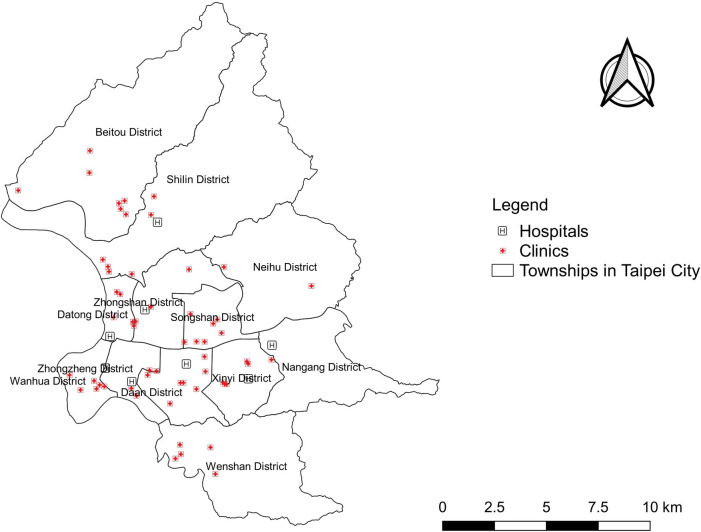
Background: Sentinel physician surveillance in communities has played an important role in detecting early signs of epidemics. The traditional approach is to let the primary care physician voluntarily and actively report diseases to the health department on a weekly basis. However, this is labor-intensive work, and the spatio-temporal resolution of the surveillance data is not precise at all. In this study, we built up a clinic-based enhanced sentinel surveillance system named "Sentinel plus" which was designed for sentinel clinics and community hospitals to monitor 23 kinds of syndromic groups in Taipei City, Taiwan. The definitions of those syndromic groups were based on ICD-10 diagnoses from physicians.
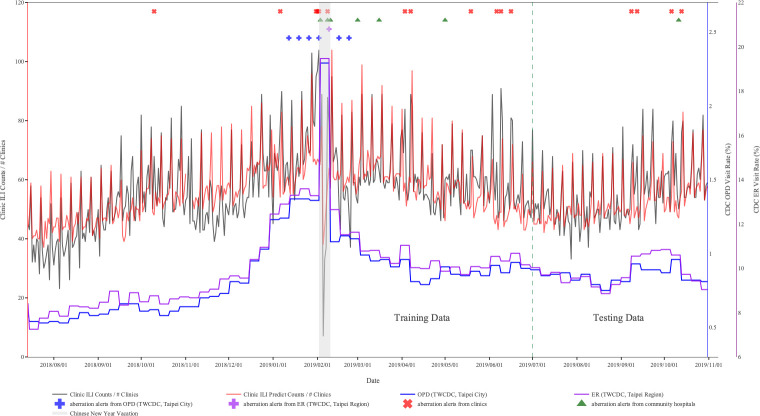
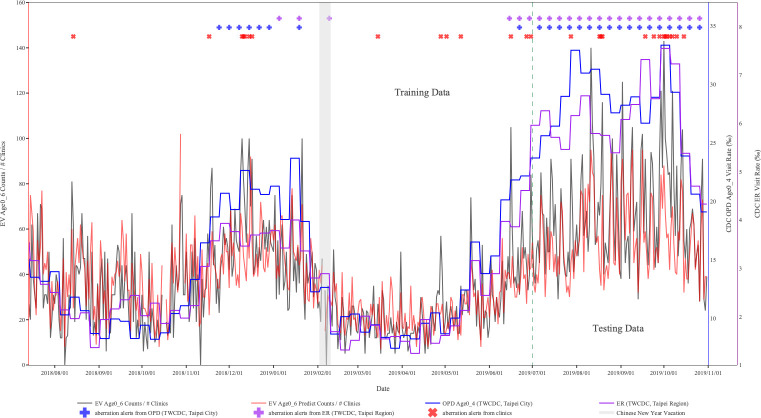
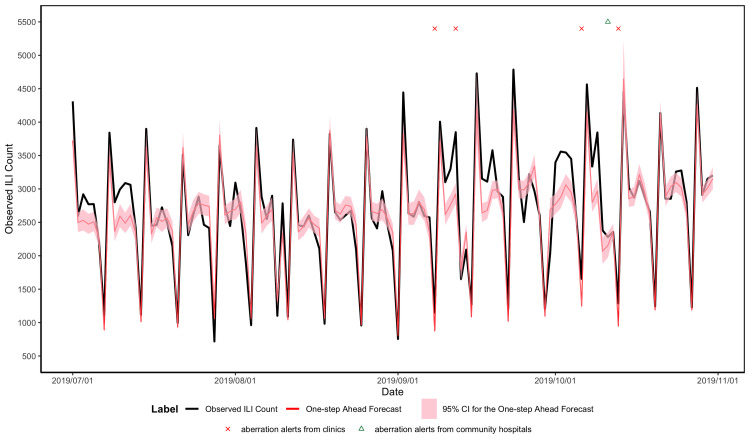
Methods: Daily ICD-10 counts of two syndromic groups including ILI and EV-like syndromes in Taipei City were extracted from Sentinel plus. A negative binomial regression model was used to couple with lag structure functions to examine the short-term association between ICD counts and meteorological variables. After fitting the negative binomial regression model, residuals were further rescaled to Pearson residuals. We then monitored these daily standardized Pearson residuals for any aberrations from July 2018 to October 2019.
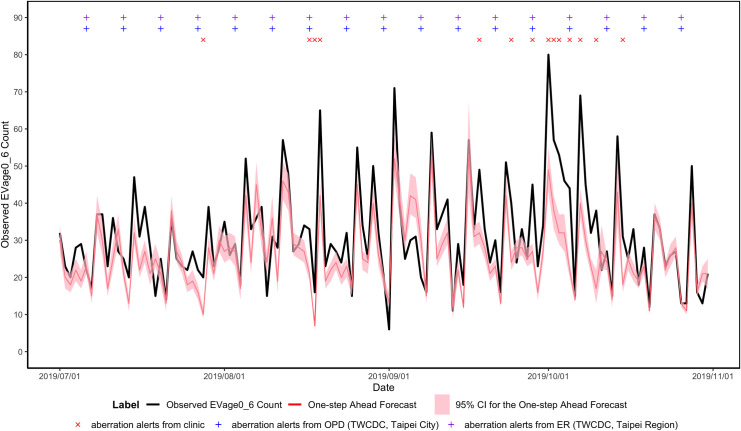
Results: The results showed that daily average temperature was significantly negatively associated with numbers of ILI syndromes. The ozone and PM2.5 concentrations were significantly positively associated with ILI syndromes. In addition, daily minimum temperature, and the ozone and PM2.5 concentrations were significantly negatively associated with the EV-like syndromes. The aberrational signals detected from clinics for ILI and EV-like syndromes were earlier than the epidemic period based on outpatient surveillance defined by the Taiwan CDC.
Conclusions: This system not only provides warning signals to the local health department for managing the risks but also reminds medical practitioners to be vigilant toward susceptible patients. The near real-time surveillance can help decision makers evaluate their policy on a timely basis.
Conflict of interest statement
The authors have declared that no competing interests exist.
Figures
References
-
- Green HK, Charlett A, Moran-Gilad J, Fleming D, Durnall H, Thomas DR, et al. Harmonizing influenza primary-care surveillance in the United Kingdom: piloting two methods to assess the timing and intensity of the seasonal epidemic across several general practice-based surveillance schemes. Epidemiol Infect. 2015;143(1):1–12. doi: 10.1017/S0950268814001757 . - DOI - PMC - PubMed
Publication types
MeSH terms
Associated data
LinkOut - more resources
Full Text Sources
