


Effect of Substituting Fish Oil with Camelina Oil on Growth Performance, Fatty Acid Profile, Digestibility, Liver Histology, and Antioxidative Status of Red Seabream (Pagrus major)
- PMID: 34359117
- PMCID: PMC8300156
- DOI: 10.3390/ani11071990
Effect of Substituting Fish Oil with Camelina Oil on Growth Performance, Fatty Acid Profile, Digestibility, Liver Histology, and Antioxidative Status of Red Seabream (Pagrus major)
Abstract
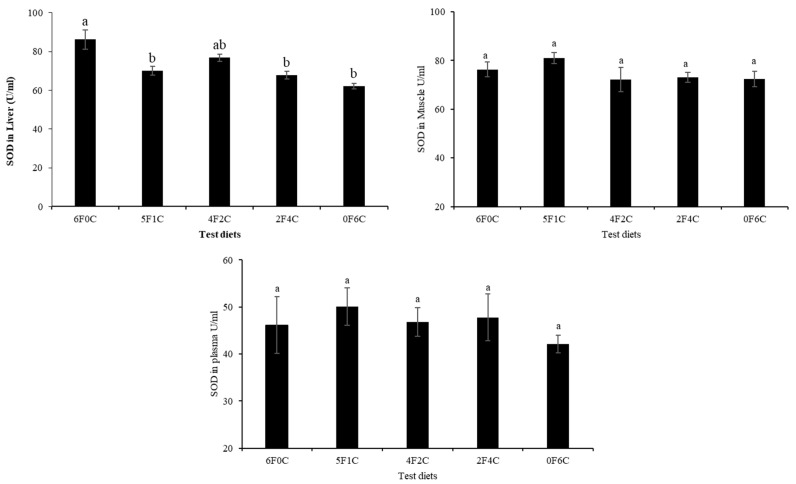
A 56-day feeding trial to evaluate the responses of red seabream (initial weight: 1.8 ± 0.02 g) to the substitution of fish oil (FO) with camelina oil (CO) at different ratios was conducted. The control diet formulated at 46% CP (6F0C) contained only FO without CO; from the second to the fifth diet, the FO was substituted with CO at rates of 5:1 (5F1C), 4:2 (4F2C), 3:3 (3F3C), 2:4 (2F4C), and 0:6 (0F6C). The results of the present study showed that up to full substitution of FO with CO showed no significant effect on growth variables BW = 26.2 g-28.3 g), body weight gain (BWG = 1275.5-1365.3%), specific growth rate (SGR = 4.6-4.7), feed intake (FI = 25.6-27.8), feed conversion ratio (FCR = 1.0-1.1), biometric indices condition factor (CF = 2.2-2.4), hepatosomatic index (HSI = 0.9-1.1), viscerasomatic index (VSI = 7.5-9.5), and survival rates (SR = 82.2-100) with different FO substitution levels with CO. Similarly, there were no significant differences (p < 0.05) found in the whole-body composition except for the crude lipid content, and the highest value was observed in the control group (291 g/kg) compared to the other groups FO5CO1 (232 k/kg), FO4CO2 (212 g/kg), FO2CO4 (232 g/kg) and FO0CO6 (244 g/kg). Blood chemistry levels were not influenced in response to test diets: hematocrit (36-33%), glucose (Glu = 78.3-71.3 mg/dL), total protein (T-pro = 3.1-3.8 g/dL), total cholesterol (T-Chol = 196.0-241 mg/dL), blood urea nitrogen (BUN = 9.0-14.6 mg/dL), total bilirubin (T-Bil = 0.4-0.5 mg/dL), triglyceride (TG = 393.3-497.6 mg/dL), alanine aminotransferase test (ALT = 50-65.5 UL/L), aspartate aminotransferase test (AST = 38-69.3 UL/L). A remarkable modulation was observed in catalase (CAT) and superoxide dismutase (SOD) activities in the liver, as CAT and SOD values were lower with the complete FO substitution with CO (0F6C), and the highest values were observed in the control and (4F2C). This study indicates that red seabream may have the ability to maintain LC-PUFAs between tissues and diets, and CO substitution of FO could improve both lipid metabolism and oxidation resistance as well as maintain digestibility. In conclusion, dietary FO can be replaced up to 100% or 95% by CO in the diets of red seabream as long as n-3 HUFA, EPA, and DHA are incorporated at the recommended level.
Keywords: camelina oil; liver histology; oxidative status; red seabream.
Conflict of interest statement
The authors declare no conflict of interest.
Figures



References
-
- Turchini G.M., Torstensen B.E., Ng W.-K. Fish oil replacement in finfish nutrition. Rev. Aquac. 2009;1:10–57. doi: 10.1111/j.1753-5131.2008.01001.x. - DOI
-
- Dawood M.A.O. Nutritional immunity of fish intestines: Important insights for sustainable aquaculture. Rev. Aquac. 2021;13:642–663. doi: 10.1111/raq.12492. - DOI
-
- Dawood M.A.O., Ali M.F., Amer A.A., Gewaily M.S., Mahmoud M.M., Alkafafy M., Assar D.H., Soliman A.A., Van Doan H. The influence of coconut oil on the growth, immune, and antioxidative responses and the intestinal digestive enzymes and histomorphometry features of Nile tilapia (Oreochromis niloticus) Fish Physiol. Biochem. 2021:1–12. doi: 10.1007/s10695-021-00943-8. - DOI - PubMed
LinkOut - more resources
Full Text Sources
Research Materials
Miscellaneous
