


The Mechanistic Action of Biosynthesised Silver Nanoparticles and Its Application in Aquaculture and Livestock Industries
- PMID: 34359224
- PMCID: PMC8300251
- DOI: 10.3390/ani11072097
The Mechanistic Action of Biosynthesised Silver Nanoparticles and Its Application in Aquaculture and Livestock Industries
Abstract
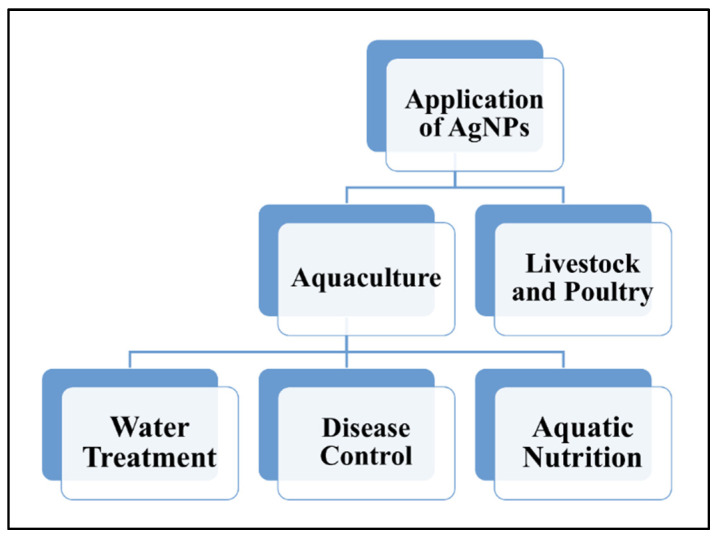
Nanotechnology is a rapidly developing field due to the emergence of various resistant pathogens and the failure of commercial methods of treatment. AgNPs have emerged as one of the best nanotechnology metal nanoparticles due to their large surface-to-volume ratio and success and efficiency in combating various pathogens over the years, with the biological method of synthesis being the most effective and environmentally friendly method. The primary mode of action of AgNPs against pathogens are via their cytotoxicity, which is influenced by the size and shape of the nanoparticles. The cytotoxicity of the AgNPs gives rise to various theorized mechanisms of action of AgNPs against pathogens such as activation of reactive oxygen species, attachment to cellular membranes, intracellular damage and inducing the viable but non-culturable state (VBNC) of pathogens. This review will be centred on the various theorized mechanisms of actions and its application in the aquaculture, livestock and poultry industries. The application of AgNPs in aquaculture is focused around water treatment, disease control and aquatic nutrition, and in the livestock application it is focused on livestock and poultry.
Keywords: aquaculture; biotechnology; livestock; nanotechnology; poultry; toxicity.
Conflict of interest statement
The authors declare no conflict of interest.
Figures
References
-
- Huang S., Wang L., Liu L., Hou Y., Li L. Nanotechnology in agriculture, livestock, and aquaculture in China. A review. Agron. Sustain. Dev. 2015;35:369–400. doi: 10.1007/s13593-014-0274-x. - DOI
-
- Ghidan A.Y., Al-Antary T.M., Awwad A.M. Aphidicidal potential of green synthesized magnesium hydroxide nanoparticles using Olea europaea leaves extract. J. Agric. Biol. Sci. 2017;12:293–301.
-
- Ghidan A.Y., Al-Antary T.M., Salem N.M., Awwad A.M. Facile green synthetic route to the zinc oxide (ZnONPs) nanoparticles: Effect on green peach aphid and antibacterial activity. J. Agric. Biol. Sci. 2017;9:131–138. doi: 10.5539/jas.v9n2p131. - DOI
Publication types
Grants and funding
LinkOut - more resources
Full Text Sources
Molecular Biology Databases
