Review
. 2021 Jul 16;11(7):1278.
doi: 10.3390/diagnostics11071278.

Progress in Diagnosing Primary Ciliary Dyskinesia: The North American Perspective

Affiliations
Review

Progress in Diagnosing Primary Ciliary Dyskinesia: The North American Perspective

Michael Glenn O'Connor et al. Diagnostics (Basel). .

Abstract

Primary Ciliary Dyskinesia (PCD) is a rare, under-recognized disease that affects respiratory ciliary function, resulting in chronic oto-sino-pulmonary disease. The PCD clinical phenotype overlaps with other common respiratory conditions and no single diagnostic test detects all forms of PCD. In 2018, PCD experts collaborated with the American Thoracic Society (ATS) to create a clinical diagnostic guideline for patients across North America, specifically considering the local resources and limitations for PCD diagnosis in the United States and Canada. Nasal nitric oxide (nNO) testing is recommended for first-line testing in patients ≥5 years old with a compatible clinical phenotype; however, all low nNO values require confirmation with genetic testing or ciliary electron micrograph (EM) analysis. Furthermore, these guidelines recognize that not all North American patients have access to nNO testing and isolated genetic testing is appropriate in cases with strong clinical PCD phenotypes. For unresolved diagnostic cases, referral to a PCD Foundation accredited center is recommended. The purpose of this narrative review is to provide insight on the North American PCD diagnostic process, to enhance the understanding of and adherence to current guidelines, and to promote collaboration with diagnostic pathways used outside of North America.

Keywords: North America; PCD; diagnostic guidelines; primary ciliary dyskinesia.


Conflict of interest statement

The authors declare no conflict of interest.

Figures
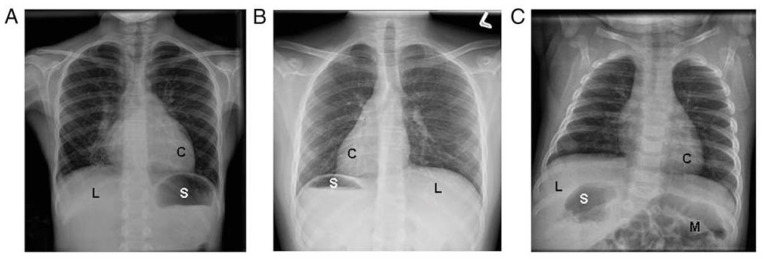
Figure 1
Figure 1
Examples of laterality defects on radiology imaging: (A) situs solitus, (B) situs inversus totalis, and (C) situs ambiguus. (C = cardiac apex; L = liver; M = intestinal malrotation; S = stomach). Reprinted with permission from ref. [11]. Copyright 2014 Shapiro AJ, Davis SD, Ferkol T, Dell SD, Rosenfeld M, Olivier KN, et al.
Figure 2
Figure 2
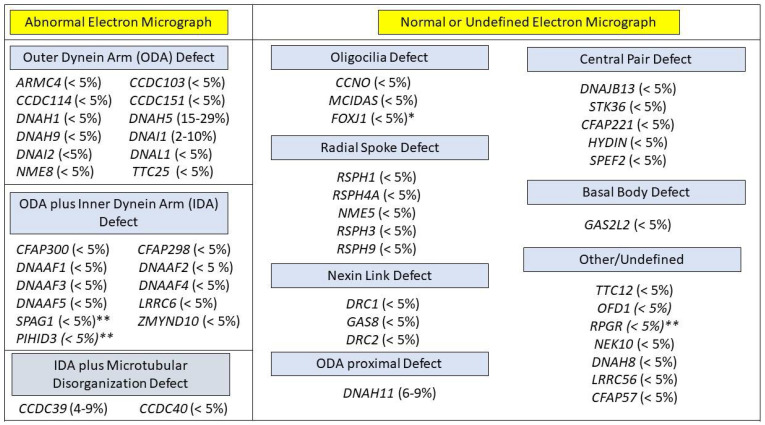
PCD genotypes, grouped by expected ciliary ultrastructure on electron micrograph (EM). Genotypes with an x-linked mode of inheritance are labeled with **. Genotypes in with an autosomal dominant mode of inheritance are labled with *. All other genotypes have an autosomal recessive mode of inheritance. Approximate prevalence of each genotype appears in paretheses.
Figure 3
Figure 3
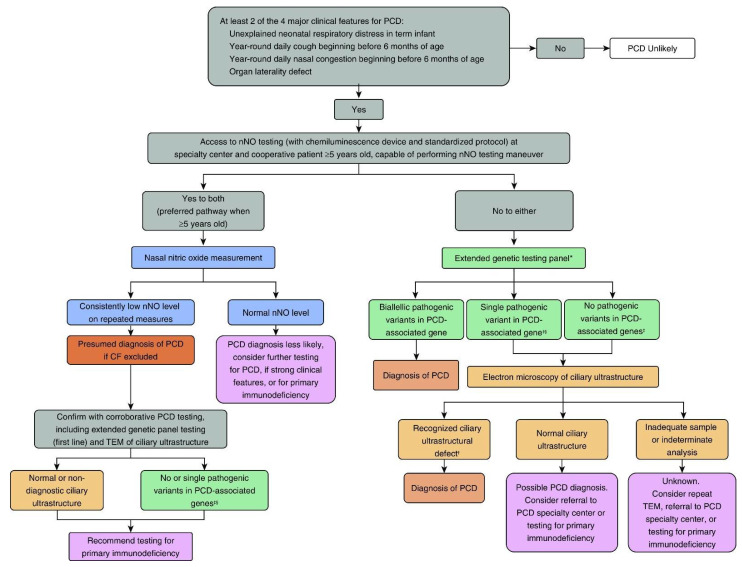
American Thoracic Society (ATS) PCD Diagnostic Guidelines. * Genetic panels testing for mutations in >12 disease associated PCD genes, including deletion/duplication analysis. † Known disease-associated TEM ultrastructural defects include outer dynein arm defects, outer dynein arm plus inner dynein arm defects, and IDA defects with microtubular disorganization. ‡ In genes associated with autosomal recessive trait. § Or presence of variants of unknown significance. Adapted from American Journal of Respiratory and Critical Care Medicine. CF = cystic fibrosis; nNO = nasal nitric oxide; PCD = primary ciliary dyskinesia; TEM = transmission electron microscopy. Reprinted with permission Ref. [24]. Copyright © 2021 American Thoracic Society.
Figure 4
Figure 4
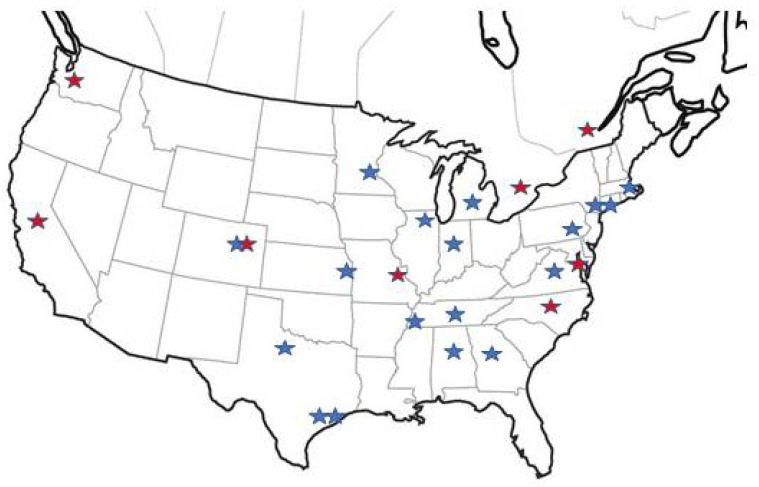
Map of PCD Foundation accredited clinical centers in the United States and Canada. Location of centers represented by stars. Red stars represent the original PCD centers of the Genetic Disorders of Mucociliary Clearance. Blue starts represent new centers that have been added since the formation of PCDF CRCN and creation of diagnostic guidelines.

References

    1. Knowles M.R., Daniels L.A., Davis S.D., Zariwala M.A., Leigh M.W. Primary Ciliary Dyskinesia. Recent Advances in Diagnostics, Genetics, and Characterization of Clinical Disease. Am. J. Respir. Crit. Care Med. 2013;188:913–922. doi: 10.1164/rccm.201301-0059CI. - DOI - PMC - PubMed
    1. Leigh M.W., Horani A., Kinghorn B., O’Connor M.G., Zariwala M.A., Knowles M.R. Primary ciliary dyskinesia (PCD): A genetic disorder of motile cilia. Transl. Sci. Rare Dis. 2019;4:51–75. doi: 10.3233/TRD-190036. - DOI - PMC - PubMed
    1. Shapiro A.J., Davis S.D., Polineni D., Manion M., Rosenfeld M., Dell S.D., Chilvers M.A., Ferkol T.W., Zariwala M.A., Sagel S.D., et al. Diagnosis of Primary Ciliary Dyskinesia. An Official American Thoracic Society Clinical Practice Guideline. Am. J. Respir. Crit. Care Med. 2018;197:e24–e39. doi: 10.1164/rccm.201805-0819ST. - DOI - PMC - PubMed
    1. Lucas J.S., Barbato A., Collins S.A., Goutaki M., Behan L., Caudri D., Dell S., Eber E., Escudier E., Hirst R.A., et al. European Respiratory Society guidelines for the diagnosis of primary ciliary dyskinesia. Eur. Respir. J. 2016;49:1601090. doi: 10.1183/13993003.01090-2016. - DOI - PMC - PubMed
    1. Shoemark A., Dell S., Shapiro A., Lucas J.S. ERS and ATS diagnostic guidelines for primary ciliary dyskinesia: Similarities and differences in approach to diagnosis. Eur. Respir. J. 2019;54:1901066. doi: 10.1183/13993003.01066-2019. - DOI - PubMed

LinkOut - more resources