Review
. 2021 Jul 23;13(15):3696.
doi: 10.3390/cancers13153696.

Overview of Oral Potentially Malignant Disorders: From Risk Factors to Specific Therapies

Affiliations
Review

Overview of Oral Potentially Malignant Disorders: From Risk Factors to Specific Therapies

Luigi Lorini et al. Cancers (Basel). .

Abstract

Oral squamous cell carcinoma (OSCC) is a very aggressive cancer, representing one of the most common malignancies worldwide. Oral potentially malignant disorders (OPMDs) regroup a variegate set of different histological lesions, characterized by the potential capacity to transform in OSCC. Most of the risk factors associated with OSCC are present also in OPMDs' development; however, the molecular mechanisms and steps of malignant transformation are still unknown. Treatment of OSCC, including surgery, systemic therapy and radiotherapy (alone or in combination), has suffered a dramatic change in last years, especially with the introduction of immunotherapy. However, most cases are diagnosed during the advanced stage of the disease, decreasing drastically the survival rate of the patients. Hence, early diagnosis of premalignant conditions (OPMDs) is a priority in oral cancer, as well as a massive education about risk factors, the understanding of mechanisms involved in malignant progression and the development of specific and more efficient therapies. The aim of this article is to review epidemiological, clinical, morphological and molecular features of OPMDs, with the purpose to lay the foundation for an exhaustive comprehension of these lesions and their ability of malignant transformation and for the development of more effective and personalized treatments.

Keywords: molecular alterations; morphological features; oral potentially malignant disorders; risk factors and etiology; treatment.


Conflict of interest statement

The author declares no conflict of interest.

Figures
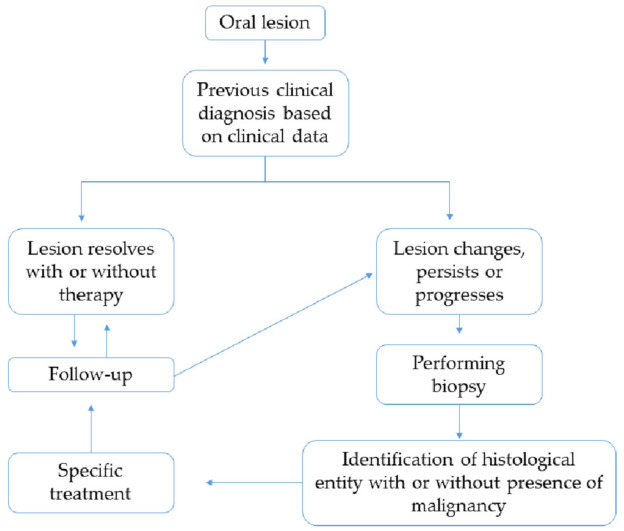
Figure 1
Figure 1
Flowchart representing the steps in identification, diagnosis and managing of OPMDs.
Figure 2
Figure 2
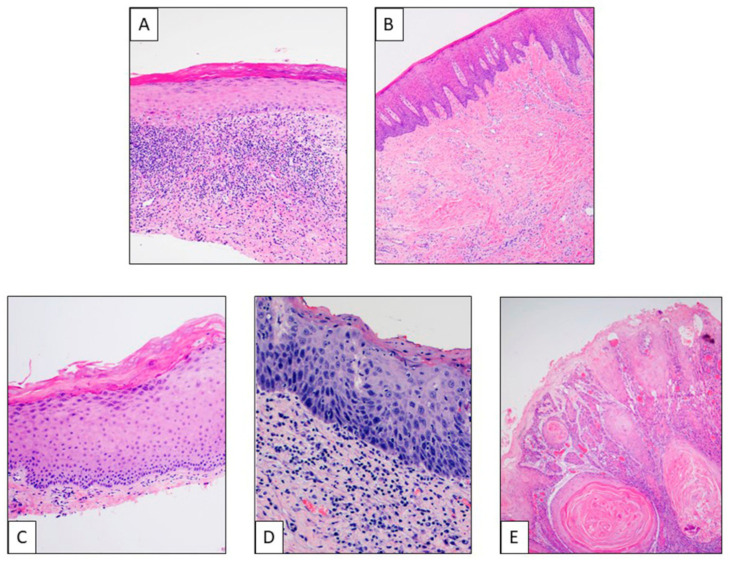
Different histological entities of oral lesions. (A) Lichen planus: Histologically characterized by degeneration of the basal cell line of the epithelium oral mucosa, with presence of diverse degrees of orthokeratosis and parakeratosis besides thickness of spinous layer and a characteristic band-like lymphocytic infiltration at the basal level and superficial submucosa. (B) Oral submucous fibrosis: This is a chronic progressive scarring lesion, morphologically showing evident submucosal changes such as fibrosis, diffuse chronic inflammatory infiltrate, atrophy of minor salivary glands, skeletal muscle atrophy, band-like infiltrate, edema and congestion, and vesicle formation. At mucosa level, we found changes such as atrophic changes, pigment incontinence, ulceration with granulation tissue, hyperplastic changes, dysplasia or malignant transformation. (C) Low-grade dysplasia. (D) High-grade dysplasia/in situ carcinoma: Dysplasia is a premalignant condition that refers to abnormal epithelial growth characterized by architectural and cytologic atypia, including dyskeratosis, basal cell hyperplasia and anaplasia, keratin pearls, etc. Low-grade refers to architectural and cytologic atypia affect from 1/3 to 2/3 of epithelium; high-grade/in situ carcinoma represents full thickness cytological or architectural atypia, without invasion of the neoplastic keratinocytes through the basement membrane. (E) Infiltrating squamous cell carcinoma: Malignant neoplasm characterized by severe dysplasia of the surface epithelium with invasion of the stromal–epithelial interface.

References

    1. Warnakulasuriya S., Johnson N.W., van der Waal I. Nomenclature and classification of potentially malignant disorders of the oral mucosa. J. Oral Pathol. Med. 2007;36:575–580. doi: 10.1111/j.1600-0714.2007.00582.x. - DOI - PubMed
    1. Warnakulasuriya S. Clinical features and presentation of oral potentially malignant disorders. Oral Surg. Oral Med. Oral Pathol. Oral Radiol. 2018;125:582–590. doi: 10.1016/j.oooo.2018.03.011. - DOI - PubMed
    1. Aguirre-Urizar J.M., Lafuente-Ibáñez de Mendoza I., Warnakulasuriya S. Malignant transformation of oral leukoplakia: Systematic review and meta-analysis of the last 5 years. Oral Dis. 2021 doi: 10.1111/odi.13810. - DOI - PubMed
    1. Abati S., Bramati C., Bondi S., Lissoni A., Trimarchi M. Oral cancer and precancer: A narrative review on the relevance of early diagnosis. Int. J. Environ. Res. Public Health. 2020;17:9160. doi: 10.3390/ijerph17249160. - DOI - PMC - PubMed
    1. Porter S., Gueiros L.A., Leao J.C., Fedele S. Risk factors and etiopathogenesis of potentially premalignant oral epithelial lesions. Oral Surg. Oral Med. Oral Pathol. Oral Radiol. 2018;125:603–611. doi: 10.1016/j.oooo.2018.03.008. - DOI - PubMed

LinkOut - more resources