Review
. 2021 Jul 1;10(7):1653.
doi: 10.3390/cells10071653.

Apoptosis in the Pancreatic Cancer Tumor Microenvironment-The Double-Edged Sword of Cancer-Associated Fibroblasts

Affiliations
Review

Apoptosis in the Pancreatic Cancer Tumor Microenvironment-The Double-Edged Sword of Cancer-Associated Fibroblasts

Ester Pfeifer et al. Cells. .

Abstract

Pancreatic ductal adenocarcinoma (PDAC) is associated with poor prognosis. This is attributed to the disease already being advanced at presentation and having a particularly aggressive tumor biology. The PDAC tumor microenvironment (TME) is characterized by a dense desmoplastic stroma, dominated by cancer-associated fibroblasts (CAF), extracellular matrix (ECM) and immune cells displaying immunosuppressive phenotypes. Due to the advanced stage at diagnosis, the depletion of immune effector cells and lack of actionable genomic targets, the standard treatment is still apoptosis-inducing regimens such as chemotherapy. Paradoxically, it has emerged that the direct induction of apoptosis of cancer cells may fuel oncogenic processes in the TME, including education of CAF and immune cells towards pro-tumorigenic phenotypes. The direct effect of cytotoxic therapies on CAF may also enhance tumorigenesis. With the awareness that CAF are the predominant cell type in PDAC driving tumorigenesis with various tumor supportive functions, efforts have been made to try to target them. However, efforts to target CAF have, to date, shown disappointing results in clinical trials. With the help of sophisticated single cell analyses it is now appreciated that CAF in PDAC are a heterogenous population with both tumor supportive and tumor suppressive functions. Hence, there remains a debate whether targeting CAF in PDAC is a valid therapeutic strategy. In this review we discuss how cytotoxic therapies and the induction of apoptosis in PDAC fuels oncogenesis by the education of surrounding stromal cells, with a particular focus on the potential pro-tumorigenic outcomes arising from targeting CAF. In addition, we explore therapeutic avenues to potentially avoid the oncogenic effects of apoptosis in PDAC CAF.

Keywords: CAF; PDAC; TME; apoptosis; fibroblasts; pancreatic cancer; stroma; tumor microenvironment.


Conflict of interest statement

The authors declare no conflict of interest.

Figures
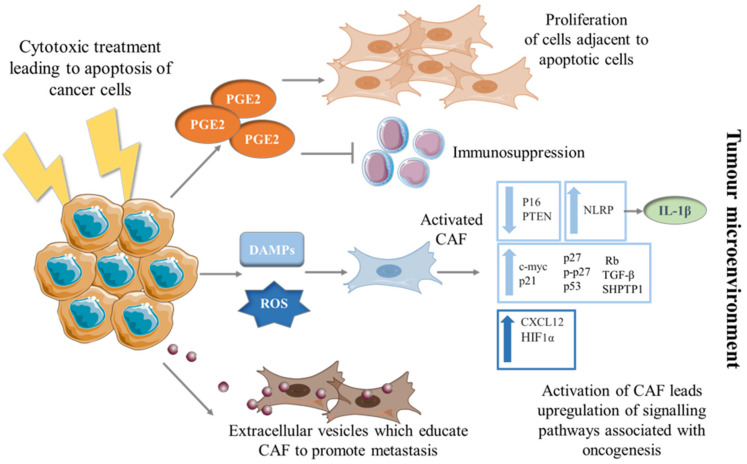
Figure 1
Figure 1
Education of CAF into a pro-tumorigenic phenotype by dying cancer cells. Mechanisms by which CAF can be transformed to a phenotype promoting tumorigenesis via the education of dying cancer cells. Cancer cells undergoing apoptosis secrete PGE2 which in turn can have pro-proliferative and immunosuppressive effects on surrounding cells in the TME. When cancer cells are exposed to cytotoxic therapies, they release DAMPs and ROS which stimulate CAF to differentiate into unfavorable phenotypes; upregulating pathways and secreting molecules associated with progression. Apoptotic cancer cells release EVs which have shown to be taken up by fibroblasts and educate them, resulting in CAF-promoting cancer cell metastasis.
Figure 2
Figure 2
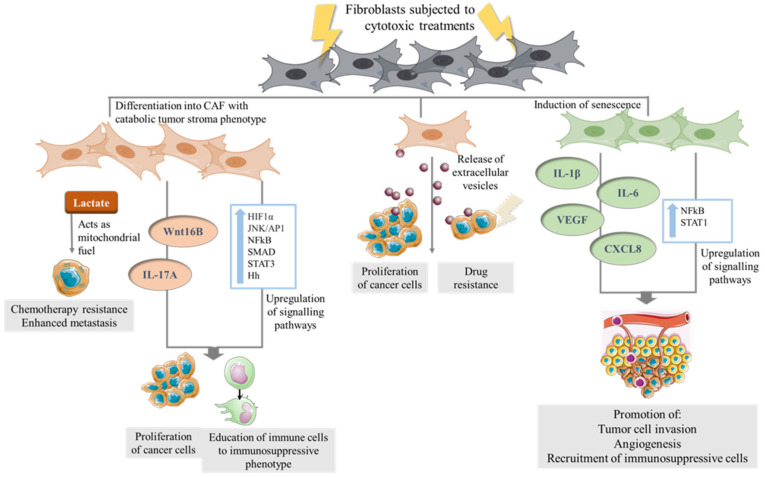
The direct effect of cytotoxic therapies on CAF. Fibroblasts in the TME of cancer cells which are subjected to cytotoxic therapies undergo transformation to a catabolic tumor stroma phenotype secreting metabolites such as lactate which in turn serves as mitochondrial fuel for cancer cells. Chemotherapy can stimulate stress-linked signaling pathways in CAF and the secretion cytokines lead to a microenvironment which in turn can promote cancer proliferation and educate immune cells to an immunosuppressive phenotype. Senescence induction in CAF have been shown to upregulate signaling pathways, leading to secretion of cytokines which promote tumor cell invasion, angiogenesis and the recruitment of myeloid-derived suppressor cells (MDSCs). CAF exposed to cytotoxic therapies release EVs which are taken up by cancer cells, leading to increased expression of genes associated with increased proliferation and drug resistance.
Figure 3
Figure 3
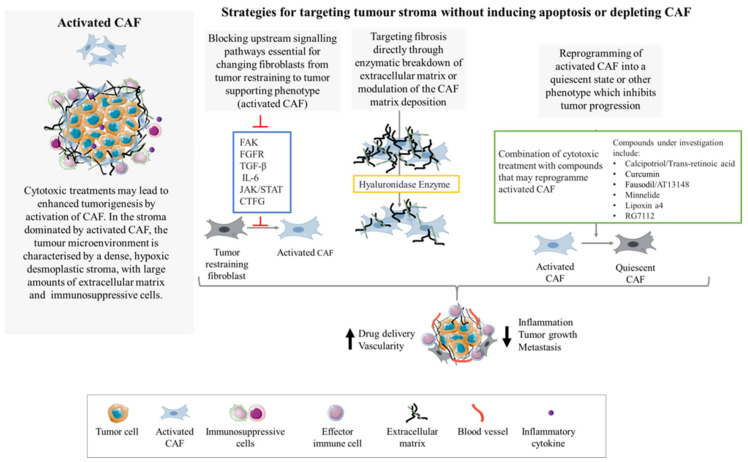
Targeting CAF without ablation or apoptosis induction. Activated CAF fuel desmoplasia, fibrosis, inflammation and tumor growth. To prevent or suppress the activation and formation of the desmoplastic reaction, strategies such as targeting upstream signaling pathways for CAF activation or reprogramming of activated CAF into a quiescent phenotype have been trialed. Another strategy is to target fibrosis directly with enzymatic breakdown of the ECM.

References

    1. Siegel R.L., Miller K.D., Jemal A. Cancer statistics, 2020. CA Cancer J. Clin. 2020;70:7–30. doi: 10.3322/caac.21590. - DOI - PubMed
    1. Rahib L., Wehner M.R., Matrisian L.M., Nead K.T. Estimated Projection of US Cancer Incidence and Death to 2040. JAMA Netw. Open. 2021;4:e214708. doi: 10.1001/jamanetworkopen.2021.4708. - DOI - PMC - PubMed
    1. Orth M., Metzger P., Gerum S., Mayerle J., Schneider G., Belka C., Schnurr M., Lauber K. Pancreatic ductal adenocarcinoma: Biological hallmarks, current status, and future perspectives of combined modality treatment approaches. Radiat. Oncol. 2019;14:1–20. doi: 10.1186/s13014-019-1345-6. - DOI - PMC - PubMed
    1. Lambert A., Schwarz L., Borbath I., Henry A., Van Laethem J.-L., Malka D., Ducreux M., Conroy T. An update on treatment options for pancreatic adenocarcinoma. Ther. Adv. Med. Oncol. 2019;11:1758835919875568. doi: 10.1177/1758835919875568. - DOI - PMC - PubMed
    1. Bulle A., Lim K.-H. Beyond just a tight fortress: Contribution of stroma to epithelial-mesenchymal transition in pancreatic cancer. Signal Transduct. Target. Ther. 2020;5:1–12. doi: 10.1038/s41392-020-00341-1. - DOI - PMC - PubMed

Publication types