Review
. 2021 Jul 1;10(7):1654.
doi: 10.3390/cells10071654.

Heteromeric TRP Channels in Lung Inflammation

Affiliations
Review

Heteromeric TRP Channels in Lung Inflammation

Meryam Zergane et al. Cells. .

Abstract

Activation of Transient Receptor Potential (TRP) channels can disrupt endothelial barrier function, as their mediated Ca2+ influx activates the CaM (calmodulin)/MLCK (myosin light chain kinase)-signaling pathway, and thereby rearranges the cytoskeleton, increases endothelial permeability and thus can facilitate activation of inflammatory cells and formation of pulmonary edema. Interestingly, TRP channel subunits can build heterotetramers, whereas heteromeric TRPC1/4, TRPC3/6 and TRPV1/4 are expressed in the lung endothelium and could be targeted as a protective strategy to reduce endothelial permeability in pulmonary inflammation. An update on TRP heteromers and their role in lung inflammation will be provided with this review.

Keywords: TRPC1/4; TRPC3/6; TRPV1/4; endothelial permeability; heteromeric TRP assemblies; pulmonary inflammation.


Conflict of interest statement

The authors declare no conflict of interest.

Figures
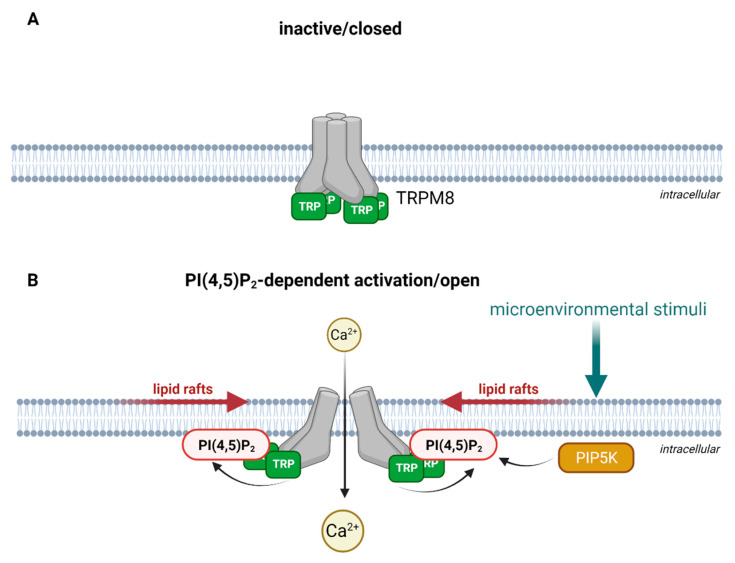
Figure 1
Figure 1
Schematic illustration of PI(4,5)P2-dependent activation as exemplified for TRPM8. (A) In the absence of PI(4,5)P2, the TRP-box holds the channel in a closed conformation. For simplification, other structural domains of TRPM8 are not illustrated. (B) Microenvironmental stimuli activate PI(4,5)P2 production via phosphorylation of phosphatidylinositol 4-phosphate by PIP5K (phosphatidylinositol-4-phosphate 5-kinase) in lipid rafts. The interaction of phosphatidylinositol 4,5-bisphosphate (PI(4,5)P2) the with the TRP-box activates TRPM8 and opens the channel for Ca2+ entry. Created with BioRender.com.
Figure 2
Figure 2
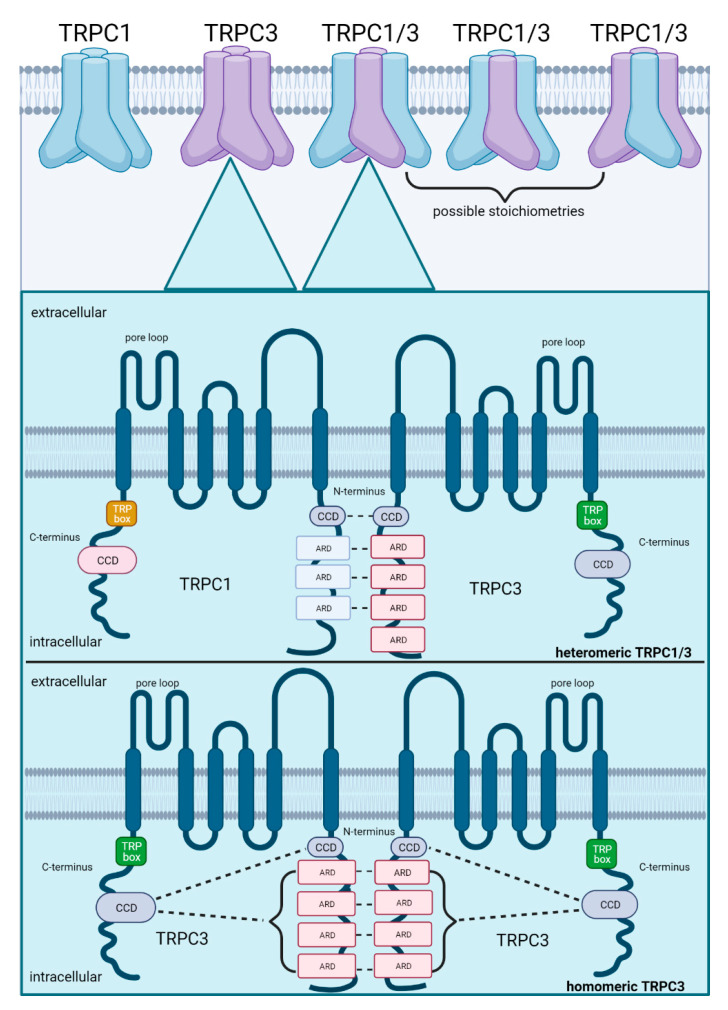
Schematic illustration of subunit assembly for heteromeric TRPC1/3 as compared to homomeric TRPC3. Co-expression of both subunits increases the probability of heteromerization, which is facilitated by their 28.7% amino acid congruency. Possible stoichiometries in a heteromeric assembly comprise 1:3, 2:2 or 3:1 (TRPC1:TRPC3). TRPC1/3 is stabilized by non-covalent interactions between ARDs (ankyrin repeat domains) and CCDs (coiled-coil domains) on their N-termini. In contrast, homomeric assembly of TRPC3 is stabilized by interactions between ARDs on their N-termini and by interactions between the CCDs on their C-termini with the ARDs and CCDs on their N-termini. Created with BioRender.com.
Figure 3
Figure 3
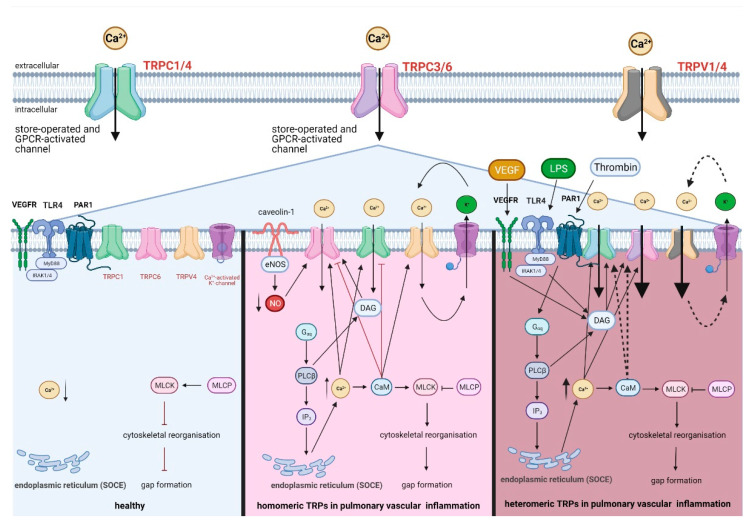
Regulation of endothelial permeability in acute pulmonary inflammation by homomeric and heteromeric TRP assemblies. Under physiological conditions (left), pro-inflammatory and barrier-disruptive receptors including TLR4 (Toll-like receptors), PAR1 (protease-activated receptor 1) and VEGFR (vascular endothelial growth factor receptor) are not activated by their respective ligands, and intracellular Ca2+ concentration is maintained low by closed confirmations of TRP homomers. In vascular inflammation with TRP homomers (centre), TRPC6 is activated by DAG (diacylglycerol) and by inhibition of NO production through eNOS (endothelial NO-synthase) uncoupling and eNOS interaction with caveolin-1. In parallel, TRPC1 is activated by IP3 (inositol 1,4,5-trisphosphate)-dependent Ca2+ release. TRPC6-mediated Ca2+ influx can then be inhibited in a Ca2+/CaM (calmodulin)-dependent manner as part of a negative feedback regulation which could (potentially) also be the case for TRPC1. TRPV4-mediated Ca2+ influx increases K+ efflux via intermediate and small Ca2+-activated K+ channels (IK and SK), causing endothelial hyperpolarization which in turn increases Ca2+ influx. In vascular inflammation with TRP heteromers (right), activation of PAR1, TLR4 and VEGFR by their respective ligands thrombin, lipopoly-saccharide (LPS) or VEGF, respectively, causes GPCR-operated activation of TRPC1/4 and TRPC3/6, and the resulting Ca2+ influx is stabilized by SOCE. The Ca2+ influx may be further stabilized via K+ efflux maintaining TRPV1/4 activation (dashed lines) and via Ca2+/CaM-complexes binding to their CaM binding sites in TRPC1/4 and TRPC3/6 (dashed lines). Heteromeric and homomeric TRP channel-mediated Ca2+ influx activates the CaM/MLCK (myosin light chain kinase)-signaling pathway by binding to CaM which in turn activates MLCK. Activated MLCK inhibits MLCP, thereby activating MLC II (myosin light chain II), actin-myosin interaction and formation of F-actin stress fibers. The resulting tensile force on endothelial cell–cell-junctions (inside-out-signaling) causes inter-endothelial gap formation and endothelial barrier failure. Created with BioRender.com.

References

    1. Cioffi D.L., Lowe K., Alvarez D.F., Barry C., Stevens T. TRPing on the lung endothelium: Calcium channels that regulate barrier function. Antioxid. Redox Signal. 2009;11:765–776. doi: 10.1089/ars.2008.2221. - DOI - PMC - PubMed
    1. Yin J., Kuebler W.M. Mechanotransduction by TRP channels: General concepts and specific role in the vasculature. Cell Biochem. Biophys. 2010;56:1–18. doi: 10.1007/s12013-009-9067-2. - DOI - PubMed
    1. Simmons S., Erfinanda L., Bartz C., Kuebler W.M. Novel mechanisms regulating endothelial barrier function in the pulmonary microcirculation. J. Physiol. 2019;597:997–1021. doi: 10.1113/JP276245. - DOI - PMC - PubMed
    1. Villalta P.C., Townsley M.I. Transient receptor potential channels and regulation of lung endothelial permeability. Pulm Circ. 2013;3:802–815. doi: 10.1086/674765. - DOI - PMC - PubMed
    1. Montell C., Birnbaumer L., Flockerzi V., Bindels R.J., Bruford E.A., Caterina M.J., Clapham D.E., Harteneck C., Heller S., Julius D., et al. A unified nomenclature for the superfamily of TRP cation channels. Mol. Cell. 2002;9:229–231. doi: 10.1016/S1097-2765(02)00448-3. - DOI - PubMed

Substances