Review
. 2021 Jul 11;10(7):1752.
doi: 10.3390/cells10071752.

Lock, Stock and Barrel: Role of Renin-Angiotensin-Aldosterone System in Coronavirus Disease 2019

Affiliations
Review

Lock, Stock and Barrel: Role of Renin-Angiotensin-Aldosterone System in Coronavirus Disease 2019

Christian Zanza et al. Cells. .

Abstract

Since the end of 2019, the medical-scientific community has been facing a terrible pandemic caused by a new airborne viral agent known as SARS-CoV2. Already in the early stages of the pandemic, following the discovery that the virus uses the ACE2 cell receptor as a molecular target to infect the cells of our body, it was hypothesized that the renin-angiotensin-aldosterone system was involved in the pathogenesis of the disease. Since then, numerous studies have been published on the subject, but the exact role of the renin-angiotensin-aldosterone system in the pathogenesis of COVID-19 is still a matter of debate. RAAS represents an important protagonist in the pathogenesis of COVID-19, providing the virus with the receptor of entry into host cells and determining its organotropism. Furthermore, following infection, the virus is able to cause an increase in plasma ACE2 activity, compromising the normal function of the RAAS. This dysfunction could contribute to the establishment of the thrombo-inflammatory state characteristic of severe forms of COVID-19. Drugs targeting RAAS represent promising therapeutic options for COVID-19 sufferers.

Keywords: ACE inhibitors; ACE2; COVID-19; SARS-CoV2; renin-angiotensin-aldosterone system; sartans; zinc-chelating agents.


Conflict of interest statement

The authors declare no conflict of interest.

Figures

Figure 1
Figure 1
Schematic diagram of the effects of RAAS system during SARS-CoV-2 infection and the proposed therapeutic treatment. (1) Renin secreted, by the kidney, cleaves angiotensinogen, produced by liver, to form AT1, (2) AT1 is converted to AT2 by pulmonary ACE. (3) AT2 binds to AT2R1 (Angiotensin II receptors 1). The excess of AT2 through AT2R1 hyperactivation causes vasoconstriction, sodium retention (by aldosterone release), hypertension, inflammatory, IL-6, hypertrophy, fibrosis, thrombosis. (4) SARS-CoV-2 binds to ACE2 to gain entry into the host cell, however, cellular protective response leads to ACE2 shedding. (5) ADAM17-regulated ectodomain shedding of ACE2 results in increased amount of soluble and active ACE2 (sACE2). (6) AT1 and AT2 can also bind to sACE2. (7) They are then metabolized by ACE2 into Ag 1–9 and Ag 1–7, respectively. (8) The excess of Ag 1–9 and Ag 1–7 signaling via the AT2R2 and MasR can induce vasodilatation, natriuresis, hypotension, anti-inflammatory, IL-10, lymphopenia, apoptosis, thrombosis. (9) These events, in turn, produce a compensatory upregulation of both renin secretion and ACE activity, which establish the onset of a positive feedback loop. In the black boxes, drugs that can potentially to stop the positive feedback loop, by inhibiting enzymes of the RAAS, are indicated. Dashed arrows indicate enzymatic activity, full arrows indicate non enzymatic passage and dashed blue arrows represent the positive feedback loop. Created in Biorender.com.
Figure 2
Figure 2
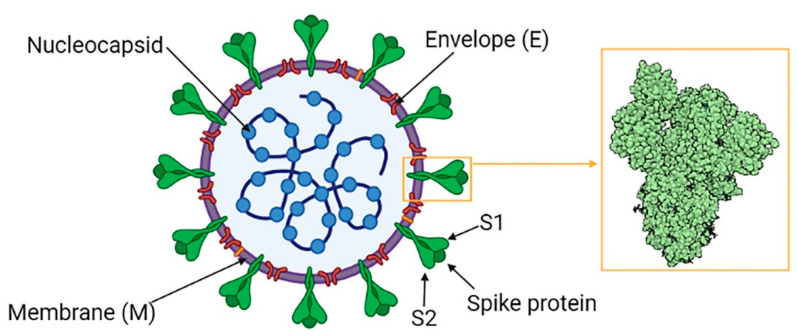
SARS-CoV 2 Structure. In the yellow box the structure-based design of prefusion-stabilized SARS-CoV-2 spikes. Created in Biorender.com.

References

    1. World Health Organization Coronavirus Disease (COVID-19) Situation Reports. [(accessed on 10 May 2021)]; Available online: https://www.who.int/emergencies/diseases/novel-coronavirus-2019/situatio...
    1. Hoffmann M., Kleine-Weber H., Schroeder S., Krüger N., Herrler T., Erichsen S., Schiergens T.S., Herrler G., Wu N.H., Nitsche A., et al. SARS-CoV-2 Cell Entry Depends on ACE2 and TMPRSS2 and Is Blocked by a Clinically Proven Protease Inhibitor. Cell. 2020;181:271–280.e8. doi: 10.1016/j.cell.2020.02.052. - DOI - PMC - PubMed
    1. Wan Y., Shang J., Graham R., Baric R.S., Li F. Receptor Recognition by the Novel Coronavirus from Wuhan: An Analysis Based on Decade-Long Structural Studies of SARS Coronavirus. J. Virol. 2020;94 doi: 10.1128/JVI.00127-20. - DOI - PMC - PubMed
    1. Wrapp D., Wang N., Corbett K.S., Goldsmith J.A., Hsieh C.L., Abiona O., Graham B.S., McLellan J.S. Cryo-EM structure of the 2019-nCoV spike in the prefusion conformation. Science. 2020;367:1260–1263. doi: 10.1126/science.abb2507. - DOI - PMC - PubMed
    1. Drenjančević-Perić I., Jelaković B., Lombard J.H., Kunert M.P., Kibel A., Gros M. High-salt diet and hypertension: Focus on the renin-angiotensin system. Kidney Blood Press. Res. 2011;34:1–11. doi: 10.1159/000320387. - DOI - PMC - PubMed

MeSH terms

Substances