


A Weakly-Supervised Named Entity Recognition Machine Learning Approach for Emergency Medical Services Clinical Audit
- PMID: 34360065
- PMCID: PMC8345494
- DOI: 10.3390/ijerph18157776
A Weakly-Supervised Named Entity Recognition Machine Learning Approach for Emergency Medical Services Clinical Audit
Abstract
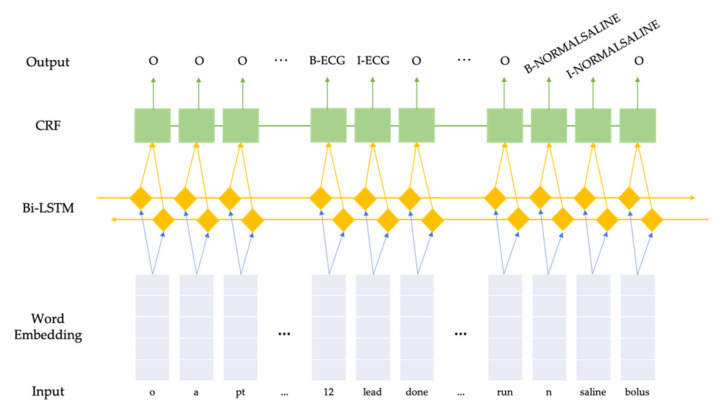
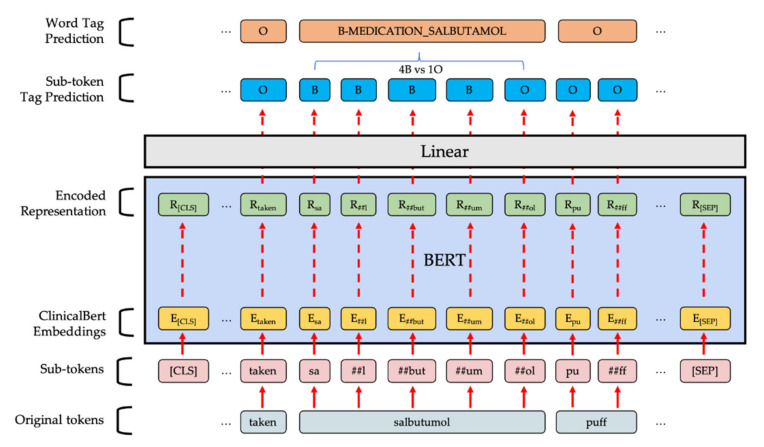
Clinical performance audits are routinely performed in Emergency Medical Services (EMS) to ensure adherence to treatment protocols, to identify individual areas of weakness for remediation, and to discover systemic deficiencies to guide the development of the training syllabus. At present, these audits are performed by manual chart review, which is time-consuming and laborious. In this paper, we report a weakly-supervised machine learning approach to train a named entity recognition model that can be used for automatic EMS clinical audits. The dataset used in this study contained 58,898 unlabeled ambulance incidents encountered by the Singapore Civil Defence Force from 1st April 2019 to 30th June 2019. With only 5% labeled data, we successfully trained three different models to perform the NER task, achieving F1 scores of around 0.981 under entity type matching evaluation and around 0.976 under strict evaluation. The BiLSTM-CRF model was 1~2 orders of magnitude lighter and faster than our BERT-based models. Our proposed proof-of-concept approach may improve the efficiency of clinical audits and can also help with EMS database research. Further external validation of this approach is needed.
Keywords: clinical audit; emergency medical services; named entity recognition; natural language processing; weakly-supervised learning.
Conflict of interest statement
The authors declare no conflict of interest.
Figures
References
Publication types
MeSH terms
LinkOut - more resources
Full Text Sources
Medical
Miscellaneous
