Review
. 2021 Jul 27;22(15):8005.
doi: 10.3390/ijms22158005.

Anti-Inflammatory Therapeutic Approaches to Prevent or Delay Post-Traumatic Osteoarthritis (PTOA) of the Knee Joint with a Focus on Sustained Delivery Approaches

Affiliations
Review

Anti-Inflammatory Therapeutic Approaches to Prevent or Delay Post-Traumatic Osteoarthritis (PTOA) of the Knee Joint with a Focus on Sustained Delivery Approaches

Christine M Khella et al. Int J Mol Sci. .

Abstract

Inflammation plays a central role in the pathogenesis of knee PTOA after knee trauma. While a comprehensive therapy capable of preventing or delaying post-traumatic osteoarthritis (PTOA) progression after knee joint injury does not yet clinically exist, current literature suggests that certain aspects of early post-traumatic pathology of the knee joint may be prevented or delayed by anti-inflammatory therapeutic interventions. We discuss multifaceted therapeutic approaches that may be capable of effectively reducing the continuous cycle of inflammation and concomitant processes that lead to cartilage degradation as well as those that can simultaneously promote intrinsic repair processes. Within this context, we focus on early disease prevention, the optimal timeframe of treatment and possible long-lasting sustained delivery local modes of treatments that could prevent knee joint-associated PTOA symptoms. Specifically, we identify anti-inflammatory candidates that are not only anti-inflammatory but also anti-degenerative, anti-apoptotic and pro-regenerative.

Keywords: IL-1 receptor antagonist; IL-10; IL-13; IL-1β; IL-4; IL-6; TNF-α; anti-apoptotic; anti-inflammatory cytokines; antibody; articular cartilage; cartilage; cartilage repair; chondrocyte; clinical; complement inhibitors; complement system; degeneration; dexamethasone; drug delivery; early PTOA; early disease; fat pad; hyaluronic acid; immunomodulation; inflammation; knee joint; knee trauma; osteoarthritis; post-traumatic osteoarthritis; prevention; regeneration; synovium; tranexamic acid; triamcinolone acetonide.


Conflict of interest statement

The authors declare no conflict of interest.

Figures
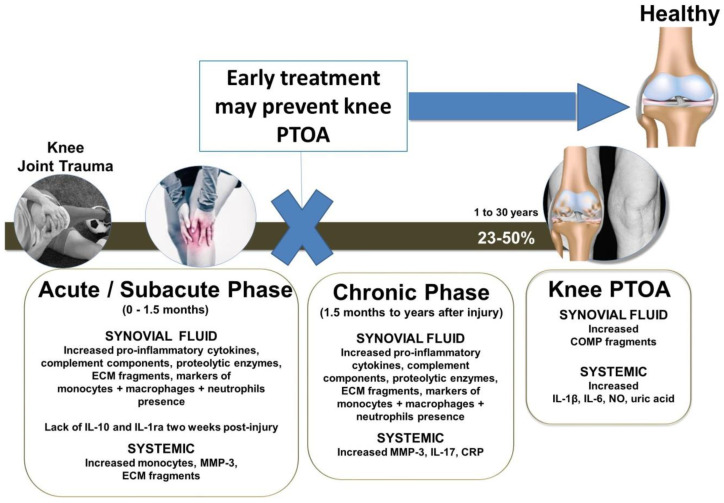
Figure 1
Figure 1
An early multifaceted anti-inflammatory therapeutic approach may reduce the continuous cycle of inflammation and articular cartilage degradation that often endures for months to many years following knee trauma. Whether resolution of chronic inflammation (indicated by the blue x) can be accomplished to prevent or halt the development of PTOA remains to be determined. This figure was adapted and summarized based on clinical data that demonstrated significant increases of these markers at the indicated time points after knee joint injury as discussed in detail in our systematic evidence-based review [3]. Abbreviations: cartilage oligomeric matrix protein (COMP), c reactive protein (CRP), extracellular matrix (ECM), matrix metalloproteinase 3 (MMP-3), nitric oxide (NO).
Figure 2
Figure 2
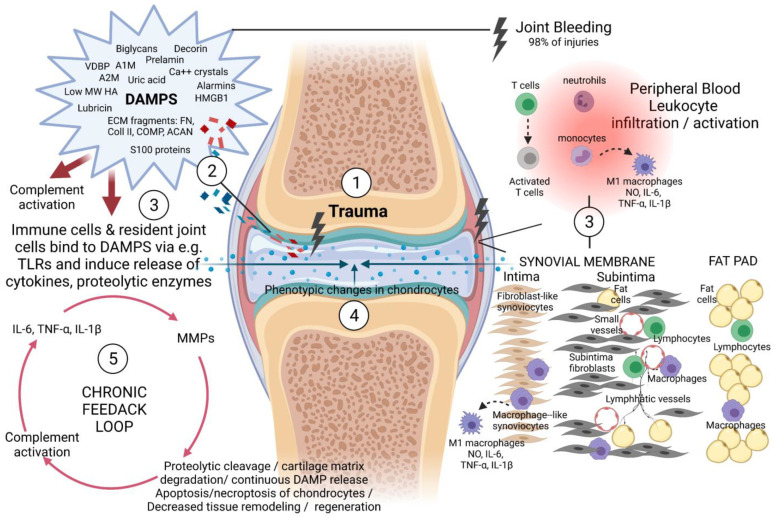
The major cells, tissues and factors involved in the trauma-associated response following knee joint injury and chronic inflammation of the knee joint. In OA [42,43] and (1) trauma-associated conditions (e.g., mechanical injury, joint bleeding) [44,45], (2) damage-associated molecular patterns (DAMPS) are released from injured cells and tissues, which (3) mainly drives the inflammatory response in the cells of the synovial tissue [26,34,35,36] but also chondrocytes [3], IFP cells [38,39] as well as in the innate immune cells (peripheral blood leukocytes including T cells [32,46,47,48] and monocytes/macrophages [3]). DAMPs bind to cells through pattern recognition receptors (PRRs) including toll-like receptors (TLRs), NOD-like receptors (NLRs), and receptors for advanced glycosylation end products (RAGEs). This leads to activation of signaling pathways that cause the production of various factors including pro-inflammatory cytokines (IL-6, TNF-α, IL-1β), chemokines that, in turn, further recruit leukocytes to the site of injury, catabolic factors (MMP-1, MMP-3, MMP-9, MMP-10, and the intracellular catabolic procathepsin B that can be activated by GAGs [49]) and activation of the complement cascade [43,45]; factors described as essential in PTOA knee pathogenesis [3]. Hence, the generation of DAMPs that are produced by trauma or enzymatic degradation that turn immunologically quiescent ECM components into fragments that activate PRR signaling pathways are referred to as extracellular DAMPs. Those associated with OA/PTOA (reviewed in [42,43]) include fragments of aggrecan (ACAN); collagen type II (Coll II); cartilage oligomeric matrix protein (COMP); low mw hyaluronic acid (HA); biglycan and decorin that belong to the small leucine-rich repeat proteoglycan (SLRP) family; and lubricin. DAMPs can also be intracellular molecules that are released during cell necrosis including prelamin located in the inner nuclear membrane; S100 proteins: S100A8 and S100A9 released by monocytes, activated macrophage and neutrophils; the high mobility group box protein 1 (HMGB1) nuclear protein released by necrotic cells or secreted by macrophages in response to inflammatory cytokines TNF-α and IL-1β; uric acid (the metabolic breakdown of purine nucleotides), and calcium (Ca+)-containing crystals [calcium pyrophosphate dehydrate (CPPD) and basic calcium phosphate (BCP)]), and even plasma proteins (α1-microglobulin (A1M); α2-macroglobulin (A2M); and Gc-globulin also known as vitamin D-binding protein, VDPB) (reviewed in [42,43]). (4) These pathogenic effects cause phenotypic changes of chondrocytes, cell death and proteolytic enzyme production, which may further drive cartilage degradation [26,27,28,29] and, hence, DAMP production. The DAMP/PRR response is a normal response that serves as a defense strategy for maintaining and restoring homeostasis, but it can also become (5) dysregulated if DAMPs continue to be produced, resulting in inflammatory and tissue repair processes that may become pathogenic [44]. If the inflammatory process is not resolved, a chronic feedback loop that involves cross-talk and feedback among the cells within these tissues continues and may lead to PTOA progression due to continuous proteolytic cleavage of the ECM, cell death and continued activation of the innate and adaptive immune response [3].
Figure 3
Figure 3
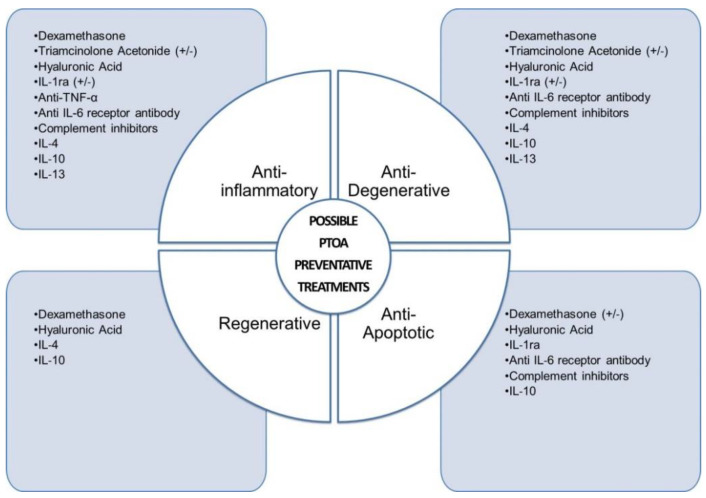
Possible treatment interventions that could prevent or delay PTOA-driving processes in the knee joint by suppressing inflammation, degeneration and apoptosis, while activating regenerative processes. All of the therapeutic candidates shown here exert anti-inflammatory effects by decreasing the injury/inflammation-related joint swelling, synovial inflammation and/or levels of pro-inflammatory mediators. Although some agents have anti-degenerative activity, and inhibit cartilage degradation following injury by, e.g., decreasing the expression of MMPs as well as the loss of GAG, anti-TNF-α showed adverse effects on cartilage and bone and increased inflammation. Few of these agents have regenerative effects that are capable of enhancing the chondrogenic properties of injured cartilage. Similarly, only a few agents counteract the apoptosis of chondrocytes. Only hyaluronic acid and IL-10 possess all four main therapeutic potentials against PTOA development. The (+/−) sign indicates conflicting reports, based on knee joint-related clinical, articular cartilage ex vivo and/or in vitro studies.

References

    1. Brown T.D., Johnston R.C., Saltzman C.L., Marsh J.L., Buckwalter J.A. Posttraumatic osteoarthritis: A first estimate of incidence, prevalence, and burden of disease. J. Orthop. Trauma. 2006;20:739–744. doi: 10.1097/01.bot.0000246468.80635.ef. - DOI - PubMed
    1. Cui A., Li H., Wang D., Zhong J., Chen Y., Lu H. Global, regional prevalence, incidence and risk factors of knee osteoarthritis in population-based studies. E. Clin. Med. 2020;29:100587. - PMC - PubMed
    1. Khella C.M., Asgarian R., Horvath J.M., Rolauffs B., Hart M.L. An evidence-based systematic review of human knee post-traumatic osteoarthritis (ptoa): Timeline of clinical presentation and disease markers, comparison of knee joint ptoa models and early disease implications. Int. J. Mol. Sci. 2021;22:1996. doi: 10.3390/ijms22041996. - DOI - PMC - PubMed
    1. Schenker M.L., Mauck R.L., Ahn J., Mehta S. Pathogenesis and prevention of posttraumatic osteoarthritis after intra-articular fracture. J. Am. Acad. Orthop. Surg. 2014;22:20–28. doi: 10.5435/JAAOS-22-01-20. - DOI - PMC - PubMed
    1. Lohmander L.S., Englund P.M., Dahl L.L., Roos E.M. The long-term consequence of anterior cruciate ligament and meniscus injuries: Osteoarthritis. Am. J. Sports Med. 2007;35:1756–1769. doi: 10.1177/0363546507307396. - DOI - PubMed

MeSH terms

Substances