. 2021 Aug 10;118(32):e2022136118.
doi: 10.1073/pnas.2022136118.

Mycobacterium tuberculosis VapC4 toxin engages small ORFs to initiate an integrated oxidative and copper stress response

Affiliations

Mycobacterium tuberculosis VapC4 toxin engages small ORFs to initiate an integrated oxidative and copper stress response

Valdir C Barth et al. Proc Natl Acad Sci U S A. .

Abstract

The Mycobacterium tuberculosis (Mtb) VapBC4 toxin-antitoxin system is essential for the establishment of Mtb infection. Using a multitier, systems-level approach, we uncovered the sequential molecular events triggered by the VapC4 toxin that activate a circumscribed set of critical stress survival pathways which undoubtedly underlie Mtb virulence. VapC4 exclusively inactivated the sole transfer RNACys (tRNACys) through cleavage at a single site within the anticodon sequence. Depletion of the pool of tRNACys led to ribosome stalling at Cys codons within actively translating messenger RNAs. Genome mapping of these Cys-stalled ribosomes unexpectedly uncovered several unannotated Cys-containing open reading frames (ORFs). Four of these are small ORFs (sORFs) encoding Cys-rich proteins of fewer than 50 amino acids that function as Cys-responsive attenuators that engage ribosome stalling at tracts of Cys codons to control translation of downstream genes. Thus, VapC4 mimics a state of Cys starvation, which then activates Cys attenuation at sORFs to globally redirect metabolism toward the synthesis of free Cys. The resulting newly enriched pool of Cys feeds into the synthesis of mycothiol, the glutathione counterpart in this pathogen that is responsible for maintaining cellular redox homeostasis during oxidative stress, as well as into a circumscribed subset of cellular pathways that enable cells to defend against oxidative and copper stresses characteristically endured by Mtb within macrophages. Our ability to pinpoint activation or down-regulation of pathways that collectively align with Mtb virulence-associated stress responses and the nonreplicating persistent state brings to light a direct and vital role for the VapC4 toxin in mediating these critical pathways.

Keywords: RNA-seq; mass spectrometry; mycothiol; protein translation; sulfur assimilation.


Conflict of interest statement

The authors declare no competing interest.

Figures

Fig. 1.
Fig. 1.
VapC4 inhibits growth but does not completely inhibit translation. (A) Newly synthesized (AHA-labeled) proteins from ±VapC4 Mtb H37Rv cells at 12, 24, and 48 h postinduction were visualized with an alkyne-TAMRA conjugate. Each lane was normalized to contain 10 μg total protein. (B) Whole lane fluorescence was measured by ImageJ software selecting equal areas. The average fluorescence signals from triplicates are shown. Error bars correspond to SEM. (C) Growth profiles obtained from Mtb H37Rv cultures with (blue) or without (orange) VapC4 expression for 0, 24, 48, and 72 h. Dotted lines are OD600 readings for each replicate, and solid lines represent the average of the triplicates. Error bars represent the SEM.
Fig. 2.
Fig. 2.
tRNACysGCA is the sole VapC4 target in vivo. (A) Heat map obtained from 5′-P RNA-seq libraries (represented in fold change of internal 5′ monophosphate ends in induced versus uninduced samples) indicating internal cleavage at a single position in only one (cysU) of the Mtb 45 tRNA genes 24 h post VapC4 induction in Mtb H37Rv cells. (B) Bar graph showing the fold change of 5′ monophosphate ends (induced versus uninduced) in the only Cys tRNA gene after 24 h of VapC4 induction. (C) Representation of tRNACysGCA (D, D-loop; T, TψC loop; ASL, anticodon stem loop). Cleavage site, yellow arrow. Anticodon positions are numbered according to standardized tRNA guidelines.
Fig. 3.
Fig. 3.
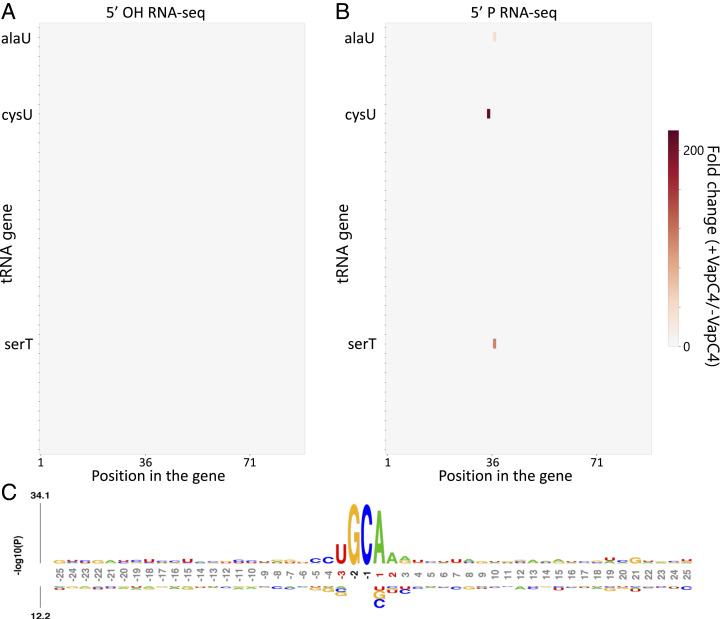
VapC4 cleavage generates 5′ monophosphate ends and lacks specificity in in vitro assays. Heat map showing fold changes obtained in 5′ RNA-seq for internal 5′-OH (A) or 5′-P (B) ends in all 45 tRNA genes after incubating purified VapC4 with total RNA extracted from Mtb mc2 6206. (C) Probability logo (obtained using kpLogo) showing the consensus sequence observed in 100 RNA hits with highest fold change (induced versus uninduced) in the in vitro cleavage 5′-P libraries. The RNA sequence flanking the cleavage site (25 nucleotides up- and downstream) is shown. Nucleotide positions (shown below the kpLogo) are numbered relative to the cleavage site and colored red if the nucleotide is statistically enriched at the position or black if the nucleotide is statistically enriched and its frequency is above 75%.
Fig. 4.
Fig. 4.
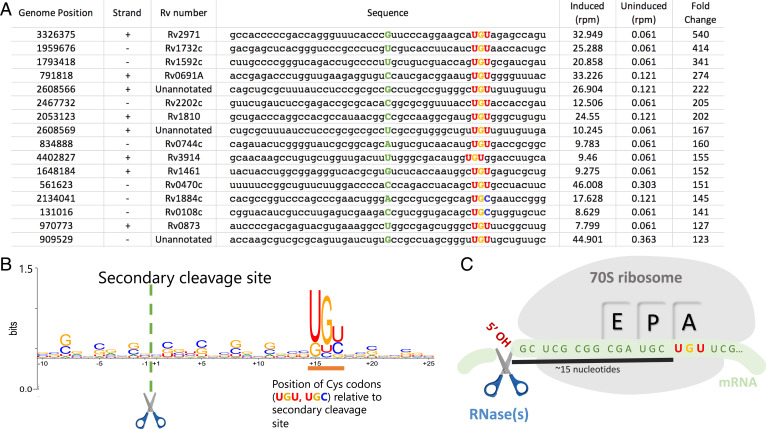
The 5′-OH RNA-seq method reveals ribosome stalling at Cys codons with single nucleotide resolution. (A) Top 16 mRNA hits in 5′-OH RNA-seq libraries constructed from Mtb mc2 6206 RNA extracted after 24 h of VapC4 induction. Cysteine codons are highlighted, ∼15 nucleotides downstream of the 5′-OH cleavage site (5′ of the green capitalized letter). The genome position and strand where the secondary cleavage occurs is shown as well as the Rv number of the gene containing the Cys codon. (B) Web logo showing the consensus sequence from the top 100 mRNA hits found by 5′-OH RNA-seq. Positions are numbered relative to 5′-OH cleavage site (scissor). Cysteine codons are predominantly positioned at +15 to +17 (orange underline). (C) Following VapC4-mediated cleavage of tRNACys, ribosome stalling occurs when a transcript containing a Cys codon (UGU or UGC) reaches the A-site because the pool of tRNACys is depleted by VapC4 cleavage. The 5’-OH cleavage site (scissor) represents a secondary cleavage event on the mRNA by an unknown RNase that generates a 5′-OH, enabling accurate detection Cys stalling events within our 5′-OH RNA-seq dataset.
Fig. 5.
Fig. 5.
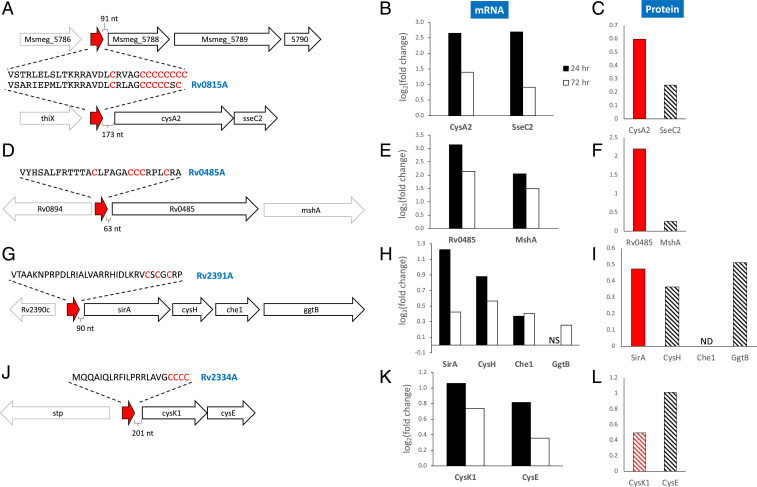
Downstream genes of identified Cys-containing sORFs are generally up-regulated. (A, D, G, and J) Genomic organization of the region surrounding the Cys-containing sORFs that occur upstream of annotated genes. Unannotated putative sORFs (red arrow) and their amino acid sequence (Cys residues highlighted in red) are shown. The Cys-containing sORFs in A, D, and G have orthologs in M. smegmatis (15, 21). VapC4 up-regulates the transcription of genes downstream of these sORFs in Mtb mc2 6206 (B, E, H, and K; all adjusted P values ≤ 0.05; NS, not statistically significant) and translation of their corresponding proteins (C, F, I , and L; solid red, Strimmer q value ≤ 0.05; striped red, Strimmer q value ≤ 0.1; striped black, Strimmer q value ≥ 0.1; ND, not detected).
Fig. 6.
Fig. 6.
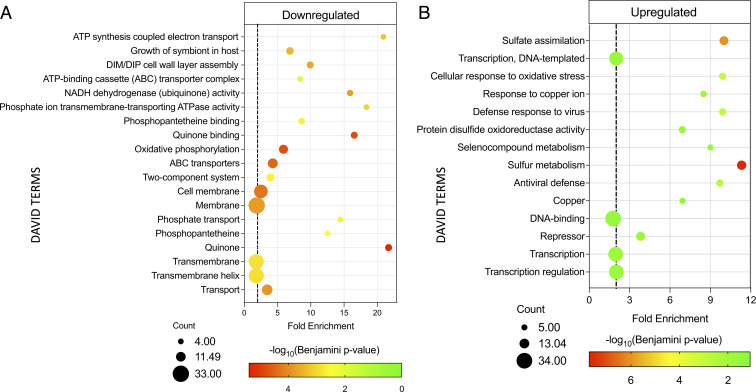
DAVID analysis of transcripts down- and up-regulated by VapC4. (A) VapC4 engages multiple mechanisms for growth control. DAVID Functional Analysis Tool terms (38, 39) associated with genes that were significantly (twofold) down-regulated after 24 h of VapC4 induction by total RNA-seq analysis. (B) VapC4 mimics Cys starvation to activate the oxidative and Cu stress responses. DAVID terms associated with genes that were significantly (twofold) up-regulated after 24 h of VapC4 induction by RNA-seq analysis. The dotted lines in both A and B represent a twofold enrichment between the proportion of the term in the observed genes compared to the expected proportion of the term when considering all genes in the genome. The area of each circle in both A and B is proportional to the number of observed genes in the corresponding category.
Fig. 7.
Fig. 7.
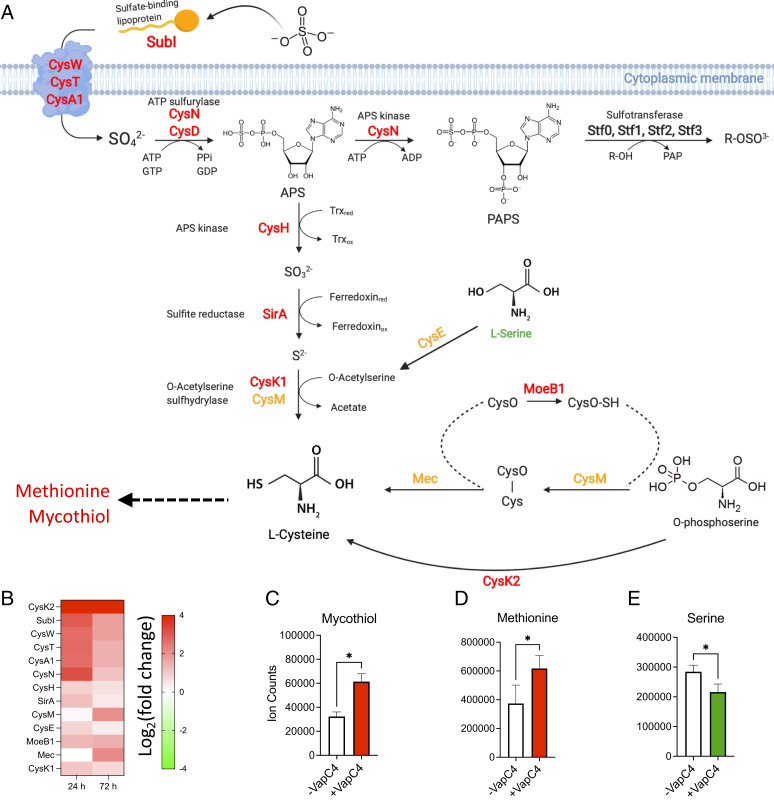
VapC4 mimics Cys starvation to activate the oxidative and Cu stress responses. (A) Transcripts involved in sulfate assimilation are up-regulated in Mtb cells expressing VapC4. Red, up-regulated at both 24 and 72 h in Mtb H37Rv cells (≥1.5 fold, adjusted P value ≤ 0.05); orange, up-regulated at 72 h only (≥1.5 fold, adjusted P value ≤ 0.05). CysN is sometimes referred to as CysC. Data from refs. , , , and . Sufur assimilation illustration created with https://Biorender.com. (B) Heat map of transcripts corresponding to up-regulated enzymes shown in A. (C) Mass spectrometry of mycothiol (asterisk represents P value of 0.02), (D) methionine (asterisk represents P value of 0.02), and (E) serine (asterisk represents P value of 0.05); all P values for CE used the paired Wilcoxon signed-rank test.
Fig. 8.
Fig. 8.
VapC4 up-regulates key components of Cu homeostasis. (A) CsoR and RicR regulon proteins with known functions are illustrated; all were up-regulated by VapC4 (labeled in black text). MctB was not affected by VapC4 expression (labeled with gray text). (B) Heat map of up-regulated CsoR and RicR regulon transcripts 24 and 72 h post VapC4 induction in Mtb H37Rv cells (≥1.5 fold, adjusted P value ≤ 0.05). The proteins encoded by the mmcO and cysK2 (white text, boxed in red) genes were also identified in quantitative mass spectrometry datasets (adjusted P values ≤ 0.05 [RNA-seq, Strimmer q values ≤ 0.05 (QMS). Since socA and B were not annotated in the NCBI Mtb H37Rv database, we used their genome positions to identify read counts within the raw RNA-seq datasets (log2FC at 24/72 h: socA 1.17/2.23, socB 1.17/3.59; all adjusted P values ≤ 0.05). The illustration of Mtb Cu pathways (A) was created with https://Biorender.com. (C) VapC4 transcript levels are elevated in M. tuberculosis cultures exposed to copper at 5 μM and 50 μM [data from Ward. et al (39)]. Error bars represent the SEM from microarray data obtained from two replicates.
Fig. 9.
Fig. 9.
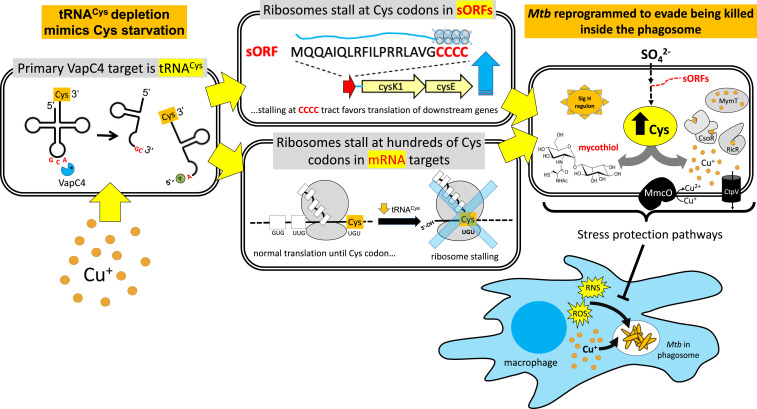
VapC4 reprograms Mtb physiology to protect against oxidative and Cu stress. Cu up-regulates VapC4 transcription, and VapC4 toxin precisely cuts the sole tRNACys at its anticodon GC↓A to create tRNA halves. These tRNA halves are nonfunctional in protein synthesis, resulting in ribosome stalling at Cys codons (UGU, UGC) requiring this depleted tRNA. Stalled ribosomes at Cys codons globally reduce new synthesis of Cys-containing proteins (SI Appendix, Fig. S2). A subset of transcripts with stalled ribosomes were Cys codon-containing unannotated small ORFs in which ribosome stalling at tracts of Cys codons within these sORFs is predicted to be a novel mode of Cys attenuation to regulate translation of downstream genes (as shown for sORF Rv2334A). Many of these sORFs up-regulate translation of enzymes for sulfate assimilation to Cys. As macrophages attempt to eliminate Mtb with ROS/RNS and toxic Cu+, the enriched pool of Cys can be incorporated into molecules needed to defend against these assaults. Key components of these two major stress response pathways are up-regulated by VapC4. For oxidative stress, these include mycothiol, the abundant, essential, glutathione counterpart in Mtb that regulates cellular redox status and multiple genes in the SigH regulon. For copper stress, these include multiple mechanisms controlled by copper-responsive regulators RicR and CsoR to mitigate copper toxicity.

References

    1. Ramage H. R., Connolly L. E., Cox J. S., Comprehensive functional analysis of Mycobacterium tuberculosis toxin-antitoxin systems: Implications for pathogenesis, stress responses, and evolution. PLoS Genet. 5, e1000767 (2009). - PMC - PubMed
    1. Sala A., Bordes P., Genevaux P., Multiple toxin-antitoxin systems in Mycobacterium tuberculosis. Toxins (Basel) 6, 1002–1020 (2014). - PMC - PubMed
    1. Harms A., Brodersen D. E., Mitarai N., Gerdes K., Toxins, targets, and triggers: An overview of toxin-antitoxin biology. Mol. Cell 70, 768–784. (2018). - PubMed
    1. Masuda H., Inouye M., Toxins of prokaryotic toxin-antitoxin systems with sequence-specific endoribonuclease activity. Toxins (Basel) 9, E140 (2017). - PMC - PubMed
    1. Arcus V. L., McKenzie J. L., Robson J., Cook G. M., The PIN-domain ribonucleases and the prokaryotic VapBC toxin-antitoxin array. Protein Eng. Des. Sel. 24, 33–40 (2011). - PubMed

Publication types

MeSH terms

LinkOut - more resources