


Biotic threats for 23 major non-native tree species in Europe
- PMID: 34362931
- PMCID: PMC8346479
- DOI: 10.1038/s41597-021-00961-4
Biotic threats for 23 major non-native tree species in Europe
Abstract
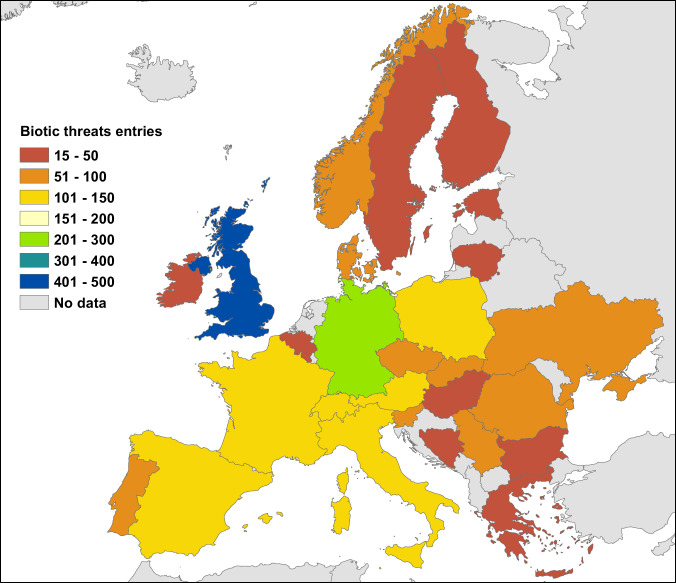
For non-native tree species with an origin outside of Europe a detailed compilation of enemy species including the severity of their attack is lacking up to now. We collected information on native and non-native species attacking non-native trees, i.e. type, extent and time of first observation of damage for 23 important non-native trees in 27 European countries. Our database includes about 2300 synthesised attack records (synthesised per biotic threat, tree and country) from over 800 species. Insects (49%) and fungi (45%) are the main observed biotic threats, but also arachnids, bacteria including phytoplasmas, mammals, nematodes, plants and viruses have been recorded. This information will be valuable to identify patterns and drivers of attacks, and trees with a lower current health risk to be considered for planting. In addition, our database will provide a baseline to which future impacts on non-native tree species could be compared with and thus will allow to analyse temporal trends of impacts.
© 2021. The Author(s).
Conflict of interest statement
The authors declare no competing interests.
Figures
References
-
- Pötzelsberger E, et al. Growing Non-native Trees in European Forests Brings Benefits and Opportunities but Also Has Its Risks and Limits. Curr. For. Reports. 2020;6:339–353.
-
- Brus R, et al. Extent, distribution and origin of non-native forest tree species in Europe. Scand. J. For. Res. 2019;34:533–544. doi: 10.1080/02827581.2019.1676464. - DOI
-
- Keane R. Exotic plant invasions and the enemy release hypothesis. Trends Ecol. Evol. 2002;17:164–170. doi: 10.1016/S0169-5347(02)02499-0. - DOI
-
- Branco M, Brockerhoff EG, Castagneyrol B, Orazio C, Jactel H. Host range expansion of native insects to exotic trees increases with area of introduction and the presence of congeneric native trees. J. Appl. Ecol. 2015;52:69–77. doi: 10.1111/1365-2664.12362. - DOI
-
- Frenzel, M., Brändle, M. & Brandl, R. The colonization of alien plants by native phytophagous insects. In 42nd IAVS Symposium, Uppsala, Sweden, July 1999 223–225 (2000).
Publication types
MeSH terms
Grants and funding
- FP1403/European Cooperation in Science and Technology (COST)
- FP1403/European Cooperation in Science and Technology (COST)
- FP1403/European Cooperation in Science and Technology (COST)
- FP1403/European Cooperation in Science and Technology (COST)
- FP1403/European Cooperation in Science and Technology (COST)
- FP1403/European Cooperation in Science and Technology (COST)
- FP1403/European Cooperation in Science and Technology (COST)
- FP1403/European Cooperation in Science and Technology (COST)
- FP1403/European Cooperation in Science and Technology (COST)
- FP1403/European Cooperation in Science and Technology (COST)
- FP1403/European Cooperation in Science and Technology (COST)
- FP1403/European Cooperation in Science and Technology (COST)
- FP1403/European Cooperation in Science and Technology (COST)
- FP1403/European Cooperation in Science and Technology (COST)
- FP1403/European Cooperation in Science and Technology (COST)
- FP1403/European Cooperation in Science and Technology (COST)
- FP1403/European Cooperation in Science and Technology (COST)
- FP1403/European Cooperation in Science and Technology (COST)
- FP1403/European Cooperation in Science and Technology (COST)
- FP1403/European Cooperation in Science and Technology (COST)
- FP1403/European Cooperation in Science and Technology (COST)
- FP1403/European Cooperation in Science and Technology (COST)
- 451-03-68/2020-14/ 200197/Ministarstvo Prosvete, Nauke i Tehnološkog Razvoja (Ministry of Education, Science and Technological Development of the Republic of Serbia)
LinkOut - more resources
Full Text Sources
