


Similar survival on home haemodialysis and automated peritoneal dialysis: an inception cohort study
- PMID: 34363472
- PMCID: PMC9317172
- DOI: 10.1093/ndt/gfab233
Similar survival on home haemodialysis and automated peritoneal dialysis: an inception cohort study
Abstract
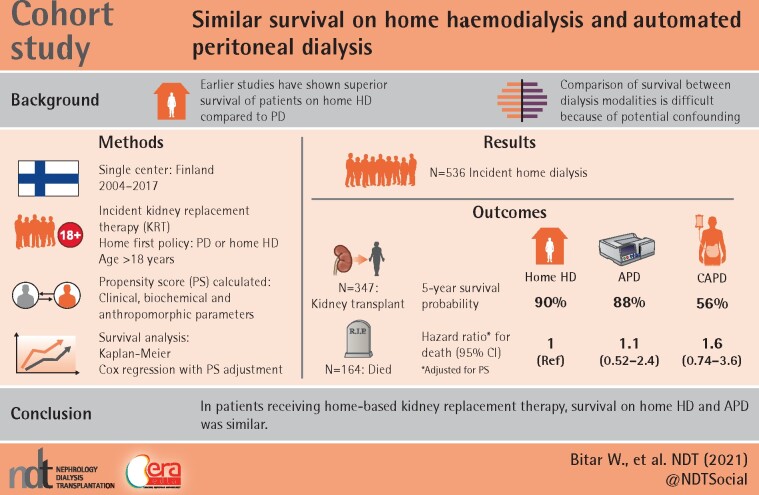
Background: Several studies have shown superior survival of patients on home haemodialysis (HD) compared with peritoneal dialysis (PD), but patients on automated PD (APD) and continuous ambulatory PD (CAPD) have not been considered separately. As APD allows larger fluid volumes and may be more efficient than CAPD, we primarily compared patient survival between APD and home HD.
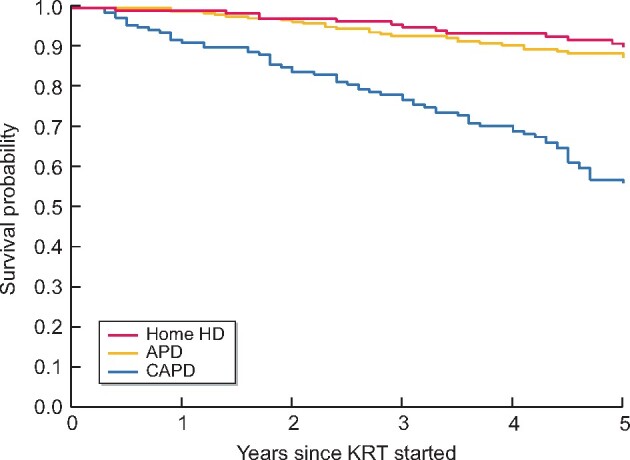
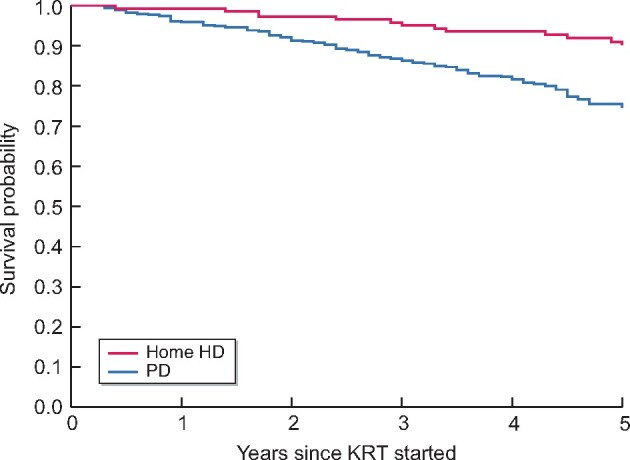
Methods: All adult patients who started kidney replacement therapy (KRT) between 2004 and 2017 in the district of Helsinki-Uusimaa in Finland and who were on one of the home dialysis modalities at 90 days from starting KRT were included. We used intention-to-treat analysis. Survival of home HD, APD and CAPD patients was studied using Kaplan-Meier curves and Cox regression with adjustment for propensity scores that were based on extensive data on possible confounding factors.
Results: The probability of surviving 5 years was 90% for home HD, 88% for APD and 56% for CAPD patients. After adjustment for propensity scores, the hazard ratio of death was 1.1 [95% confidence interval (CI) 0.52-2.4] for APD and 1.6 (95% CI 0.74-3.6) for CAPD compared with home HD. Censoring at the time of kidney transplantation (KTx) or at transfer to in-centre HD did not change the results. Characteristics of home HD and APD patients at the start of dialysis were similar, whereas patients on CAPD had higher median age and more comorbidities and received KTx less frequently.
Conclusions: Home HD and APD patients had comparable characteristics and their survival appeared similar.
Keywords: home dialysis; home haemodialysis; kidney replacement therapy; peritoneal dialysis; survival.
© The Author(s) 2021. Published by Oxford University Press on behalf of ERA-EDTA.
Conflict of interest statement
P.F. has received honoraria for lectures and membership in advisory board from Baxter. V.R. has received honoraria for lectures from Baxter and Fresenius and research funding (not for this project) from Business Finland. The findings, results and conclusions in this report are those of the authors and are independent from the funding sources.
Figures
Comment in
-
Comparing survival between home hemodialysis and peritoneal dialysis-is the controversy over?Nephrol Dial Transplant. 2022 Jul 26;37(8):1393-1395. doi: 10.1093/ndt/gfac057. Nephrol Dial Transplant. 2022. PMID: 35289898 No abstract available.
References
-
- Kraus MA, Fluck RJ, Weinhandl ED. et al. Intensive hemodialysis and health-related quality of life. Am J Kidney Dis 2016; 68(5 Suppl 1): S33–S42 - PubMed
-
- Helanterä I, Haapio M, Koskinen P. et al. Employment of patients receiving maintenance dialysis and after kidney transplant: a cross-sectional study from Finland. Am J Kidney Dis 2012; 59: 700–706 - PubMed
-
- United States Renal Data System. 2018 USRDS Annual Data Report: Epidemiology of Kidney Disease in the United States. Bethesda, MD: National Institutes of Health, National Institute of Diabetes and Digestive and Kidney Diseases, 2018
-
- Heaf JG, Løkkegaard H, Madsen M.. Initial survival advantage of peritoneal dialysis relative to hemodialysis. Nephrol Dial Transplant 2002; 17: 112–117 - PubMed
Publication types
MeSH terms
LinkOut - more resources
Full Text Sources
Research Materials
