


Comparative sequence analysis of the accessory and nucleocapsid genes of feline coronavirus strains isolated from cats diagnosed with effusive feline infectious peritonitis
- PMID: 34363535
- PMCID: PMC8346774
- DOI: 10.1007/s00705-021-05188-7
Comparative sequence analysis of the accessory and nucleocapsid genes of feline coronavirus strains isolated from cats diagnosed with effusive feline infectious peritonitis
Abstract
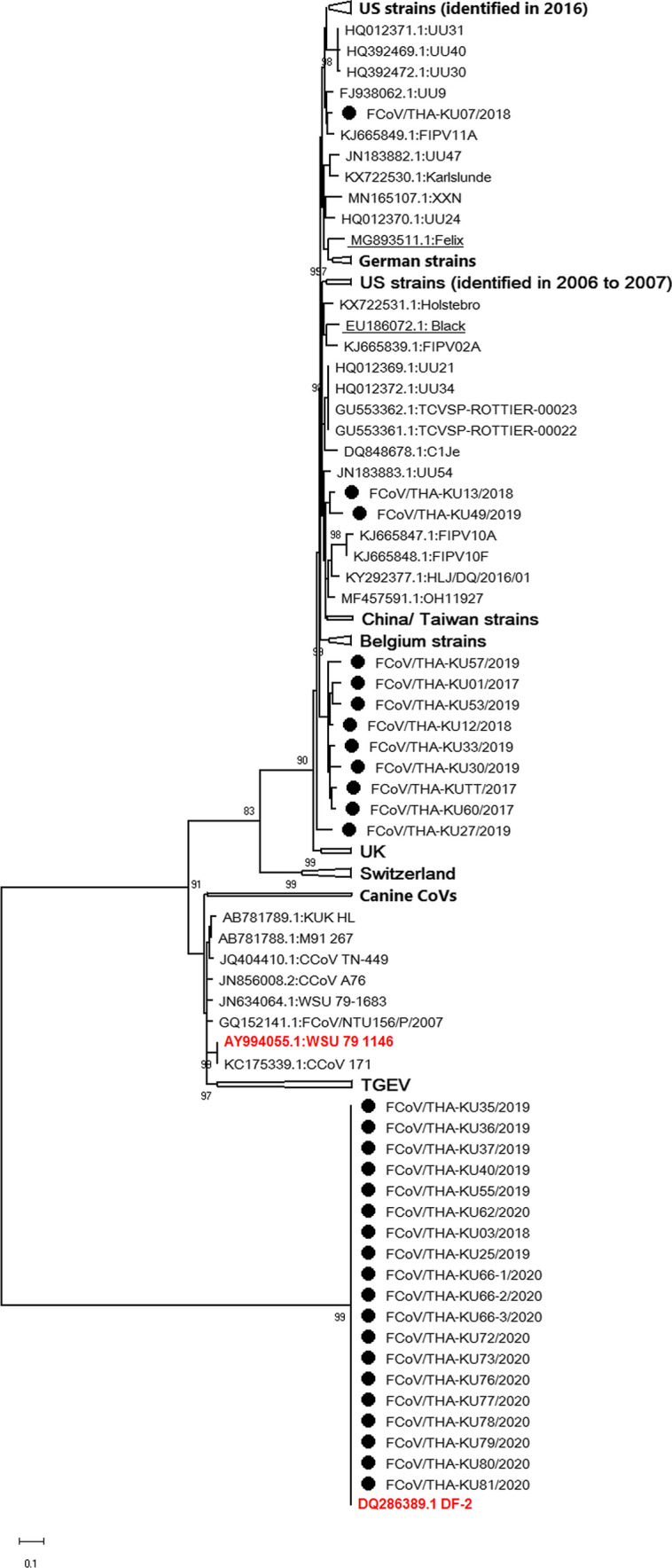
Feline infectious peritonitis (FIP) is a lethal infectious disease of domestic cats caused by feline coronavirus (FCoV) infection. Feline infectious peritonitis virus (FIPV) is a mutant type of FCoV that is characterized by causing fibrinous serositis with effusions in the pleural and abdominal cavities (wet form) and/or granulomatous-necrotizing inflammatory lesions in several organs (dry form). There have been numerous studies on FIP worldwide, whereas information about this disease in Thailand is still limited. Most studies involving molecular surveillance and evaluation of FCoV field strains have examined the genetic diversity of the spike and accessory ORF3c coding regions. Of these, the S gene is more divergent and is responsible for the two FCoV serotypes, while ORF3c harbors mutations that result either in early termination or destruction of the protein. In this study, we investigated the genetic diversity and genetic relationships among the current Thai and global FCoV strains in the accessory and nucleocapsid genes using a virus-specific PCR method. Comparative sequence analysis suggested that the Thai FCoV isolates were most closely related to strains reported in the Netherlands, the USA, and China. In the ORF3ab sequences, some Thai strains were more than 99% identical to the DF-2 prototype strain. Truncation of the 3a gene product was found in Thai FCoV strains of group 2. Amino acid deletions were observed in the N, ORF3c, and ORF7b proteins of Thai FCoV sequences. The accessory gene sequence divergence may be responsible for driving the periodic emergence and continued persistence of FCoVs in Thai domestic cat populations. Our findings provide updated information about the molecular characteristics of the accessory and nucleocapsid genes of FCoV strains in circulation that were not previously documented in this country.
© 2021. The Author(s), under exclusive licence to Springer-Verlag GmbH Austria, part of Springer Nature.
Conflict of interest statement
The authors have no completing of interest to declare.
Figures
References
-
- Bredenbeek PJ, Pachuk CJ, Noten AF, Charite J, Luytjes W, Weiss SR, Spaan WJ. The primary structure and expression of the second open reading frame of the polymerase gene of the coronavirus MHV-A59; a highly conserved polymerase is expressed by an efficient ribosomal frameshifting mechanism. Nucleic Acids Res. 1990;18:1825–1832. doi: 10.1093/nar/18.7.1825. - DOI - PMC - PubMed
Publication types
MeSH terms
Substances
LinkOut - more resources
Full Text Sources
Miscellaneous
